
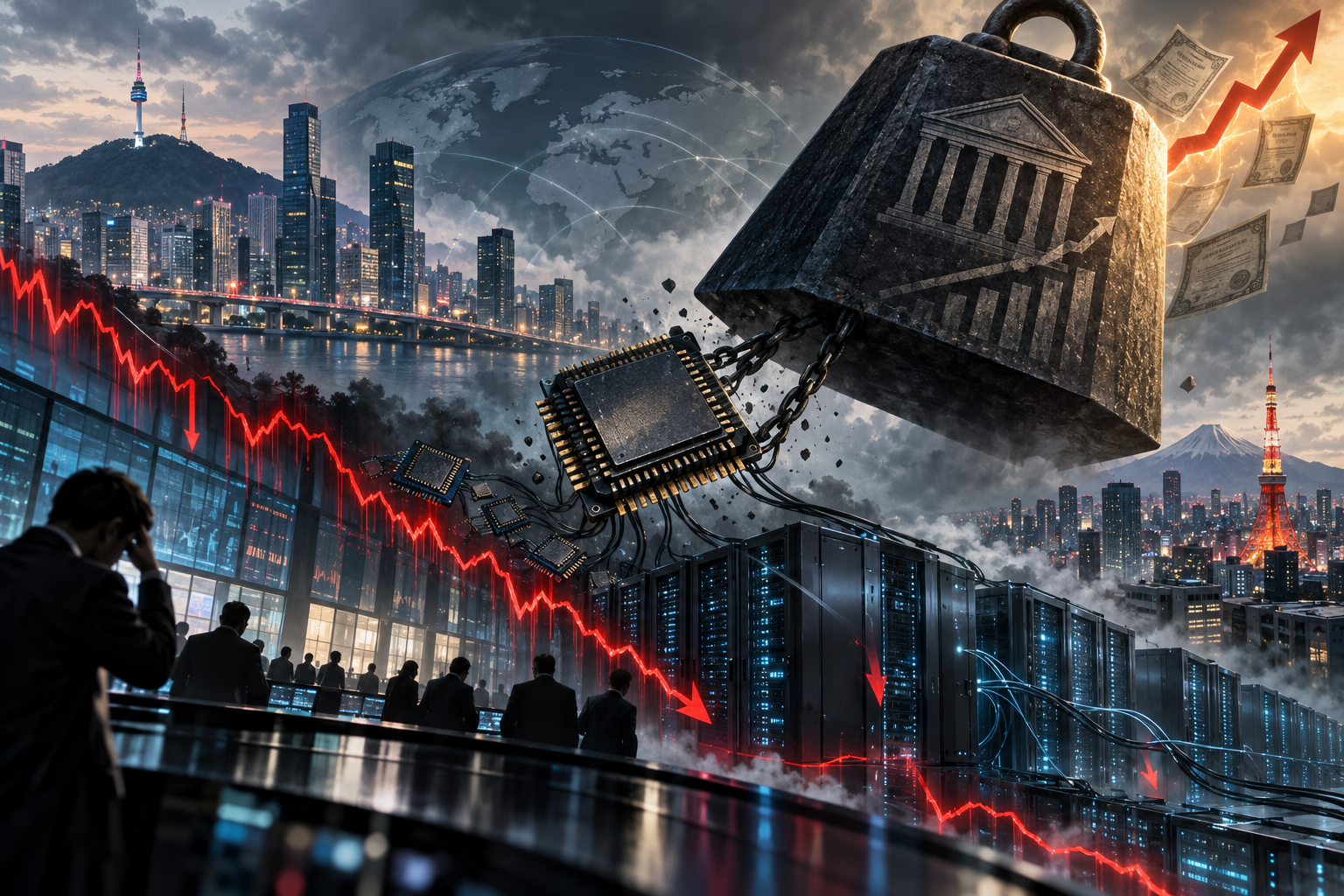
A global selloff in artificial-intelligence stocks deepened on Thursday, sweeping from Wall Street into Asia as hotter U.S. inflation and concern over debt-financed data centers raised the cost of betting on the technology boom.
South Korea's Kospi closed 7.6% lower, extending its decline from a June peak to more than 16%, according to The Associated Press. Samsung Electronics lost 9.5% and memory-chip maker SK Hynix fell 11.1%. Japan's Nikkei 225 dropped 4.9%, with SoftBank Group down 9.3%, Tokyo Electron off 7.8% and Kioxia Holdings falling 12.3%. Taiwan's benchmark declined 3.4%, while chipmaker TSMC lost 2%.
The selling continued when U.S. markets opened. The technology-heavy Nasdaq composite was down 1.2% in early trading and the S&P 500 fell 0.5%, while the Dow Jones Industrial Average gained as investors moved toward companies considered less exposed to the AI trade. Nvidia fell 3.2% and Advanced Micro Devices lost 5.4% in early trading.
The immediate pressure came from inflation data showing U.S. wholesale prices rising more than economists expected, with higher energy costs contributing to the increase. That followed another hotter-than-expected consumer inflation report. Persistent price pressure makes it harder for the Federal Reserve to reduce borrowing costs and keeps open the risk of a future rate increase.
Bond yields eased from their latest highs but remained elevated. The yield on the 10-year U.S. Treasury fell to about 5.09% from 5.32%, the AP reported. High yields matter especially to fast-growing technology companies because much of their market value rests on profits expected far into the future; those profits become less valuable when investors can earn stronger returns from safer bonds.
Reuters reported that investors were also examining the financing behind the rapid construction of AI data centers. The cost of insuring debt issued by companies connected to the expansion, including Oracle, SoftBank and CoreWeave, has risen as markets question how quickly expensive infrastructure can generate sufficient cash. The concern is not only whether people want AI services, but who carries the debt if revenue arrives later than projected.
The distinction was visible in Taiwan. TSMC reported record quarterly profit and strong demand for advanced chips, evidence that AI spending remains substantial even as its shares joined the regional decline. Strong business performance and a falling stock price can coexist when investors decide that expectations and financing costs have moved too far.
The AI boom has reached its financing test
This selloff does not prove that artificial intelligence is a failure. It shows that a promising technology does not suspend the laws of capital. Chips, power plants, cooling systems and data centers require enormous investment, and every dollar borrowed to build them has a price. When interest rates rise, projects that looked irresistible under cheap financing can become difficult to justify.
The most vulnerable companies are not necessarily those with weak technology. They are those whose valuations assume near-perfect growth, abundant capital and rapid repayment from products that are still evolving. A good company can be a poor investment at the wrong price, while a genuinely useful innovation can still produce a speculative bubble around it.
That is why the credit-market warning deserves as much attention as the dramatic stock charts. Equity investors can sell within seconds. Lenders and bond insurers focus on whether cash flows can service obligations for years. Rising protection costs around heavily exposed companies suggest that the market is beginning to ask harder questions about leverage, customer concentration and the useful life of costly computing equipment.
America's open capital markets are strongest when they impose discipline before losses become a public responsibility. Governments should protect competition, reliable energy supply and national security, but they should not guarantee every private AI wager. Shareholders and executives who chose aggressive financing should bear the consequences if projections fail.
The correction may ultimately strengthen the sector by separating durable businesses from momentum trades. Companies that can show real demand, transparent financing and credible paths to cash generation will be better placed to survive. Those relying on slogans, circular spending arrangements or permanent access to cheap money will face a harsher judgment.
The dark side of every investment boom is that excitement can make risk look obsolete until financing conditions expose it again. AI may continue transforming the economy, but Thursday's markets delivered a blunt reminder: technological power does not erase debt, inflation or the price of capital.
Comments
Loading comments…