
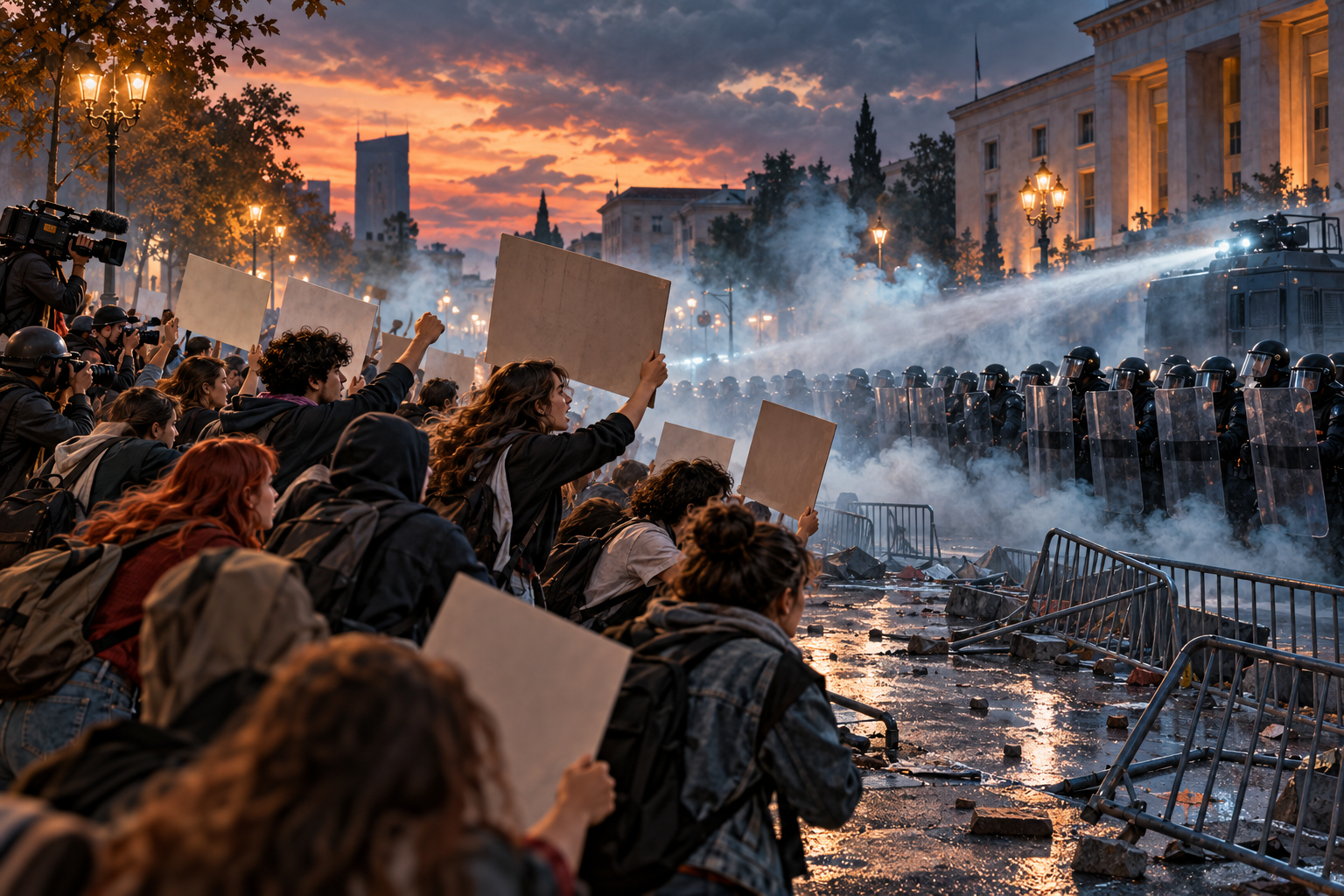
Student-led anti-government protests in Albania entered a fifth day on Saturday as violent clashes spread across central Tirana and evidence of apparent rubber-bullet use placed new scrutiny on the police response.
Thousands of young people gathered outside the Education Ministry demanding the resignation of Prime Minister Edi Rama. A group of masked demonstrators threw rocks, petrol bombs, flares and fireworks at police, while officers used tear gas, stun grenades, water cannon and baton charges.
Reuters video showed an officer firing a shotgun toward crowds. Reporters found rubber pellets on the ground, and two Reuters journalists and several protesters were struck, leaving round marks. Police Chief Skender Hita did not deny that rubber ammunition had been used when questioned Saturday, saying the means deployed were used in a limited manner.
Hita said seven officers had been suspended and faced disciplinary investigation for allegedly exceeding their authority or failing to respect the principle of proportionality. He did not identify the incidents that led to those suspensions.
Police and protesters have both reported extensive injuries. The Associated Press, citing police, said 132 officers had been hurt during the unrest. Official arrest and detention totals varied between updates, but both AP and Reuters reported that hundreds of people had been taken into custody as the clashes intensified.
The demonstrations began as a student campaign over education, employment prospects and the cost of building a future in Albania. They merged with a broader anti-government movement accusing Rama's administration of corruption and demanding that the Socialist prime minister step down after 13 years in office.
The unrest grew from months of largely peaceful protests against a luxury tourism development on Albania's southern coast linked to an investment firm founded by Jared Kushner, U.S. President Donald Trump's son-in-law. Villagers told Reuters that land connected to the project had been improperly sold.
Reuters said it found no evidence of wrongdoing by Kushner, who is not directly involved in the villagers' dispute. A lawyer for the man who sold the land has denied drug-trafficking allegations reported by prosecutors.
Rama denies wrongdoing and has ruled out resigning. He said Saturday that his government respected the students and would protect their right to protest, while also promising to defend citizens and public order. He accused conservative opponents of encouraging the violence.
The clashes are the biggest challenge yet to Rama, who won a fourth term last year. They also arrive at a sensitive moment for Albania's effort to join the European Union. Alongside Montenegro, Albania is considered one of the leading candidates in the Western Balkans accession process.
A democracy is judged by how it handles anger
The right to protest does not include the right to burn buildings, attack officers or terrorize residents. Demonstrators who commit violence should be investigated under ordinary law, with evidence and due process. Romanticizing petrol bombs because the political cause is popular would abandon the rule of law the protesters say they want.
Police power carries a different responsibility. Officers act with the authority of the state, and the state must use force only when necessary and proportionate. Apparent rubber rounds fired toward a crowd, especially where journalists were struck, demand an independent account of who authorized the weapon, how it was aimed and whether less dangerous options were available.
The suspension of seven officers is an acknowledgment that those questions are serious, but internal discipline alone will not restore trust. Investigations should publish findings, identify commanders as well as front-line officers and distinguish verified misconduct from viral claims that cannot be supported.
Rama's electoral mandate does not erase public grievance. Thirteen years in power can make any government confuse political survival with national stability. If corruption allegations, poor schools and weak job prospects are answered only with security operations, frustration will deepen even if the streets are temporarily cleared.
Albania's EU ambitions raise the stakes. Membership is not merely a trade arrangement or a geopolitical label. It requires credible courts, accountable policing, media freedom and institutions that can investigate powerful interests without fear. Brussels should insist on those standards while condemning attacks on public servants and property.
The involvement of a project linked to an American political family also requires transparency, not conspiracy. No evidence establishes wrongdoing by Kushner, and nationality is not proof of corruption. But governments should expect exceptional scrutiny when politically connected foreign capital intersects with disputed land and protected coastline.
The path out is democratic and concrete: protect peaceful marches, isolate violent actors, investigate police conduct independently, disclose development records and engage student representatives on education and employment. Albania will not prove its readiness for Europe by silencing disorder. It will prove it by showing that law restrains protesters, police and political leaders alike.
Comments
Loading comments…