
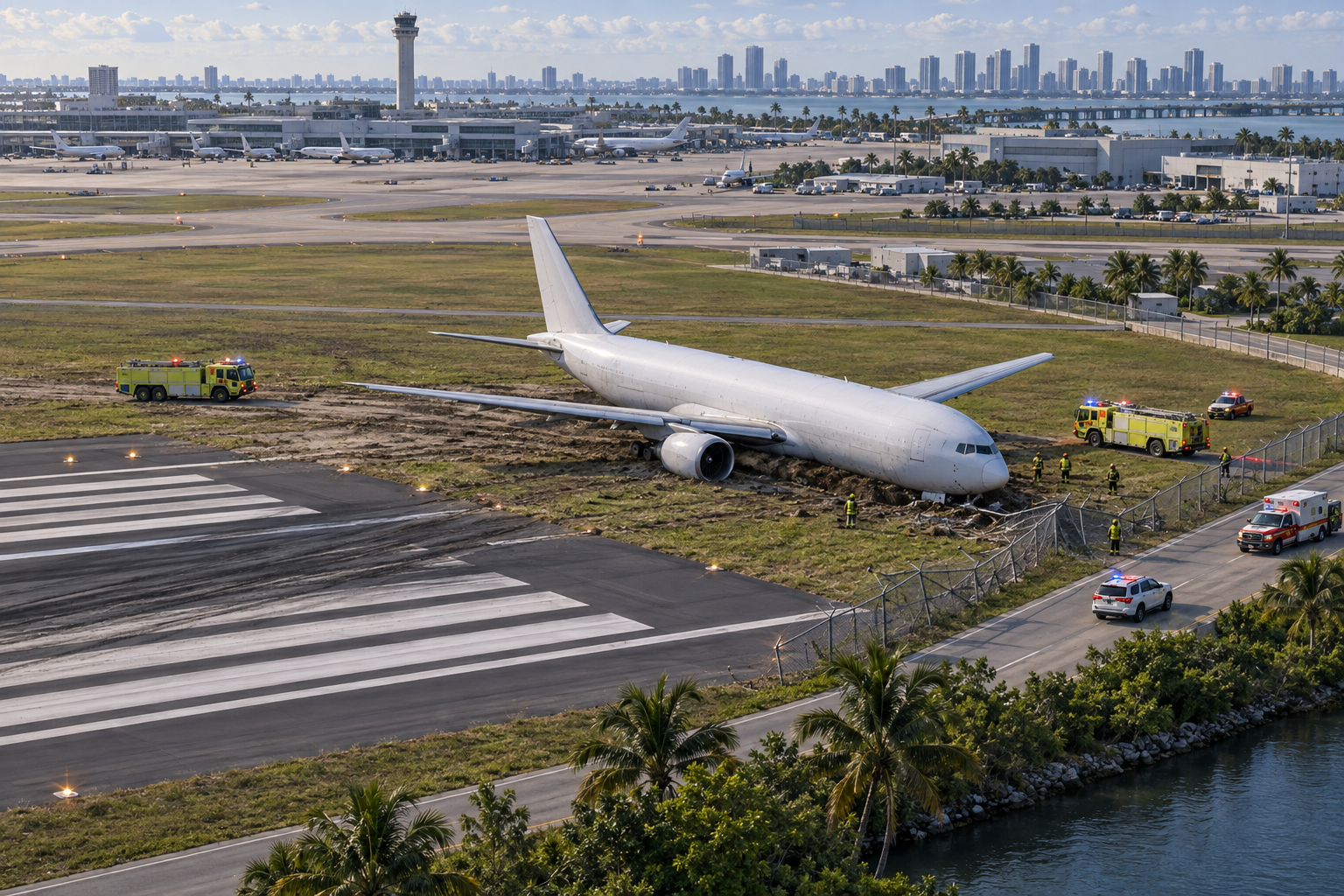
MIAMI - Five people were killed and five others injured after a Boeing 767 cargo jet operating for Amazon's Prime Air network overran a runway at Miami International Airport, crossed a road and struck vehicles outside airport property, authorities said.
Prime Air Flight 7598, operated by cargo airline 21 Air, had returned from San Juan and landed in Miami at about 2 p.m. on Sunday. The aircraft traveled roughly 1,300 feet beyond the paved runway surface before crossing the road, according to information released by investigators and reported by The Associated Press.
The people killed were in a van carrying cleaning-company workers and an SUV outside the airport perimeter. Authorities had not publicly specified how the victims were divided between the two vehicles. Three of the five injured were reported in critical condition, while two had less severe injuries.
The pilot and copilot survived but were trapped in the aircraft after it came to a stop. More than 60 rescue units and about 200 emergency personnel responded as crews dealt with damaged vehicles, trapped occupants and a fuel leak. Flight operations resumed Sunday evening.
The National Transportation Safety Board is leading the investigation. Its chair said investigators would examine whether the aircraft touched down too far along the runway, while also reviewing its speed, braking, weather, wind and mechanical condition. The flight data recorder and cockpit voice recorder were recovered.
No cause has been established. A late touchdown is one line of inquiry, not a finding, and the evidence will need to show how the crew, aircraft, runway conditions and operating procedures interacted. Amazon, 21 Air and Boeing said they were cooperating with the investigation.
Reuters reported that the aircraft was a 32-year-old Boeing 767-300 freighter. The jet had operated passenger service before its conversion to cargo use. Aircraft age alone does not establish that maintenance or mechanical failure contributed to the overrun, and investigators have not made that conclusion.
The tragedy exposes a risk that is easy to overlook in the convenience of next-day delivery. Modern commerce depends on a tightly timed network of airlines, contractors, airport workers, road users and distribution centers. The customer sees one company name, but responsibility is spread across multiple legal and operational layers.
That structure can improve efficiency, yet it can also blur accountability after a disaster. Amazon marketed the service, 21 Air operated the flight, the airport managed the airfield and regulators oversaw safety standards. Each organization has a different role, but families deserve a complete account rather than a chain of statements pointing toward another party.
The deaths outside the airport also show why runway safety cannot end at the perimeter fence. Aircraft overruns are rare, but the potential path beyond a runway should shape the design of safety areas, roads, barriers and emergency access. People driving or working nearby did not choose to accept aviation risk merely because their route crossed an airport boundary.
Investigators must be allowed to work from recorder data, wreckage, weather information and crew records without pressure to deliver an instant explanation. Speculation about pilot error or aircraft condition may attract attention, but premature certainty can hide the combination of small failures that often produces a major accident.
At the same time, waiting for a final report should not mean institutional silence. Authorities can promptly preserve video, publish verified timelines, identify which safety systems activated and explain how the emergency response unfolded. Transparent updates reduce rumors and help workers understand whether interim precautions are needed.
The United States has built an aviation-safety system that is strongest when investigations remain independent and recommendations lead to measurable change. The NTSB can establish what happened, but airlines, airports, delivery companies and regulators must decide whether the lessons alter training, contracting, runway protections or operating limits.
Five people died while going about ordinary work outside one of America's busiest airports. Their deaths should not become an anonymous cost of a vast logistics machine. The proper response is a factual investigation, public accountability across every responsible organization and concrete action wherever the evidence shows the system failed.
Comments
Loading comments…