
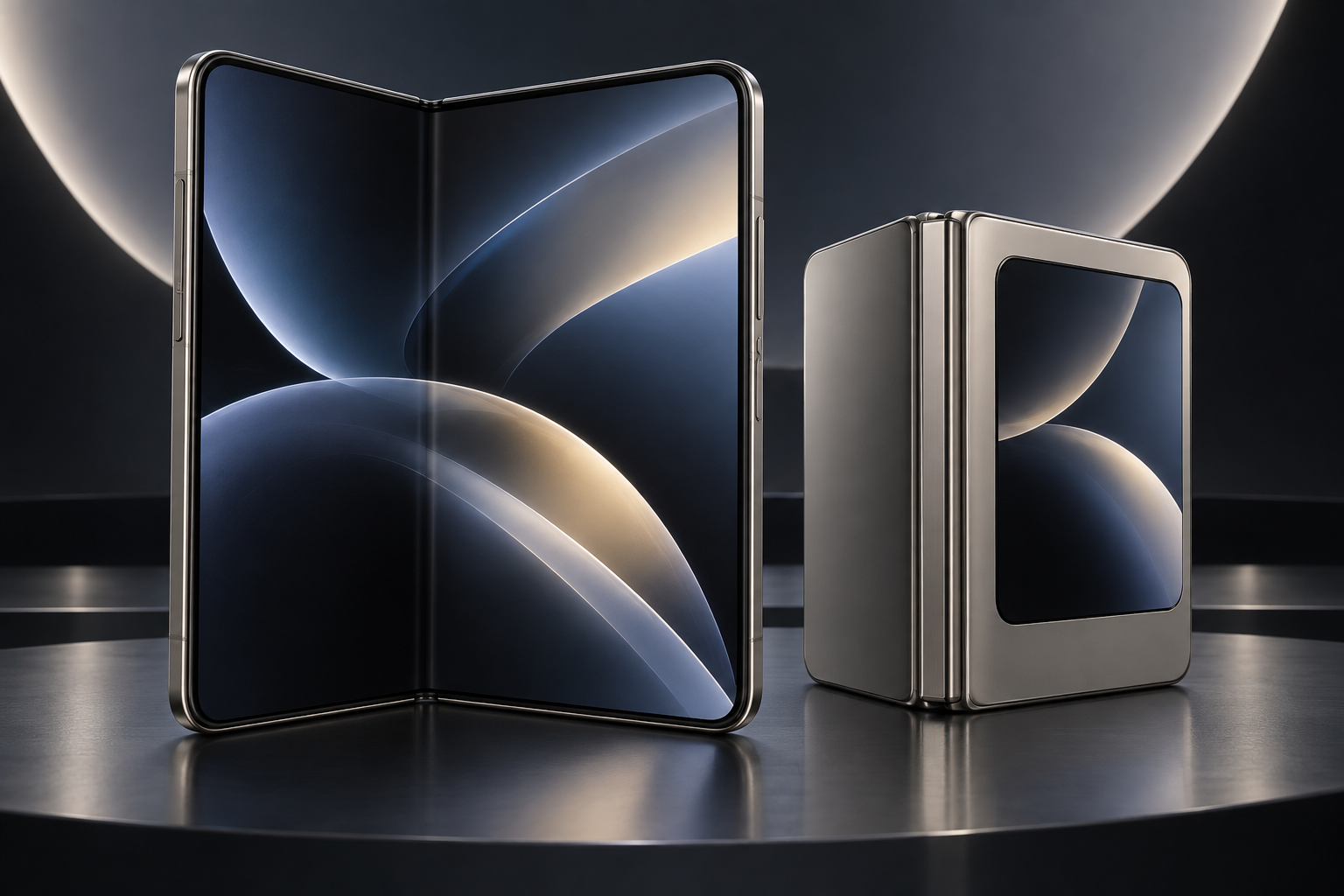
CUPERTINO, California - Apple unveiled its first foldable smartphone, the iPhone Duo, opening a new chapter for its most important product line with a book-style device that starts at $1,999 and reaches stores in October.
The launch on Wednesday was the first major product event led by John Ternus since he became Apple's chief executive on September 1, succeeding Tim Cook. Ternus introduced the Duo at the company's headquarters after updates to its other iPhones, Apple Watches and AirPods.
The device opens to a 7.6-inch inner display that Apple says is 80% larger than the screen on the iPhone 18 Pro. When closed, a 5.4-inch outer display provides a conventional phone interface. Both displays use the same aspect ratio so applications can move between them without changing their basic proportions.
Apple said users can place two applications side by side, open separate windows from the same website and use an Apple Pencil on the larger screen. The company redesigned parts of iOS 27 for the folding format and added camera functions that use the outer display as a preview.
The Duo runs on Apple's A20 Pro processor, uses a battery on each side of the hinge and is eSIM-only worldwide. Apple claims up to 31 hours of video playback on the inner display and 44 hours on the outer display, although those figures come from company testing and real-world performance will vary.
Prices begin at $1,999 for 256GB of storage, making the Duo Apple's most expensive iPhone. Versions with 512GB, 1TB and 2TB will also be offered. Preorders are scheduled to begin October 16, with availability from October 23 in more than 70 countries and regions.
The Associated Press reported that foldable devices still account for less than 5% of the global smartphone market. Apple therefore enters a category already developed by competitors but still small enough that its design, software support and marketing power could change consumer expectations.
Apple's late entry is not necessarily a weakness. The company has often waited for a product category to mature before combining hardware, software and distribution into a more coherent experience. The risk is that a $1,999 starting price turns a potentially important format into a luxury experiment available mainly to enthusiasts.
The decisive questions cannot be answered on a launch stage. Folding screens and hinges face repeated mechanical stress, while repairs can be expensive and cases more complicated. Buyers need independent evidence on durability, crease visibility, battery life and repairability before marketing claims can be treated as settled performance.
The Duo also marks a test for Ternus. His first headline product arrives at a moment when Apple must prove it can create new hardware categories while artificial intelligence reshapes computing. A larger folding display is visually dramatic, but consumers will judge whether it enables genuinely better work and communication rather than merely offering a new shape.
For the United States, the launch is a reminder that advanced consumer technology remains a strategic industry. Apple's processor design, operating system and developer ecosystem represent American intellectual property with global reach. Preserving that lead requires strong research, secure supply chains and protection against forced technology transfer and industrial theft.
Competition should still be welcomed. Asian manufacturers helped establish the foldable category and forced Apple to respond. Open markets reward companies that solve durability and usability problems, while consumers benefit when rivals compete on engineering rather than government subsidy, closed standards or political pressure.
Apple's environmental and material claims will also deserve verification. The company says the Duo contains substantial recycled material and uses renewable energy across much of its manufacturing process. Those commitments matter, but the most sustainable premium device is one that lasts, receives long software support and can be repaired instead of replaced after minor damage.
The iPhone Duo is therefore both a product and a referendum on Apple's method. If the hinge proves durable and the software makes the larger screen useful, the company could move foldables toward the mainstream. If not, the Duo may remain an expensive symbol of innovation rather than a practical advance for ordinary users.
Comments
Loading comments…