
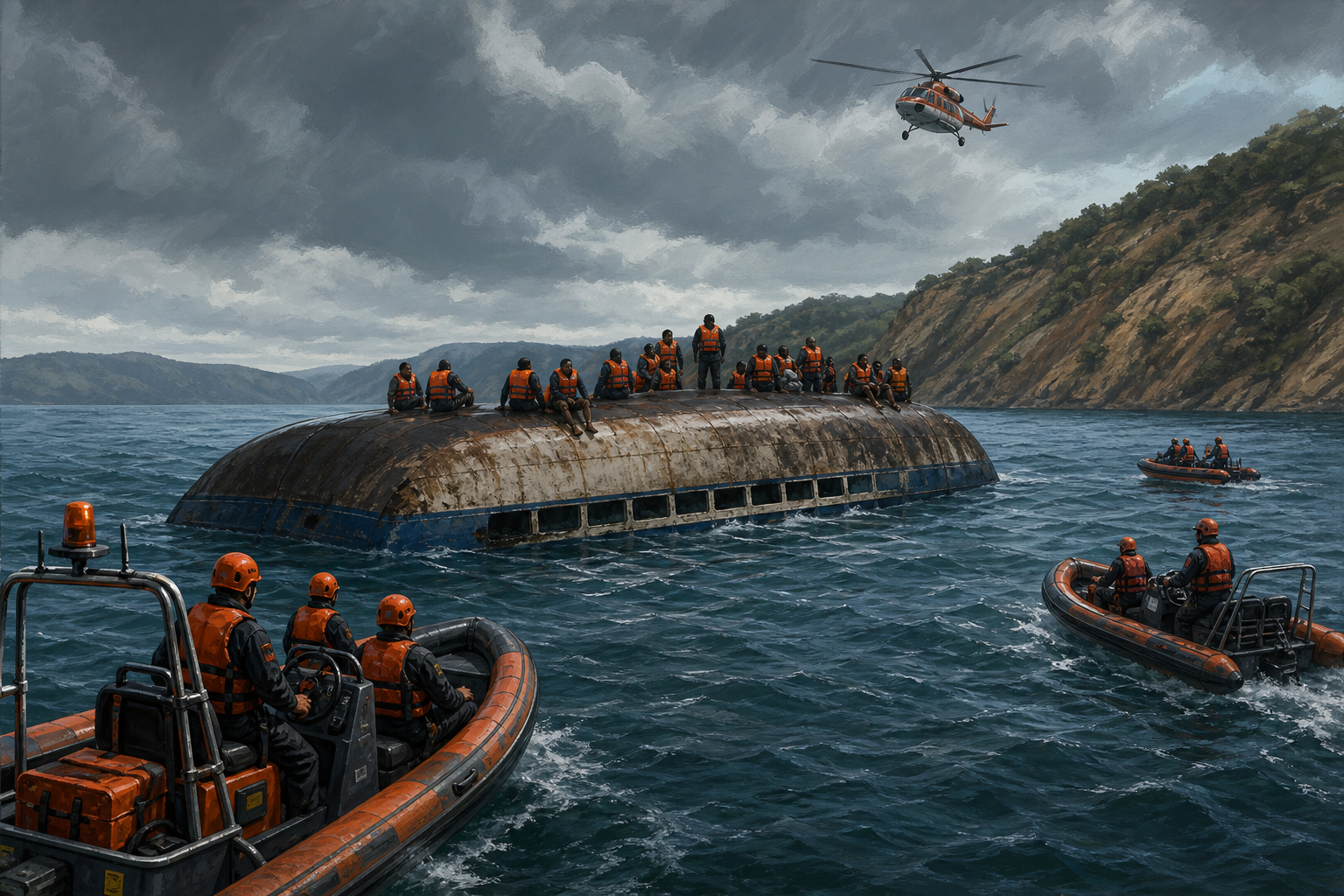
HARARE, Zimbabwe - At least 44 people were killed when an overloaded government-operated ferry capsized on Lake Kariba, according to Zimbabwean police, as survivors described passengers repeatedly urging the captain to turn back while strong waves and water entering the vessel made the danger clear.
The ferry overturned on Tuesday while carrying people from communities around the vast lake toward the town of Kariba. Zimbabwe's Civil Protection Unit said ticket records showed at least 114 adult passengers and five crew members aboard a vessel with a stated capacity of 90. An unknown number of children below ticketing age may also have been on board.
A surviving crew member, Anyway Chambati, told state broadcaster ZBC News that he counted 153 people, including crew and infants, before departure. He said passengers shouted that the boat was flooding and goods were spilling as water entered the engine room. The difference between the ticket count and his estimate has not been reconciled.
Survivors told ZBC that they warned the captain at the harbor and again after the ferry entered rougher water. One passenger said bags and other items began falling overboard. Another said water was pouring into one side about 30 minutes into the trip but the captain refused calls to return or request help. The captain was among the dead, according to Zimbabwe's state-run Herald newspaper.
Police raised the confirmed death toll to 44 on Wednesday and said the bodies had been recovered from the lake. The Civil Protection Unit earlier reported that 77 people had been rescued. Because the full passenger manifest remains uncertain, the number still missing could change as authorities compare survivor lists, ticket records and reports from families.
President Emmerson Mnangagwa declared the accident a state of disaster, allowing the government to mobilize extraordinary resources. Rescue boats, a helicopter and a specialized underwater team were deployed. The Associated Press and The Guardian both reported that some survivors waited on the exposed hull of the overturned ferry while assistance approached.
Lake Kariba stretches for more than 200 kilometers along the Zimbabwe-Zambia border and is the world's largest human-made lake by volume. Its scale makes conditions closer to those of an inland sea than a sheltered local reservoir. Communities depend on boats for transport to markets, public services and larger towns, which makes safe, reliable ferry operations essential rather than optional.
The immediate cause must be determined by a competent investigation. Strong waves may have triggered the final loss of stability, but the evidence already reported raises deeper questions. Why was a vessel rated for 90 allowed to depart with at least 119 ticketed adults and crew, plus children? Who controlled boarding? What weather information was available? Were there enough accessible life jackets for everyone? Why, according to survivors, was no early distress call made?
It would be convenient for officials to place every failure on a captain who cannot answer. That would leave the operating system untouched. A government agency ran the ferry, according to AP, and public authorities are responsible for inspection, capacity enforcement, crew training, communications and emergency planning. Accountability must follow the full chain of decisions, including managers who set schedules and officials who tolerated unsafe practices.
The uncertainty over the passenger count is itself a warning. Children who travel without tickets still require seats, life jackets and a place on the manifest. A ferry operator should know exactly how many people are aboard before leaving port, and rescue commanders should receive that number immediately after an accident. When the manifest is only an estimate, families suffer longer and search teams cannot know when every person has been found.
Zimbabwe's government should preserve the vessel, ticket records, maintenance logs, weather reports, radio data and witness testimony. An independent maritime panel should publish its findings, rather than allowing the investigation to disappear after funerals and official condolences. Survivors deserve protection from pressure, and bereaved families deserve a verified list of victims and a clear explanation.
The disaster also exposes a wider reality in places where isolated communities depend on aging public transport. Poverty and distance can make unsafe travel feel unavoidable. That does not make the deaths inevitable. Capacity limits, functioning communications, competent maintenance and the authority to cancel a dangerous trip are basic protections, not luxuries reserved for wealthier countries.
The rescue operation remains the first priority, and the death toll should be treated as provisional until police complete identification and reconcile the passenger list. After that, the measure of the response will be whether Zimbabwe repairs more than the damaged ferry. A serious government must identify the institutional failures, publish them and ensure that the next crew can turn back without facing pressure to complete an unsafe journey.
Comments
Loading comments…