
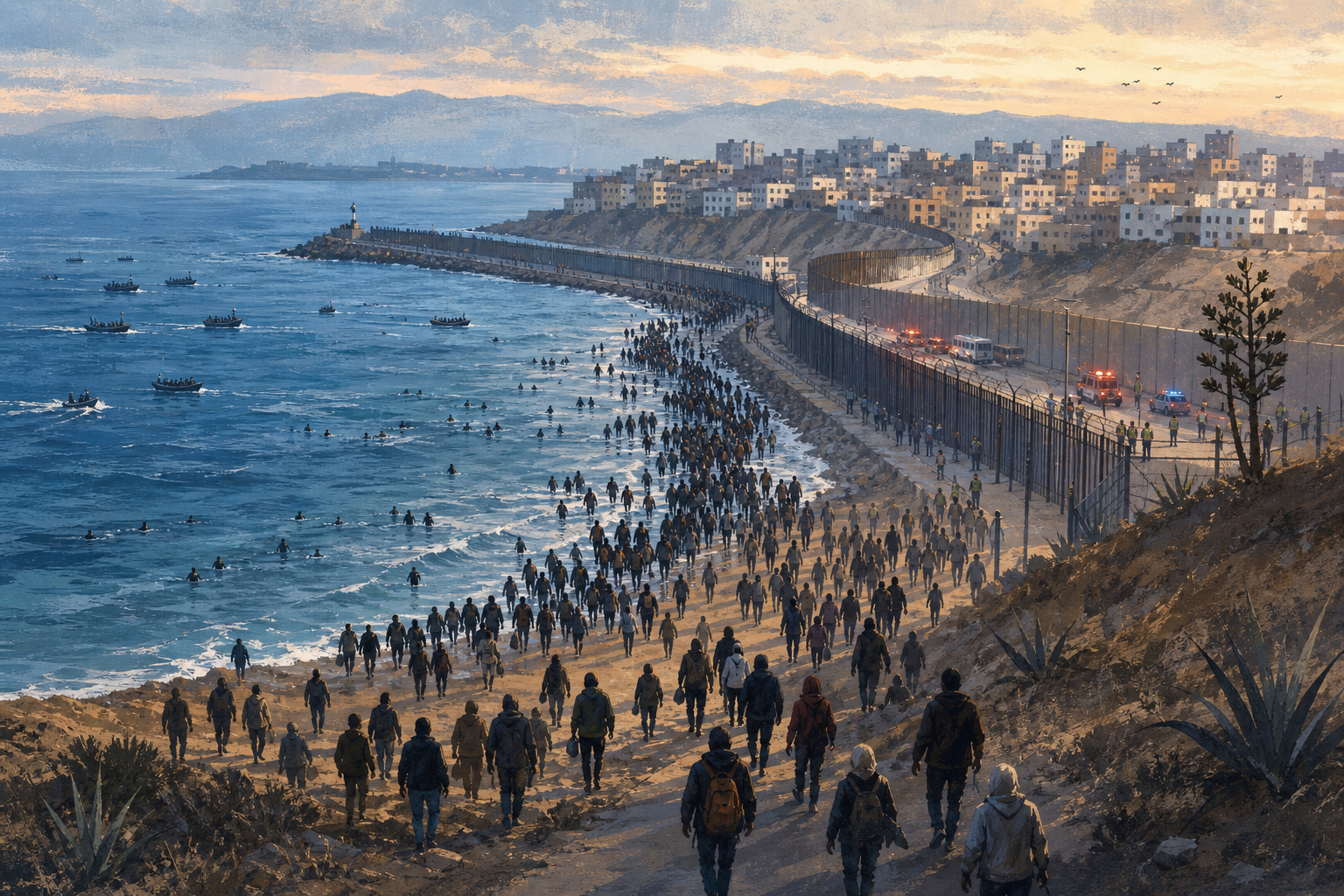
CEUTA, Spain — At least 57 people died as tens of thousands crossed from Morocco into the Spanish enclave of Ceuta beginning Thursday, overwhelming a city whose normal population is about 85,000 and setting off an urgent humanitarian, security and political crisis. Ceuta's president estimated that about 60,000 people had arrived, while Spain's Interior Ministry put the number at roughly 50,000. The difference reflects the difficulty of counting people during a fast-moving surge and should not be mistaken for a settled total.
By Friday evening, the Interior Ministry said 48,300 people had voluntarily returned to Morocco. That rapid movement back across the frontier reduced the immediate pressure but did not erase the scale of what had happened. Spain deployed soldiers and additional police officers to reinforce the border, manage crowds and support local authorities. Thousands still needed screening, shelter or assistance, and officials estimated that about 7,000 of those who entered were minors, creating an especially difficult safeguarding challenge.
People reached Ceuta by different routes. Some swam through the Mediterranean from the Moroccan coast, while others moved around or across the breakwater near the Tarajal border checkpoint. The journey turned deadly in the water and on land. Authorities and local representatives said some victims drowned, while others were killed in a stampede near the breakwater barrier. Images showed young men, families, women and children among the crowds, underscoring that the influx could not be reduced to a single profile or motive.
Prime Minister Pedro Sánchez travelled to Ceuta on Friday and called the mass crossing a violation of Spain's territorial integrity. He said human-smuggling networks had spread a false interpretation of a recent Supreme Court ruling concerning people intercepted at sea near Ceuta and Melilla. According to Sánchez, traffickers presented the decision as an opening that would prevent rapid return, and that message spread through their networks. His government said it would reinforce the frontier as authorities registered arrivals and processed cases.
That explanation remains an official assessment, not a fully proven account of why so many people moved at once. Morocco's ambassador to Spain, Karima Benyaich, said Rabat had consistently supported legal, orderly and safe migration and indicated that the crisis unfolded against Morocco's wishes. Moroccan security forces attempted to stop crossings, and authorities on both sides said cooperation continued. No public evidence cited by the Associated Press, BBC or Guardian established that the Moroccan state organised the surge.
The absence of proof matters because Ceuta has a politically charged history. The Spanish territory sits on the North African coast and, with Melilla, forms the European Union's only land border with Africa. In 2021, about 10,000 people entered Ceuta during a diplomatic confrontation in which Morocco loosened border controls. That precedent naturally fuels suspicion in Madrid, but history is not evidence that the same mechanism caused this week's events. Democratic governments preserve credibility by separating what is documented from what is merely plausible.
The immediate numbers also reveal how quickly municipal capacity can collapse. An arrival estimate equivalent to well over half of Ceuta's resident population would strain any city, even if most people later returned. Emergency shelter, medical care, family tracing and child protection cannot be improvised without risk. At the same time, border enforcement conducted amid panic can itself become dangerous. The drownings and fatal crush show why crowd control, rescue capacity and clear communication are not secondary concerns; they are part of responsible border security.
The repercussions spread beyond Spain. Italy temporarily restored checks for air and sea travel with Spain, while France said it would strengthen controls along its Spanish border. Those steps reflected concern about onward movement and domestic political pressure, although Ceuta is subject to special Schengen arrangements and travellers leaving the enclave already face checks. European leaders therefore confront two obligations at once: helping Spain secure an external border and resisting claims that turn a complex emergency into evidence-free accusations or collective blame.
The Supreme Court ruling and smugglers' messaging deserve close investigation, but a legal judgment alone does not explain the organisation, timing and extraordinary size of the movement. Spain and Morocco should release what they know about trafficking networks, communications and border decisions, while European institutions coordinate humanitarian support and verify the figures. The central facts are already grave enough: at least 57 people are dead, thousands of minors were caught in a chaotic crossing, and a small city was overwhelmed. Accountability should begin with evidence, and policy should protect both the border and the people placed in danger at it.
Comments
Loading comments…