
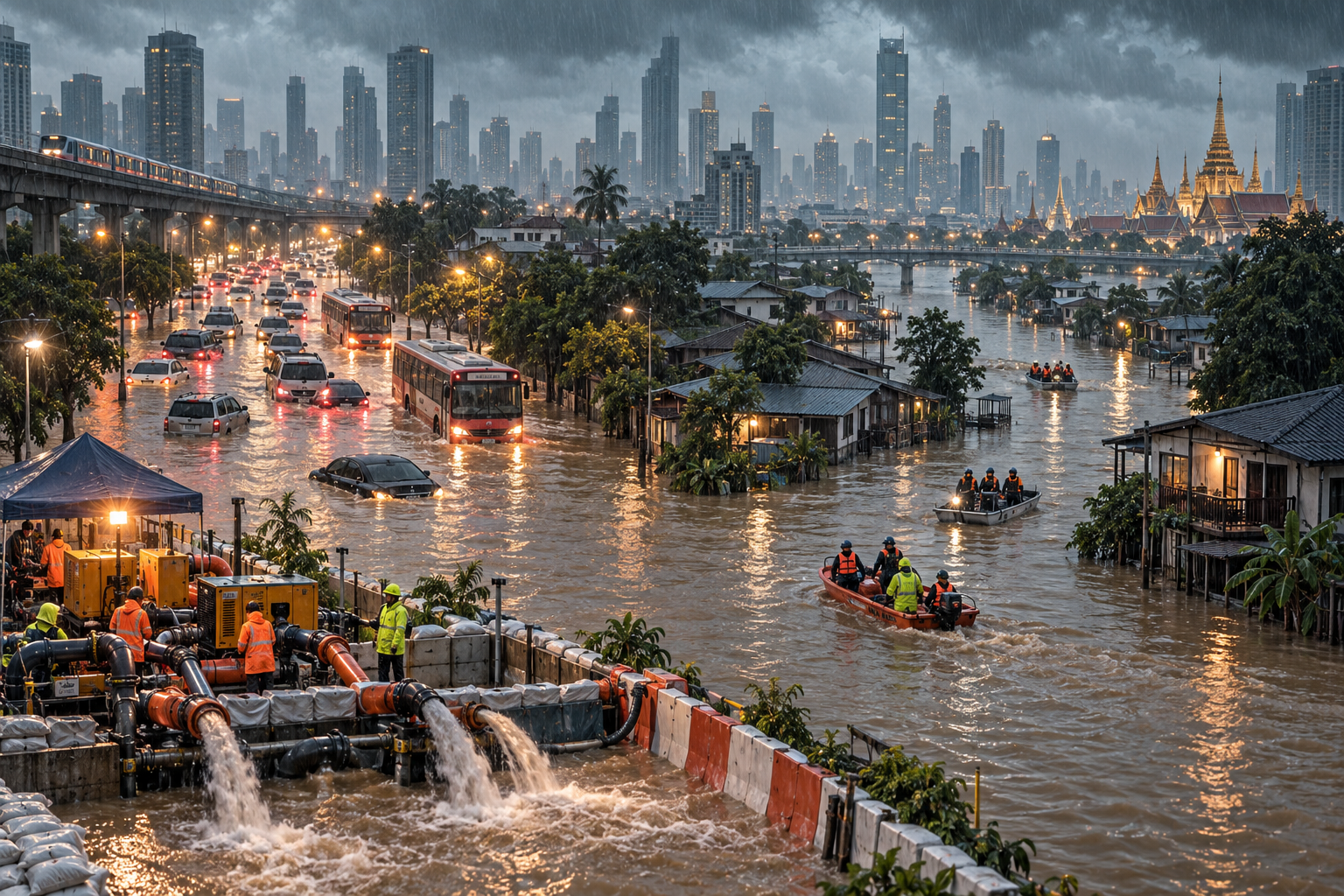
BANGKOK - Authorities have declared all 50 districts of Thailand's capital disaster zones after days of heavy rain flooded roads and homes, filled major canals and disrupted travel across the city.
Bangkok Governor Chadchart Sittipunt expanded an earlier declaration covering Nong Chok, Suan Luang and Khan Na Yao to the entire capital on Saturday. The designation gives agencies and district offices a common legal and administrative framework to mobilize assistance, manage shelters and respond to threats to life and property.
Nearly 300 millimeters, or 11.8 inches, of rain fell over roughly 48 hours beginning Wednesday, the governor said. Eastern Bangkok was among the hardest-hit areas. Officials warned people living near canals to move possessions to higher ground because the waterways were full and pumps were struggling to remove water as quickly as rain entered the system.
Residents who could remain at home were advised to avoid unnecessary travel. Flooding affected several major routes, including Ramkhamhaeng, New Phetchaburi, Ekkamai, Sena Nikhom 1, Lat Krabang and sections of Vibhavadi Rangsit roads. District offices opened temporary shelters in schools and public buildings on higher ground, while officials urged bedridden people dependent on medical equipment to consider temporary hospital care.
Chadchart said Saturday afternoon that conditions had stabilized and estimated that drainage could take two to three days if additional rain did not fall. The Thai Meteorological Department, however, forecast heavy to very heavy rain in Bangkok and other parts of the country through Sunday as a strong low-pressure system intensified monsoon conditions.
The emergency reached beyond the capital. Thai authorities said more than 84,000 people in 21 provinces had been affected as of Saturday. The military deployed more than 10,000 personnel and over 1,000 trucks and specialized vehicles nationwide, according to Malaysia's Bernama news agency. No casualties had been reported in Bangkok as of midday Saturday, although roads were closed, some shops shut and transport services were interrupted.
A modern capital facing an old vulnerability
Bangkok's declaration does not mean every street is under the same depth of water. It recognizes that the emergency has become citywide and that localized conditions can change quickly. That distinction is important for residents and travelers: dramatic images from one district should not be treated as a map of the entire capital, but neither should a dry street create false confidence about a flooded route nearby.
The crisis also demonstrates why drainage cannot be judged only by whether pumps are operating. Officials said the main systems remained functional, yet sustained rain filled canals faster than water could be moved. A functioning network can still be overwhelmed when rainfall, canal capacity, road design and development pressure converge.
Bangkok is built on the low-lying Chao Phraya delta, and its exposure is magnified by dense construction and limited room for water. Climate change does not cause every storm, but warmer air can hold more moisture and rising seas reduce the margin available to coastal cities. Planning must therefore account for rainfall extremes that exceed older design assumptions rather than treating each flood as an isolated surprise.
The immediate priority is practical: accurate alerts, accessible shelters, safe routes for ambulances and clear information about which roads and canals are dangerous. Authorities should publish drainage and water-level data in forms ordinary residents can understand, not only technical dashboards. Warnings also need to reach migrant workers, tourists, older residents and people without constant smartphone access.
After the water recedes, the public deserves a transparent review of where pumps, barriers and evacuation plans worked and where they failed. Emergency declarations can release resources quickly, but they must be followed by public accounting. Repeated flooding creates opportunities for rushed contracts and temporary repairs; open procurement and measurable performance reduce waste and build confidence.
Bangkok's experience carries a wider warning for rapidly growing Asian cities. Roads, rail lines and new towers may symbolize progress, but resilience depends on less visible systems: canals, retention areas, pumps, power supplies and neighborhood evacuation plans. Protecting those systems is not glamorous, and it is often postponed until water exposes the cost.
The governor's estimate offers hope that water can drain within days if the rain eases. The long-term test is harder. Bangkok must prepare for the next storm before memories fade, strengthen infrastructure without hiding weaknesses and give residents timely information they can trust. A city cannot control the monsoon, but it can decide how honestly and effectively it prepares for it.
Comments
Loading comments…