
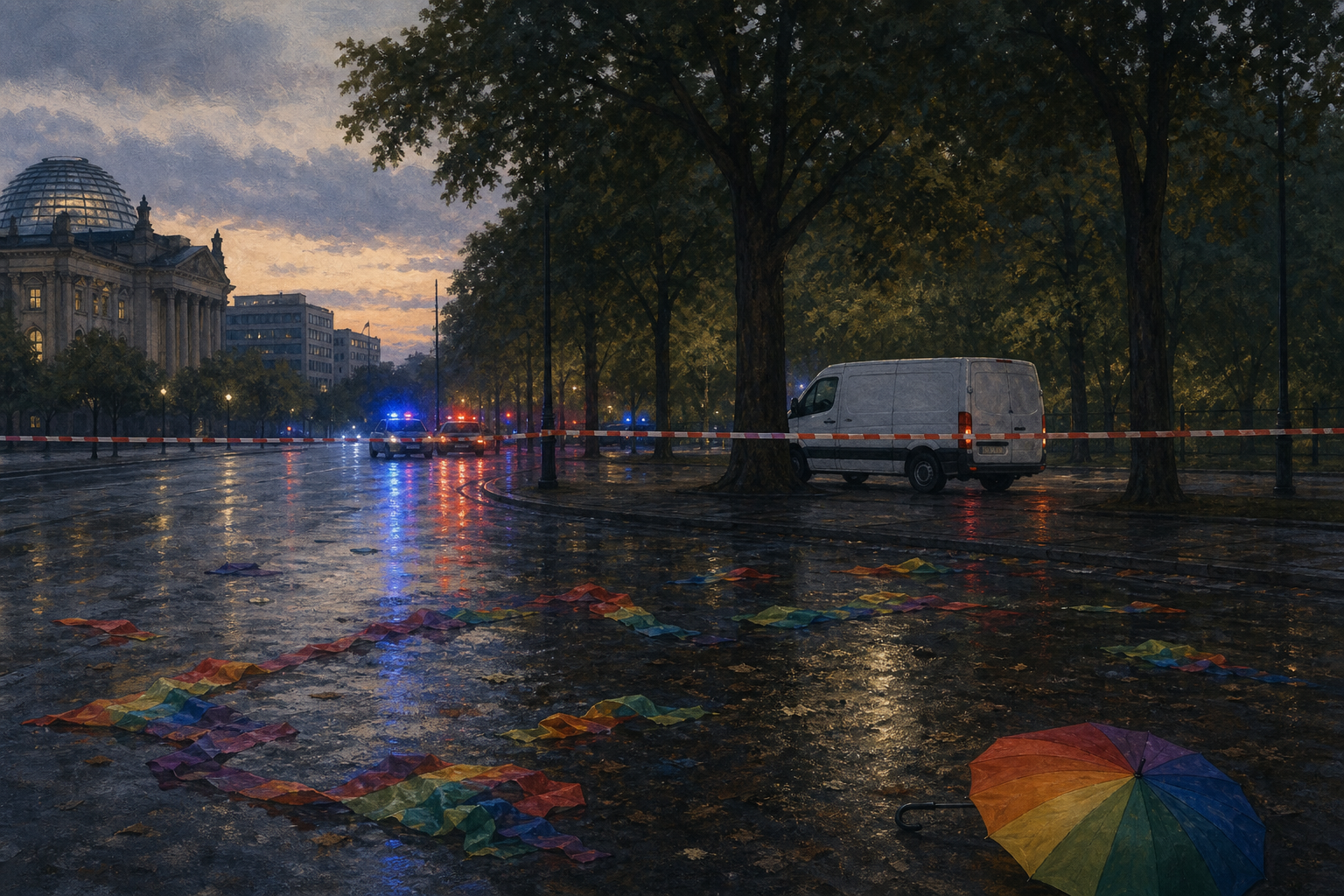
A woman was killed and 16 people were injured after a white vehicle struck people near Berlin’s Christopher Street Day celebration late Saturday, prompting authorities to end the Pride event and launch a citywide search for a 21-year-old suspect. Three of the injured were in life-threatening condition, eight were seriously hurt and five sustained minor injuries, according to the Berlin fire service.
The vehicle entered the Tiergarten park at about 10 p.m. on July 25, hit several people on Ahornsteig and then collided with a tree, according to accounts compiled by the Associated Press and German public broadcaster Tagesschau. One or more people then apparently left the vehicle. Police also said several people appeared to have been wounded with bladed weapons, an element of the incident that remained under investigation.
Organisers stopped the closing celebration near the Brandenburg Gate at about 10:15 p.m., interrupting a performance and urging attendees to leave without walking through Tiergarten. The disruption came after hundreds of thousands of people had joined one of Europe’s largest LGBTQ+ celebrations. The parade, known in Germany as Christopher Street Day, had crossed central Berlin with about 80 floats before the evening programme began.
Berlin police and prosecutors publicly identified the wanted man as Abdul B., 21, and said he was suspected of injuring several people with the moving vehicle. Their joint appeal warned members of the public not to approach him because he might be armed and dangerous. Investigators searched an apartment in the Schöneberg district early Sunday but found no one there. They asked witnesses to submit observations, photographs and video through an official evidence portal.
A police spokesperson said the suspect was known to officers and associated with Islamist circles in Berlin. That information is relevant to the search, but it does not establish why the violence occurred, whether anyone else helped carry it out or whether it meets the legal or evidentiary threshold for terrorism. Police said they had no information about a specific motive, and the suspect’s precise role had not been settled publicly. Berlin Mayor Kai Wegner likewise said it was too early to determine whether the incident was a terrorist attack.
Wegner described the violence as an assault on an open society, while Chancellor Friedrich Merz condemned the act and said Germany would defend freedom. Such statements reflect the civic meaning of violence at a Pride gathering, where visibility and public participation are central to the event itself. They should not be read as conclusions about motive before investigators establish the facts.
The immediate police task is unusually complex. Investigators must reconstruct the vehicle’s route, determine who was inside it, establish how the stabbing injuries occurred and identify any relationship between those acts. They must also separate verified evidence from the large volume of phone footage, eyewitness accounts and online speculation that follows a mass-casualty event. The official description of one or more people leaving the vehicle leaves open whether police are looking at a sole suspect, accomplices or witnesses whose roles are not yet clear.
The case also presents a familiar tension for democratic societies after spectacular public violence. Officials have to alert the public quickly enough to find a potentially dangerous fugitive, yet labels applied in the first hours can harden into assumptions that outpace the evidence. A reported association with Islamist circles warrants scrutiny by investigators; it is not proof of ideology, intent or collective responsibility. The same evidentiary discipline is essential when assessing whether the LGBTQ+ gathering itself was deliberately targeted.
Security around large open-air celebrations can reduce risk through vehicle barriers, controlled access points, surveillance and rapid medical response, but it cannot turn a city centre into a sealed venue without changing the character of the event. Berlin’s Pride celebration occupies streets and public spaces precisely to make participation visible. Any review of Saturday’s security will therefore need to examine how the vehicle reached the park and how the emergency unfolded without treating openness as the failure.
For now, the confirmed picture is narrower than the political meaning many will attach to it: one person is dead, 16 are injured, a suspect remains at large and authorities have not established a motive. The latest public reporting underscores both the urgency of the manhunt and the uncertainty surrounding the attack. Preserving that distinction serves the victims, the investigation and a community confronting violence at one of its most visible annual gatherings.
Comments
Loading comments…