
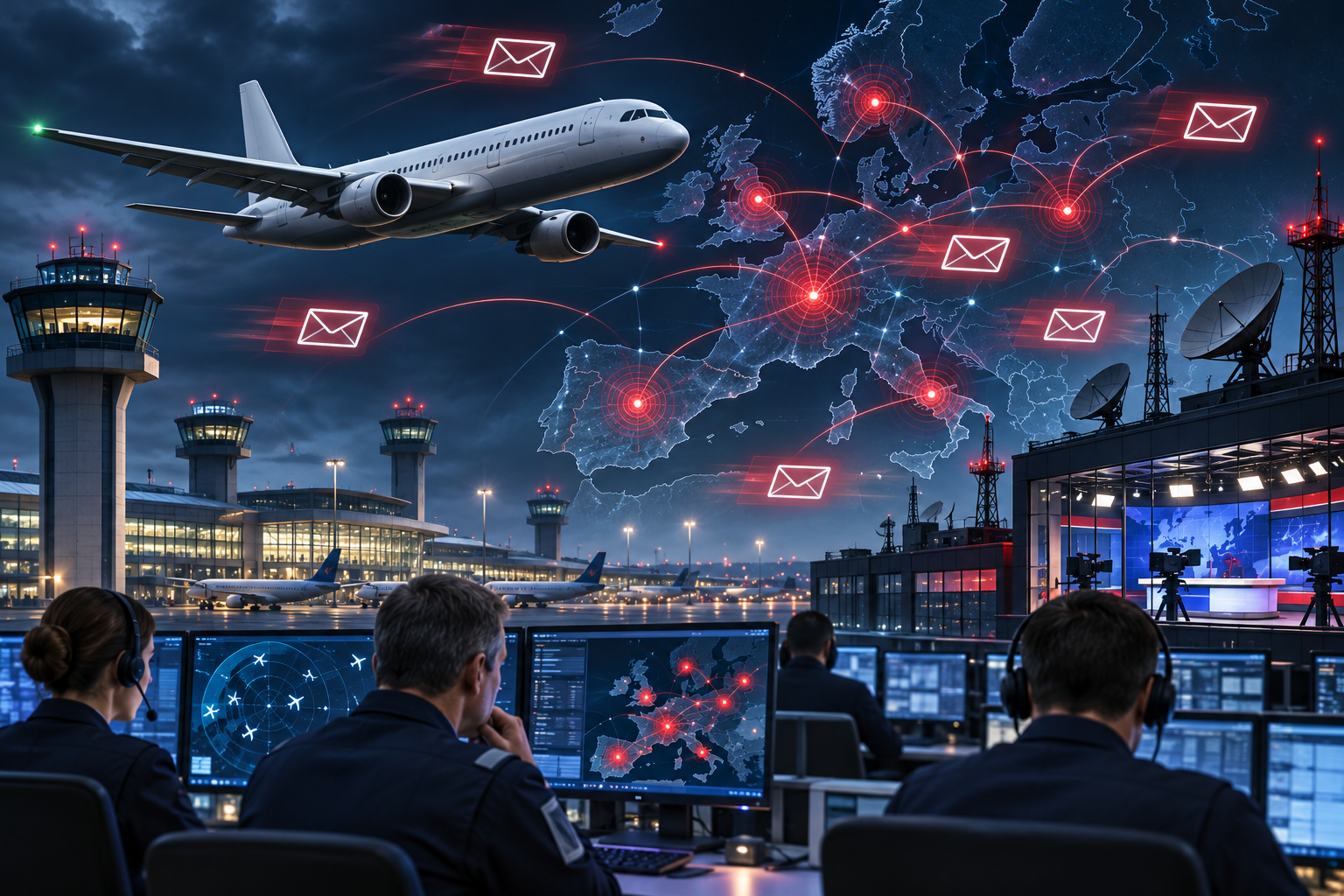
DUBLIN - A widening wave of bomb threats targeted passenger flights and broadcasters across Europe on Friday, forcing aircraft diversions and newsroom evacuations while officials investigated whether the hoaxes were part of a coordinated campaign of disruption.
No explosive devices were found and no injuries were reported. All affected aircraft landed safely, according to European officials and major news agencies. The absence of bombs did not make the threats harmless: pilots, air-traffic controllers, police and airport staff had to respond as if lives were at risk.
European Union transport commissioner Apostolos Tzitzikostas said authorities were aware of threats against 11 flights on Friday. Eurocontrol recorded threats against 14 flights on Thursday and seven on Tuesday, a small fraction of the roughly 26,300 flights operating across the network on Thursday but enough to cause diversions, security sweeps and delays in several countries.
A Wizz Air flight from Prague to Rome was diverted to Venice on Friday. Earlier incidents involved services operated by airlines including Aer Lingus, Ryanair, KLM, Finnair, LOT and Iberia. Fighter aircraft escorted or intercepted some planes during the week's earlier alerts, while other flights made unplanned landings.
The threats spread beyond aviation on Friday. Ireland's national broadcaster RTE evacuated its Dublin headquarters and replaced live programs with recorded material after receiving an emailed warning. Bulgaria's Nova TV received a similar message, and Britain's Sky said it also faced a security threat.
Emails sent to media organizations used the name "Mikhail Andropov" and presented the warnings as a message to Western countries. Reuters said it could not establish the sender's identity, the origin of the messages or whether the same person was responsible for threats made against the flights.
Officials therefore stopped short of assigning blame. Spanish Foreign Minister Jose Manuel Albares described the pattern as possible hybrid aggression and psychological warfare. Irish Prime Minister Micheal Martin said European security services had not yet determined whether the incidents came from individuals or a coordinated operation.
The warnings arrived amid a broader series of disruptions in Europe, including cyberattacks on supermarket refrigeration systems, drone incursions and sabotage investigations. Several European governments have accused Russia of earlier hybrid operations linked to Moscow's war against Ukraine. Russia has denied involvement, and no public evidence has yet connected the Kremlin to this week's threats.
A cheap weapon that forces an expensive response
A bomb threat does not need a bomb to achieve part of its purpose. A single anonymous message can redirect an aircraft, mobilize police, interrupt television broadcasts and create fear among thousands of people. The sender spends almost nothing; democratic societies carry the cost because they cannot responsibly ignore a warning.
That imbalance is what makes hoaxes useful to criminals, extremists and hostile intelligence services. Repetition can exhaust responders and tempt the public to dismiss the next alert. Yet the next message could be genuine. Security agencies are forced to distinguish danger from deception under intense time pressure, while the person behind a screen controls the tempo.
The pattern across several countries and sectors reasonably raises concern about coordination. It does not prove who coordinated it. Attribution matters because a false accusation can serve the attacker's interests by creating division or provoking retaliation against the wrong target.
Europe should be candid about Russia's established use of cyber operations, covert pressure and disinformation against states supporting Ukraine. It should also insist on technical evidence before declaring that Moscow directed these particular threats. Democratic credibility depends on showing the work, especially when an adversary may deliberately plant misleading clues.
The practical response must be collective. Airlines, broadcasters, email providers and national police should share message headers, language patterns, payment trails and infrastructure indicators quickly enough to identify links before evidence disappears. European governments also need common rules for assessing threats so attackers cannot exploit uneven procedures between countries.
Public communication is equally important. Officials should report what happened, what was searched and what remains unknown without amplifying the sender's propaganda. Publishing every threat in sensational detail can reward the campaign with the attention it seeks.
The United States and European democracies have built open transportation and media systems because movement and information are strengths. Hostile actors see those same systems as pressure points. Protecting openness now requires faster intelligence sharing and consequences for those who weaponize fear, not a retreat into permanent alarm.
Every aircraft landed safely this week. That is a success for crews and responders, but it is not proof that the campaign failed. Whoever sent the messages demonstrated how cheaply normal life can be interrupted. Europe now has to make that tactic harder, riskier and less rewarding.
Comments
Loading comments…