
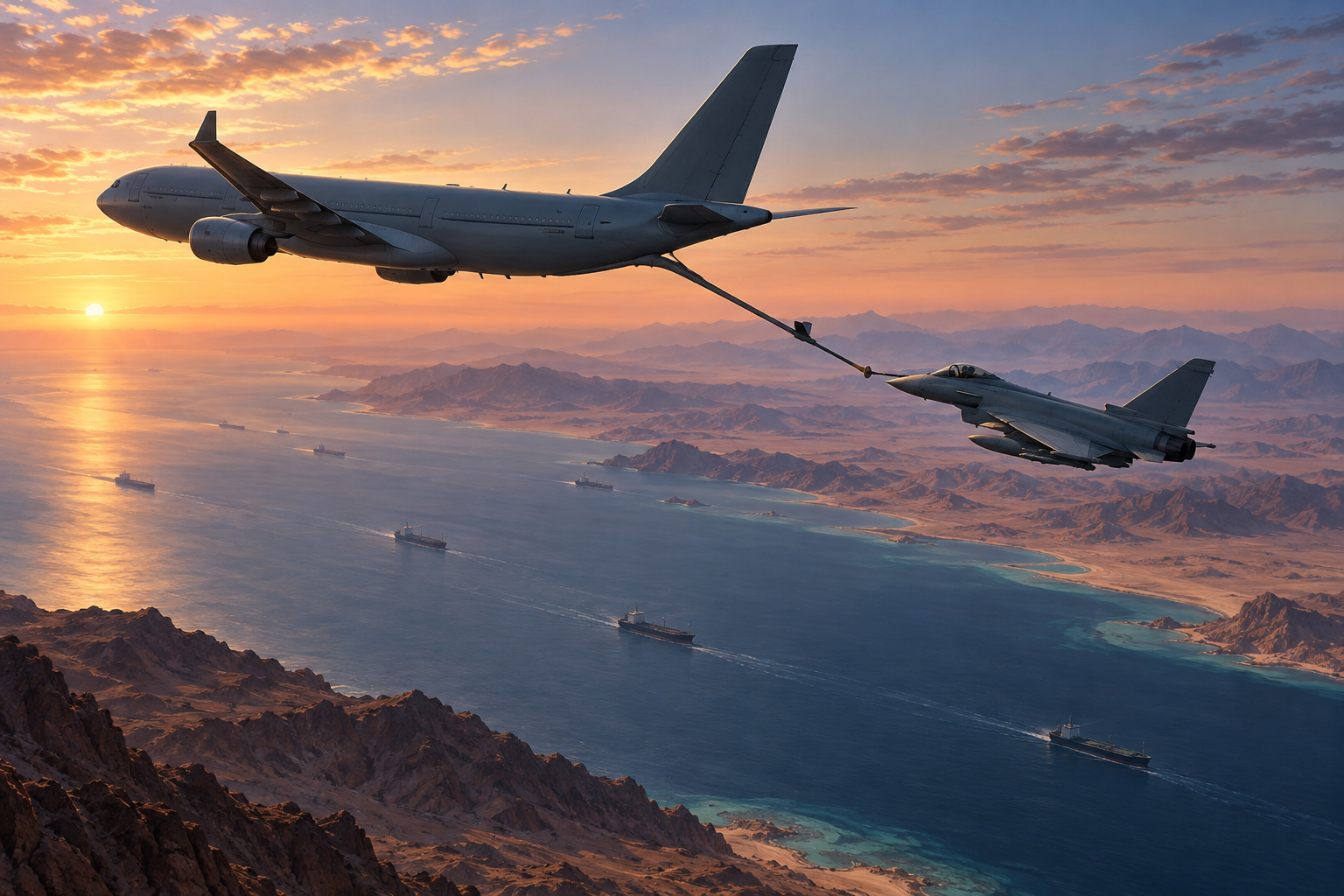
LONDON - Britain will send a Royal Air Force refueling aircraft to support Saudi warplanes on defensive missions after a request from Riyadh, Prime Minister Andy Burnham said Monday. The decision gives Saudi Arabia limited British military help as attacks by Iran-backed Houthi forces intensify around the kingdom and Red Sea shipping routes.
Burnham announced the agreement while traveling to New York for the United Nations General Assembly. He said he approved the Saudi request after advice from his defense and foreign secretaries. The mission will last a matter of weeks initially and remain under review, according to his account.
British officials said one RAF Voyager aircraft is expected to begin supporting Saudi planes in the coming days. The tanker will provide air-to-air refueling, extending the time those aircraft can remain airborne. London describes the supported flights as defensive; the announcement did not provide a complete public description of operational limits or the exact missions the refueling aircraft will serve.
The decision follows renewed Houthi missile and drone attacks on Saudi Arabia. One missile aimed at Riyadh on Saturday was intercepted, according to reporting on the conflict. The Houthis have also declared a blockade on Saudi-linked shipping around the Bab el-Mandeb Strait and Red Sea, while strikes have targeted Saudi-linked vessels and oil facilities.
Houthi fighters recently advanced along Yemen's coast and took the port city of Mokha and nearby islands, according to the Associated Press. Those positions sit near the southern entrance to the Red Sea, a shipping corridor whose security matters well beyond Yemen. Disruption there compounds problems at the Strait of Hormuz, where war with Iran has already constrained energy flows.
Britain and Saudi Arabia have a longstanding defense relationship. Reuters reported that the U.K. deployed a Sky Sabre air-defense system to Saudi Arabia earlier this year to help protect against Iranian missiles. The new refueling commitment is narrower than deploying combat jets to strike Houthi positions, but it is still operational support that can make Saudi air missions more sustainable.
Burnham said protecting routes for oil was part of his calculation. That is not merely a Saudi concern. When threats affect both sides of the Arabian Peninsula, energy and shipping costs can move through fuel prices, freight contracts and household bills in Britain, Europe and the United States. A government can call its role limited, but the economic exposure that pushed it toward involvement is global.
The difficult question is where defensive support ends and participation in a wider war begins. Refueling a Saudi aircraft during an interception mission is easier to defend than enabling an air campaign that harms civilians in Yemen. The public has not been given enough operational detail to know how London will enforce that distinction. Officials should state the mission's scope, oversight and review point without disclosing information that would endanger crews.
Saudi Arabia also carries a responsibility to show that its operations protect civilians and commercial traffic. The Houthis have attacked civilian infrastructure and threatened maritime routes, but that record does not erase the humanitarian consequences of Yemen's long conflict. Supporting a partner's defense should not mean granting a blank check for every use of force.
Washington faces a related dilemma. The United States has a strong interest in keeping both the Red Sea and Hormuz open, yet an expanding series of military commitments can turn a limited mission into an indefinite regional campaign. Allies can share the burden, but they need a common political objective: secure navigation, protect civilians and create leverage for a settlement, rather than simply chasing each new attack.
The Houthis' advantage is that even a small number of strikes can force much larger states to spend money, redirect aircraft and change trade routes. That asymmetry is the darker reality behind Burnham's announcement. An armed group does not have to defeat the Royal Air Force or Saudi military to impose costs on Western economies; it only has to keep danger credible near the chokepoints on which those economies depend.
Britain's refueling mission may strengthen immediate protection for Saudi Arabia. Its longer-term success will depend on whether the support remains genuinely limited, whether civilian harm is prevented and whether it helps reopen trade routes rather than deepening a war with no defined end.
Comments
Loading comments…