
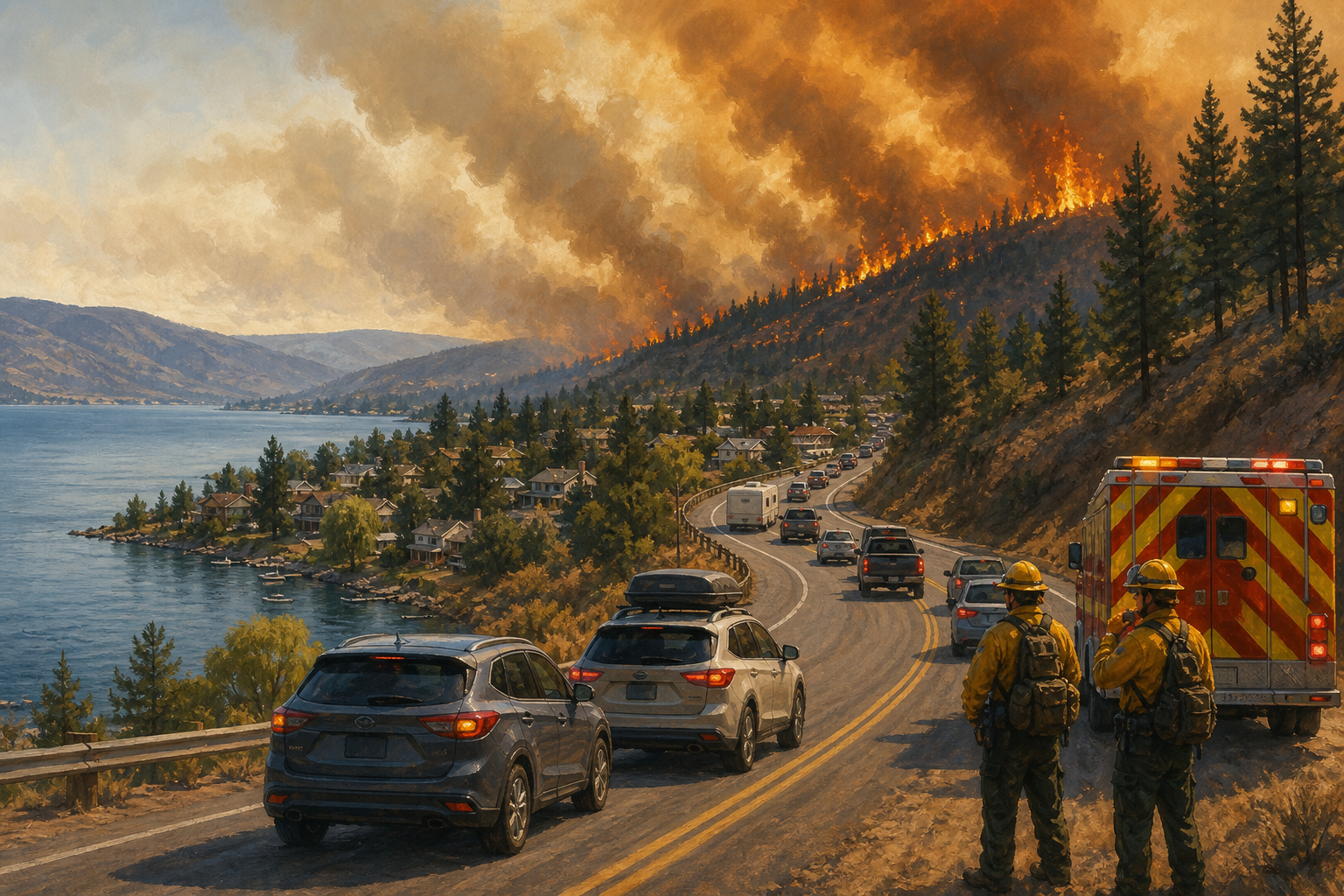
VANCOUVER, British Columbia - British Columbia declared a province-wide state of emergency on Saturday, August 8, after fast-moving wildfires destroyed homes, trapped residents and forced more than 20,000 people to flee communities around Okanagan Lake.
Premier David Eby announced the emergency as firefighters confronted more than 100 active fires across the province. Nearly half were listed as out of control amid hot, windy weather and prolonged drought, according to the Associated Press. Officials warned that conditions remained highly dynamic and could threaten additional communities with little notice.
Summerland, a community of about 12,000 people, was ordered evacuated overnight. About 8,000 more residents in Peachland and surrounding areas were also told to leave. Heavy traffic formed on escape routes, while dozens of people were rescued by aircraft after the speed of the fire cut off safer options.
Eby said homes and other properties had been lost and that some residents became trapped as conditions changed rapidly. The provincial government confirmed significant structural damage but said an accurate assessment was not yet possible because the affected area remained an active fire zone. No reliable final damage count was available at the time of publication.
The Bald Range wildfire northwest of Summerland grew rapidly as smoke spread across the Okanagan. Emergency agencies urged residents to follow local evacuation orders, use official sources for updates and avoid roads needed by firefighters and rescue crews. A provincial emergency declaration gives authorities broader powers to coordinate resources and movement during the crisis.
The first public lesson is brutally simple: evacuation orders are not forecasts. They are life-safety instructions issued because officials believe waiting could close the remaining route out. A resident may see only smoke on a distant ridge while emergency managers are watching wind, fuel, terrain and road capacity combine into a much narrower window.
That window became dangerously visible in the Okanagan. When more than 20,000 people move at once, the evacuation itself becomes a major operation. Roads jam, fuel runs low, mobile networks become congested and families separate. Communities need more than one route, accessible transport for people without cars and clear plans for hospitals, care homes, animals and visitors who do not know the area.
The emergency also exposes the difference between response and resilience. Firefighters can defend structures and slow a front, but they cannot erase years of accumulated vegetation, drought stress and development beside combustible landscapes during the hours of an evacuation. Fuel reduction, defensible space, fire-resistant construction and reliable communications must be funded before the smoke arrives.
Climate change is increasing the conditions associated with severe wildfire in many regions, but no single blaze should be reduced to one cause before investigators determine how it started. The confirmed facts here are enough: extreme fire behavior, dry and windy conditions, mass displacement and a response system operating under pressure across more than 100 incidents.
Democratic government is judged most clearly when information is incomplete and consequences are immediate. Officials must say what they know, admit what they do not and update instructions without hiding earlier uncertainty. Citizens in turn have a responsibility to act on lawful orders, resist rumors and leave scarce roads and emergency lines available for people in danger.
Canada and the United States also face a shared western fire problem. Smoke crosses the border, specialized crews move between jurisdictions and simultaneous emergencies compete for aircraft and equipment. Cross-border agreements and mutual aid are not ceremonial cooperation; they determine whether additional capacity can reach a community before weather defeats the first response.
The deeper cost will continue after the flames move on. Families will need temporary housing, businesses will lose income and insurers and governments will confront difficult rebuilding decisions. Reconstructing the same vulnerabilities in the same places may feel like restoration, but it can leave residents facing the same evacuation a few years later.
For now, the priority is survival. People in threatened areas should monitor EmergencyInfoBC, the BC Wildfire Service and local authorities, keep vehicles fueled and leave immediately when ordered. The province-wide declaration reflects the scale of the danger. It should also focus attention on the unglamorous preparation that determines whether the next fast-moving fire becomes an evacuation or a catastrophe.
Comments
Loading comments…