
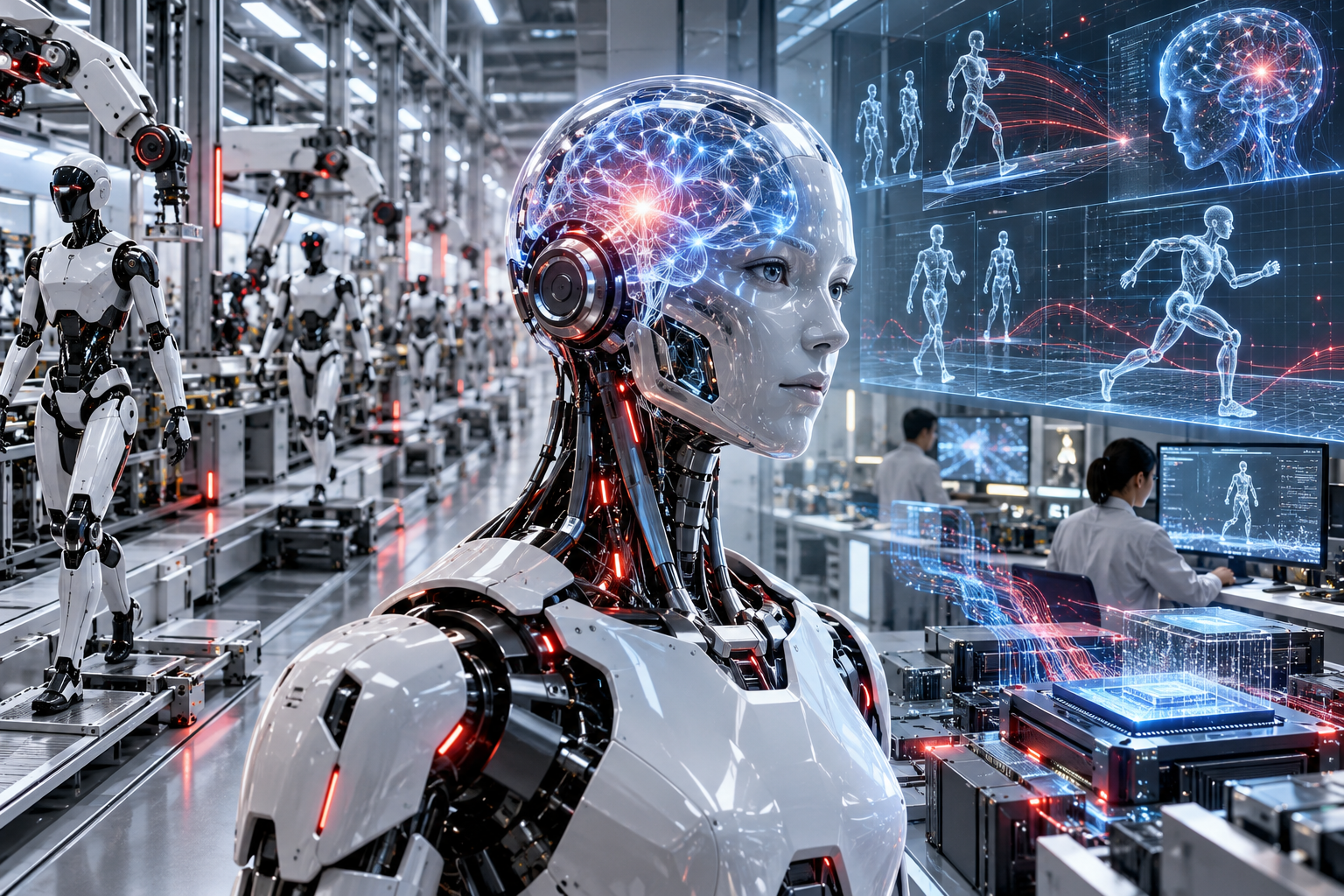
BEIJING - Chinese companies are pouring billions of dollars into artificial intelligence designed to make humanoid robots useful at work, shifting the industry's focus from impressive mechanical demonstrations toward machines that can understand and adapt to unfamiliar tasks.
Embodied AI companies in China raised 93.5 billion yuan, or about $13 billion, across 322 disclosed financing deals in the first half of 2026, according to IT Juzi data cited by Reuters and Chinese automotive research outlet Gasgoo. The total was five times the amount recorded a year earlier.
The surge reflects a growing belief that robot hardware will become cheaper and more interchangeable while the most valuable technology moves into the software that controls it. Chinese manufacturers have already demonstrated machines that run, dance and perform acrobatic movements. The harder commercial challenge is teaching them to work reliably without programming every action.
That field, often called embodied AI, combines vision, language, movement and physical feedback. A useful system must recognize objects, understand an instruction, plan a sequence and adjust when the environment differs from its training data.
Chinese startups X Square, Galaxea and Spirit AI have each reached valuations of roughly $3 billion, Reuters reported, citing company disclosures. Established manufacturers are also expanding software research. Unitree has about 30 researchers developing models that predict how objects behave, according to a person briefed by the company.
UBTech advertised a chief scientist position overseeing AI-model development with compensation worth as much as 124 million yuan, including equity and benefits. The extraordinary package shows how aggressively companies are competing for researchers who can connect advanced models to physical machines.
Chinese developers are collecting large volumes of physical-interaction data. Spirit AI has hired about 1,000 people to record household and industrial activities, according to its co-founder. Ant Group's Robbyant said it assembled 160,000 hours of training material across simulations, videos and robot interactions, including data from multiple robot designs.
Some systems are moving beyond laboratories. Spirit AI says its robots insert flexible wire connections during battery-pack testing at CATL's Zhongzhou plant with a success rate above 99%. Those figures are company-reported and apply to a defined production task, not general intelligence.
Research results show both progress and limitation. American startup Generalist says its GEN-1.5 model completed simple manipulation tasks with an average 59% success rate after watching demonstrations lasting three to 12 seconds, without updating the model's weights. A team involving X Square, Beijing Institute of Technology and Tsinghua University published a preprint describing robots learning new manipulation skills from a single human video.
Neither result means a robot can reliably enter any factory or home and perform most jobs. Laboratory tasks are short and controlled, physical failures can damage equipment or people, and performance often declines when lighting, objects or layouts change.
China has major advantages in manufacturing capacity, supply chains and access to factories where systems can be tested. American companies retain strengths in frontier AI research, advanced semiconductors and several leading robot-foundation models.
U.S. export controls on Nvidia's most advanced chips remain a constraint for Chinese developers. Chinese firms are responding with more efficient models, simulation data and domestic processors from companies including Huawei, but industry executives told Reuters that computing shortages could become more severe as models grow.
China can scale hardware quickly, but intelligence is not an assembly target
The investment boom should be taken seriously in Washington. China has repeatedly shown that it can turn state support, dense supplier networks and intense domestic competition into rapid manufacturing scale. If embodied AI becomes dependable, that combination could reshape factories, logistics and military support systems.
But funding totals and choreographed demonstrations are not proof of leadership. Gasgoo noted a sharp divide between soaring valuations and an industry that may remain years away from broad commercialization. State-backed capital can accelerate research, but it can also keep weak companies alive and reward politically favored targets before customers prove their value.
Data is another advantage with a cost. Robots need examples of people handling tools, packages, cables and unpredictable objects. An authoritarian system may collect workplace and behavioral data with fewer privacy or labor protections than an open democracy would accept. The United States should not imitate that disregard; it should build better consent standards while making high-quality industrial data easier for legitimate research.
Export controls can slow Chinese access to top chips, but controls alone are not a technology strategy. America must preserve its research universities, attract technical talent, expand energy and semiconductor production, and connect software laboratories with manufacturers that can test systems at scale.
Open research is also a strength. Published benchmarks can be challenged, reproduced and improved. Company claims from any country, including the United States, should be treated as provisional until independent testing confirms performance across different robots and workplaces.
The decisive contest will not be won by the robot with the best promotional video. It will be won by systems that learn safely, work consistently and create more value than they consume in capital and supervision. China is spending heavily to close the intelligence gap. The United States should answer with disciplined innovation, not complacency or panic.
Comments
Loading comments…