
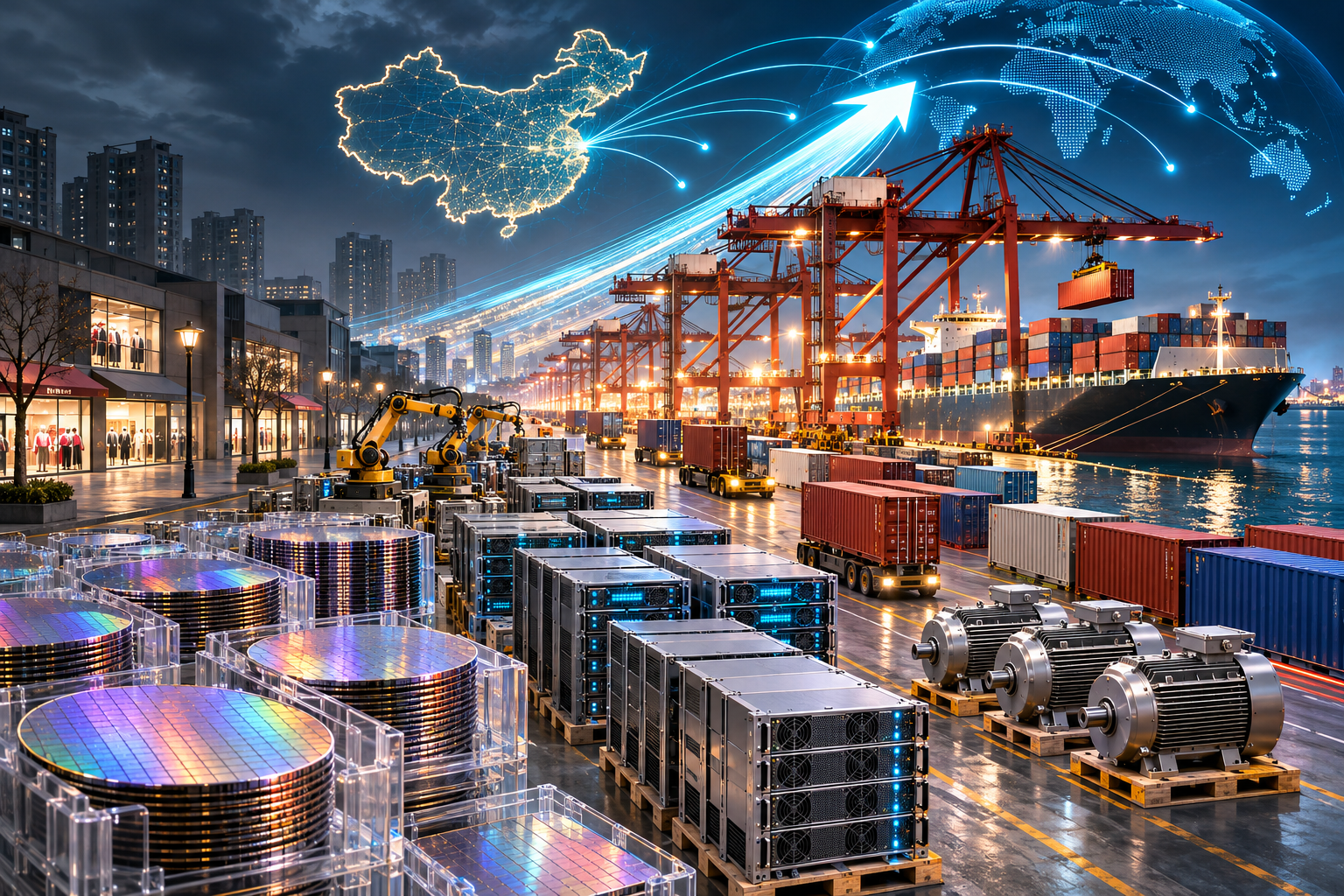
BEIJING - China's goods trade surplus exceeded $1 trillion in the first ten months of 2026, reaching the threshold a month earlier than last year as global investment in artificial-intelligence infrastructure drove rapid growth in semiconductor and high-tech exports.
Official customs data released Tuesday showed a cumulative surplus of about $1.04 trillion from January through October. China has now passed $1 trillion for a second consecutive year and is on course to challenge the record annual surplus of nearly $1.2 trillion set in 2025.
Exports measured in U.S. dollars rose 35.2% in October from a year earlier to about $412.3 billion. Imports climbed even faster, increasing 41.6% to roughly $307.1 billion, but the difference still produced a monthly surplus of about $105.2 billion.
Both sides of the trade ledger exceeded economists' expectations. A Reuters poll had projected export growth of 33.5% and import growth of 32%, indicating that international demand and purchases of foreign raw materials and components remained stronger than anticipated.
Technology shipments supplied much of the momentum. The dollar value of China's semiconductor exports rose 111.1% in the first ten months from the same period a year earlier, while exports of high-tech products increased 47.9%, according to customs figures reported by Reuters.
The global race to build data centers has created enormous demand for servers, electrical equipment, cooling systems, networking hardware and components. Chinese manufacturers have captured part of that spending even as the United States restricts China's access to the most advanced American-designed chips and manufacturing technology.
The trade performance provides Beijing with industrial revenue and employment while its domestic economy remains uneven. Separate vehicle data showed domestic auto sales declining for a twelfth consecutive month even as car exports continued to grow, illustrating how overseas buyers are absorbing output that China's own consumers may not.
Imports rising faster than exports in October could signal some improvement in demand, but one month does not resolve deeper problems involving property, household confidence and local-government debt. China's growth model remains heavily dependent on manufacturing and foreign markets.
The figures were released as Beijing extended a trade truce with Washington for two months. China has linked additional purchases of American farm products to implementation of reciprocal tariff reductions, leaving both sides with temporary stability but no final settlement.
A surplus of this scale is likely to increase pressure from the United States, European Union and emerging economies whose manufacturers compete with subsidized or highly scaled Chinese production. Trading partners benefit from lower prices, but they also face factory closures, supply dependence and political backlash when imports grow much faster than exports to China.
The world cannot absorb unlimited Chinese overcapacity
China's export achievement is real. Its companies built vast supply chains, trained workers and delivered equipment at speeds many competitors cannot match. Democratic countries should not explain every loss by alleging misconduct or use tariffs to protect businesses that refuse to innovate.
But the surplus also reflects a structural imbalance. China's system channels capital toward preferred industries while households receive a relatively limited share of national income, restraining consumption. Beijing also uses an opaque mix of subsidies, procurement and regulation to build capacity. When domestic demand cannot absorb the resulting output, foreign markets become the release valve.
That arrangement gives consumers cheaper goods in the short term. Over time it can erase competing industries and leave democracies dependent on an authoritarian state for technologies central to energy, communications and artificial intelligence. Price is not the only measure of economic security.
The United States should respond with more than broad tariffs. Tariffs can slow imports, but they also raise costs and encourage companies to route goods through third countries. A durable strategy requires faster permitting, competitive energy, research funding, skilled immigration and allied supply chains that can produce at scale.
Europe faces a similar choice. It can defend every legacy company indefinitely, or it can identify strategic sectors where open competition must be paired with protection against state-distorted markets. Transparent anti-subsidy investigations are stronger than improvised political barriers because they produce evidence allies can share.
Beijing also has choices. A richer Chinese consumer would buy more domestic and foreign goods, reducing dependence on perpetual export surpluses. Shifting income toward households would make growth more balanced, but it would also reduce the Communist Party's control over capital and industrial priorities.
The AI boom may keep exports rising for now. Demand for data-center hardware is enormous, and Chinese manufacturers have become essential suppliers below the most advanced chip layer. Yet the same concentration that creates efficiency also creates leverage, and democratic governments are beginning to treat that leverage as a security risk.
A $1.04 trillion surplus is not just a monthly economic statistic. It is evidence that China's production system is expanding faster than its own people consume and faster than many trading partners can politically accept. Unless that imbalance changes, the next phase of globalization will be defined less by open markets than by defensive blocs competing to control strategic industry.
Comments
Loading comments…