
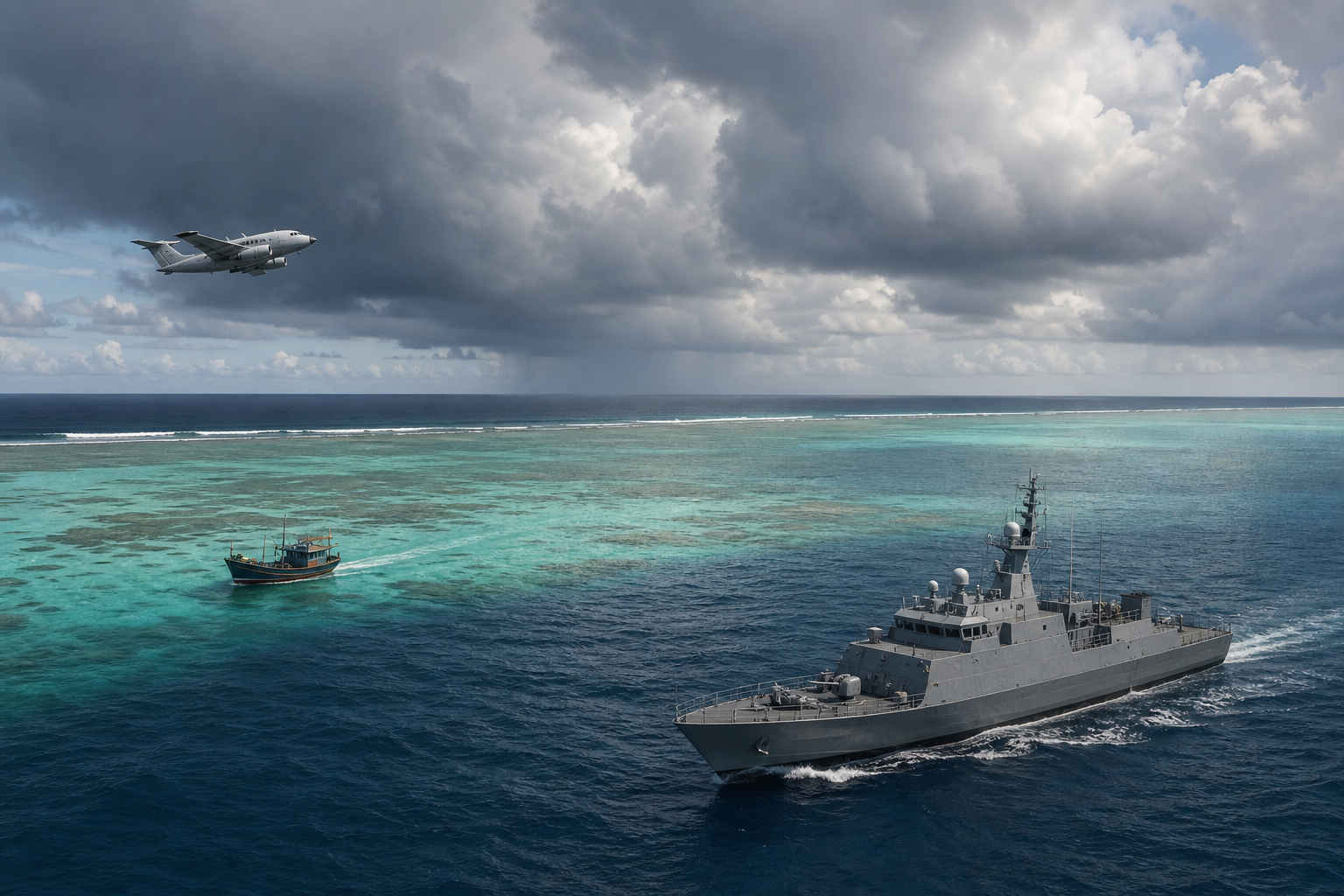
China conducted coordinated naval and air drills near the disputed Scarborough Shoal on Saturday, August 1, as tensions with the Philippines intensified at one of the South China Sea's most closely watched flashpoints. Chinese state broadcaster CCTV said the exercises tested coordination between air and naval forces and their ability to provide rapid reinforcements.
The shoal, called Panatag by the Philippines and Huangyan Dao by China, lies within the Philippines' exclusive economic zone but is also claimed by Beijing. No fighting was reported during Saturday's operation. The immediate significance was the decision by China's military to demonstrate combat coordination around a feature that is used by Filipino fishermen and sits close to the main Philippine island of Luzon.
The drills followed a Philippine submission to the United Nations seeking recognition of extended seabed rights that include the area around the shoal. China's Southern Theater Command rejected Manila's position as illegal and invalid. Beijing also released rules for a nature reserve it declared around Scarborough last year, including restrictions on unauthorized fishing, mining and coral harvesting.
Environmental protection is a legitimate concern in the South China Sea, where reefs have suffered extensive damage. The dispute is over who has authority to impose and enforce those rules. A conservation label administered unilaterally by the stronger claimant can become another instrument of control, particularly if traditional Filipino access is restricted while Chinese coast guard and military vessels remain present.
The latest drills came after a series of confrontations involving Chinese and Philippine personnel. The Associated Press reported that at least three encounters occurred in the preceding week and that the Philippine military accused a Chinese coast guard member of striking a Filipino sailor in the head with a baton during one incident. China has defended its operations as measures to protect what it calls sovereign territory.
A 2016 international arbitral tribunal rejected the legal basis for China's sweeping historic-rights claim across much of the South China Sea. The tribunal did not decide sovereignty over Scarborough Shoal, but it found that China had unlawfully prevented Filipino fishermen from engaging in traditional fishing there. Beijing rejected the ruling and has continued to rely on coast guard patrols, administrative declarations and military activity to enforce its position.
That pattern matters more than any single patrol. Authoritarian power often advances through accumulated facts rather than one dramatic act: a new regulation, a permanent patrol, a temporary barrier, a warning to a civilian vessel, and then an exercise presented as routine. Each step can look limited in isolation. Together they can change who is able to use contested waters without ever producing the formal declaration that would trigger a larger international response.
The Philippines cannot match China's fleet ship for ship, which is why law, documentation and alliances are central to Manila's strategy. Public reporting, diplomatic protests and legal filings do not physically remove a Chinese vessel, but they prevent coercion from being mistaken for accepted sovereignty. They also give the United States and other democratic partners a factual basis for coordinated deterrence and maritime support.
Washington has repeatedly said its defense commitments to the Philippines apply to attacks on Philippine armed forces, aircraft and public vessels in the South China Sea. That assurance is intended to reduce the risk that Beijing concludes it can use limited force without consequence. It must be paired with disciplined communication, because crowded waters and aggressive maneuvers also create the danger of an accident that neither side initially intended.
The harder reality is that international rulings are only as strong as the willingness of states to defend the order behind them. China can reject a tribunal and keep sending ships because it calculates that persistence may outlast resistance. The democratic answer should not be reckless escalation. It should be sustained allied presence, transparent evidence, support for lawful fishing and a refusal to let repeated coercion rewrite the map by exhaustion.
Saturday's drills therefore should not be treated as empty theater. They were a message about capability and control delivered at a location where military power, economic access and international law meet. The next test is whether Manila's partners respond consistently enough to show that a smaller democracy's rights cannot be erased simply because a larger authoritarian state has more ships.
Comments
Loading comments…