
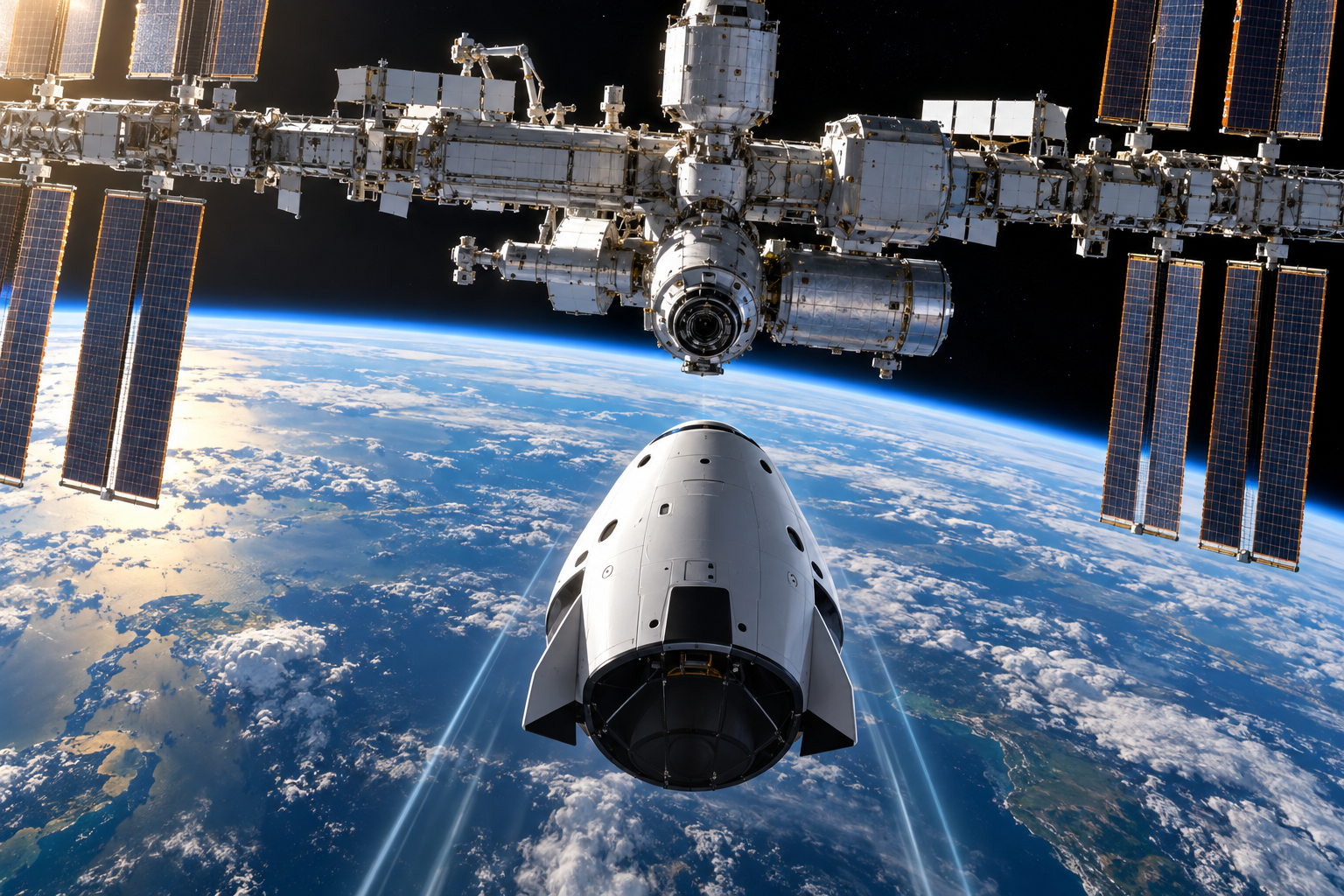
CAPE CANAVERAL, Florida - Four astronauts reached the International Space Station aboard SpaceX's Dragon spacecraft on Thursday after a seven-hour, 55-minute flight, setting a record for the fastest U.S. launch-to-docking journey to the orbiting laboratory.
NASA's Crew-13 lifted off at 11:10 a.m. Eastern time from Space Launch Complex 40 at Cape Canaveral Space Force Station. The Dragon capsule docked with the forward port of the station's Harmony module at about 7:05 p.m., completing a carefully timed orbital chase in less than a normal working day.
The crew is led by NASA astronaut Jessica Watkins, a geologist making her second spaceflight. She became the first Black woman to command a crew into orbit. NASA astronaut Luke Delaney, Canadian Space Agency astronaut Joshua Kutryk and Roscosmos cosmonaut Sergey Teteryatnikov are making their first trips to space.
The mission launched after a delay of about three weeks while teams repaired a leaking fuel system on the Dragon capsule, according to the Associated Press. Thick clouds also threatened the countdown before conditions improved enough for liftoff.
Once in orbit, the spacecraft performed a series of automated maneuvers while SpaceX monitored Dragon from Hawthorne, California, and NASA controlled station operations from Houston. The short trip was possible in part because the station was in a favorable position relative to the launch site.
The arrival increased the number of people living aboard the station to 11. Crew-13 is beginning an expected six-month science expedition and will take over from Crew-12 after several days of handover work. NASA said the outgoing crew could depart as early as Monday, depending on weather at recovery sites off California.
Watkins previously spent 170 days aboard the station in 2022 and worked with the Curiosity rover science team before joining the astronaut corps. Delaney is a retired Marine, Kutryk is a Royal Canadian Air Force colonel, and Teteryatnikov is a former submariner.
The flight was SpaceX's 13th operational crew-rotation mission for NASA and the company's 14th crewed flight under the Commercial Crew Program when the 2020 demonstration mission is included. NASA said the crew will continue research that supports life in orbit and preparation for future missions to the Moon and Mars.
Speed reflects a system that has learned to repeat success
The record is impressive, but the larger achievement is not a race measured by a stopwatch. It is the maturity of an American launch system that can combine a reusable rocket, an autonomous capsule, government oversight and international crews in a routine operational cadence.
That model represents one of the strongest advantages of the United States. NASA sets demanding safety and mission requirements, while private companies compete, build and improve hardware. Commercial capability does not replace public purpose; it gives the public program more vehicles, more operating experience and more options when schedules or spacecraft fail.
The three-week delay also deserves attention. A record-fast flight did not come from ignoring a leaking fuel system. Engineers stopped, repaired the problem and launched only when the system and weather were acceptable. In human spaceflight, disciplined delay is evidence of strength. A spectacular timetable is worthless if it is achieved by taking an avoidable risk with four lives.
Crew-13 also shows that practical cooperation can survive severe political tension. An American, a Canadian and a Russian are sharing a capsule and station at a time when Washington and Moscow confront one another over war and security. That cooperation should not obscure Russian aggression or weaken democratic resolve. It does show the value of preserving narrow channels where safety and scientific continuity require them.
The mission carries symbolism as well. Watkins' command marks another barrier broken in a field that once excluded most Americans from consideration. Her role is not merely ceremonial: she has scientific experience, a previous long-duration mission and responsibility for leading a multinational crew through launch, docking and months of operations.
A faster rendezvous can reduce time spent in the cramped capsule and make crew rotations more efficient, but it depends on orbital geometry and will not be available for every mission. NASA and SpaceX should resist turning one record into a marketing promise that pressures future crews. Reliability, redundancy and transparent review remain more important than speed.
The lasting message from Crew-13 is that American space leadership now rests on an ecosystem rather than a single vehicle or agency. Government expertise, private engineering, allied participation and repeated operations reinforce one another. Seven hours and 55 minutes is the headline. The deeper success is a system capable of making an extraordinary journey look increasingly dependable.
Comments
Loading comments…