
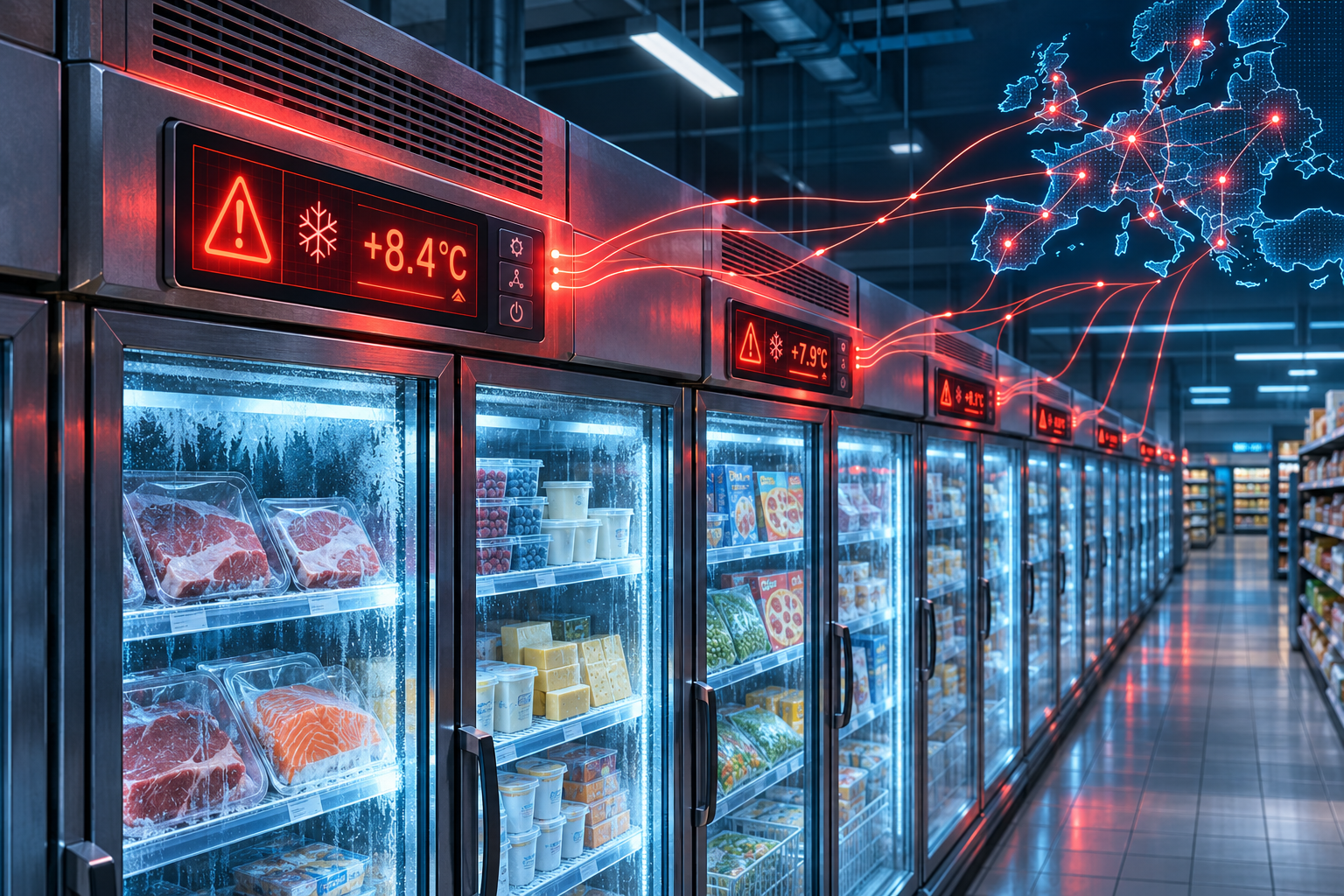
STOCKHOLM - Apparent cyberattacks manipulated supermarket refrigerators and freezers across several European countries on Monday, forcing stores to discard chilled food and exposing how ordinary connected equipment can become a target for disruptive sabotage.
The incidents affected stores in Sweden, Belgium, Luxembourg, Ireland and Estonia, according to retailers and government officials. Reuters also reported disruptions in the Netherlands and Finland. Investigators had not identified the attacker or established whether the incidents were coordinated with a similar attack in France in October.
At an ICA store in Stockholm, a manager said the attack began at about 2 a.m. and sent freezer temperatures as high as 50 degrees Celsius, or 122 Fahrenheit. Staff discovered the damage hours later and said the frozen stock had been destroyed.
Swedish grocery chains ICA and Coop said a limited number of stores were affected. Coop reported unauthorized manipulation at seven of its roughly 800 stores. In Belgium, Carrefour said 15 of more than 700 stores were hit, while Colruyt Group said refrigeration systems at five franchise shops were attacked.
Ahold Delhaize reported effects at several dozen stores, mostly in Belgium and some in Luxembourg. In Ireland, wholesaler Musgrave said monitoring systems alerted it to problems at 13 SuperValu stores. Chilled and frozen products were removed from sale before the company said the incident had been resolved.
The financial damage can be severe even when only one site is affected. The owner of a Belgian butcher shop told Reuters that remotely altered controls raised refrigerators to 18 C and ruined about 15,000 euros, or $16,800, of meat.
At least some affected units used controls supplied by Danish manufacturer Danfoss, whose equipment was also involved in the October incidents in France. Danfoss said it was working with customers on fixes. That overlap does not by itself prove that the same attacker carried out both operations.
No group had claimed responsibility. Belgium's Centre for Cybersecurity said attribution may never be possible, while the European Commission described the attacks as a deliberate effort to disrupt the food supply chain. Reuters could not determine whether a state, criminal group or individual was responsible.
The absence of an extortion demand led some security specialists to consider sabotage or a political motive, but that remains analysis rather than evidence. Remote access to an exposed controller can leave little forensic information, making a poorly equipped individual and a sophisticated state operator difficult to distinguish.
The overlooked machinery of daily life is now a security target
The attack mattered because it did not need to shut down a power grid or steal millions of customer records. Changing a temperature setting was enough to destroy inventory, interrupt sales and undermine confidence in food safety.
Retailers have connected refrigeration, heating, cameras, alarms and building controls to networks because remote monitoring reduces labor and catches equipment failures. The same convenience creates an entry point when old controllers remain exposed, passwords are reused or operational systems are connected too freely to corporate networks.
This is a warning for the United States as well as Europe. Grocery logistics, warehouses, farms, hospitals and water systems increasingly depend on devices that were designed first for reliability and only later connected to the internet. A compromised control panel can cause physical damage without an attacker ever entering the building.
Companies should isolate operational equipment from public networks, require strong authentication, remove default credentials and maintain an inventory of every remotely accessible controller. Suppliers also need a reliable way to distribute security updates during the long service life of industrial equipment.
Governments should set minimum standards for connected systems that affect food, health and public safety, while sharing threat information quickly with smaller businesses that cannot maintain large security teams. Those rules should focus on measurable protection rather than paperwork completed after an incident.
Attribution must remain evidence-based. Europe faces real hostile-state activity, and Russia has been accused of other hybrid operations since its invasion of Ukraine. But assigning this attack to Moscow, another government or a criminal group before investigators produce proof would replace security analysis with speculation.
The harder lesson is already visible without knowing the culprit. Modern economies have quietly placed physical control of essential goods behind software interfaces. Attackers no longer need to destroy a warehouse when they can make its machinery destroy the stock. Europe contained this episode store by store, but the same weakness at larger scale could become a food-security problem.
Comments
Loading comments…