
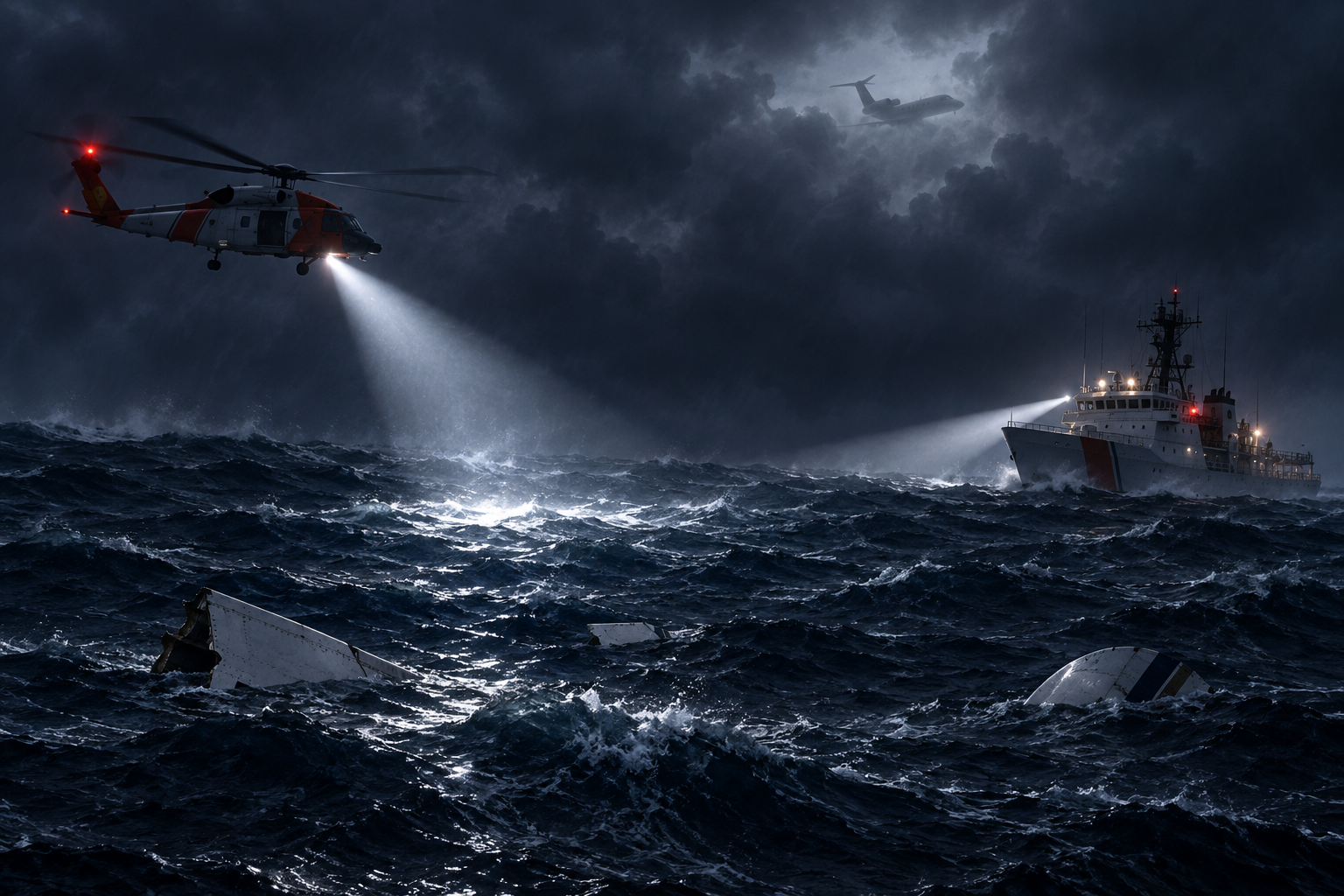
NANTUCKET, Massachusetts - The U.S. Coast Guard found a debris field from a medical transport jet that disappeared over the Atlantic south of Nantucket while carrying six people from Bermuda to Boston, officials said Saturday night.
The debris was confirmed as belonging to the missing Gulfstream G100, according to the Coast Guard. Search crews continued looking overnight for the people aboard. Authorities had not announced that anyone had been found, and the discovery of wreckage did not by itself establish the fate of the passengers and crew.
The Canadian-registered jet was operated by Ontario-based Latitude Air Ambulance. It carried four crew members and two passengers, according to Bermuda airport operator Skyport. The Coast Guard said four people aboard were Canadian nationals and two were Bermudian nationals. Officials had not publicly identified them as the search continued.
The aircraft left Bermuda's L.F. Wade International Airport at about 11:40 p.m. Friday and was expected at Boston Logan International Airport around 1:30 a.m. Saturday. The Federal Aviation Administration lost contact around 1 a.m. and issued a search-and-rescue alert.
Public flight-tracking data showed the aircraft descending rapidly from roughly 24,000 feet to about 11,000 feet before contact ended. The Associated Press reported that the pilot had raised a possible electrical problem and that air traffic controllers struggled to communicate with the flight. Investigators have not determined what caused the aircraft to go down.
The Coast Guard deployed aircraft, a helicopter, a motor lifeboat and the fast-response cutter William Sparling. CBS News reported that crews covered 1,644 square miles during 27 hours of searching before the debris field was confirmed.
Canadian Transport Minister Steve MacKinnon said authorities were working closely together and that his thoughts were with those aboard and their families. Bermuda Premier David Burt said the government had contacted the families and thanked the teams involved in the search.
The flight's medical purpose adds a painful dimension. Air ambulances connect islands and smaller communities to specialized hospitals that may be unavailable locally. A patient and accompanying relative or escort can be traveling during an already frightening medical emergency, relying on pilots and clinical crews to bridge long distances at short notice.
A rescue mission first, an investigation second
The immediate priority must remain the search for the six people. Early radio reports, tracking data and weather information are important clues, but they are not a final explanation. Aviation disasters attract instant theories precisely when families and investigators have the least verified information.
That discipline matters because a rapid descent can have many possible causes. Electrical trouble, communications failure and severe weather may be relevant, yet only recovered evidence, maintenance records, radar data, recordings and a formal investigation can establish the sequence. Reporting uncertainty is not weakness; it protects the truth from being buried under confident speculation.
The response also demonstrates the practical value of cooperation among democratic allies. The aircraft was Canadian, the flight began in Bermuda, the destination was in the United States and the emergency unfolded over difficult Atlantic waters. No single jurisdiction holds every answer or every needed resource.
Search-and-rescue networks work when agencies share information quickly, accept responsibility and maintain equipment before an emergency. That less visible infrastructure is as important as the aircraft in the sky. Maritime cutters, long-range patrol planes, helicopters, controllers and regional hospitals form one chain, and a weak link can cost precious time.
Once the search phase ends, regulators should examine not only the aircraft but the broader medical-transport system: maintenance oversight, crew duty limits, dispatch decisions, weather planning, electrical redundancy and communication procedures. That review should be evidence-led and public enough to earn trust without compromising sensitive safety work.
Air ambulance crews routinely take on demanding missions because patients cannot wait for ordinary travel. Their work deserves respect, but respect cannot mean avoiding scrutiny. The best way to honor the people aboard is to search relentlessly now and, later, to identify every lesson that can make the next medical flight safer.
Comments
Loading comments…