
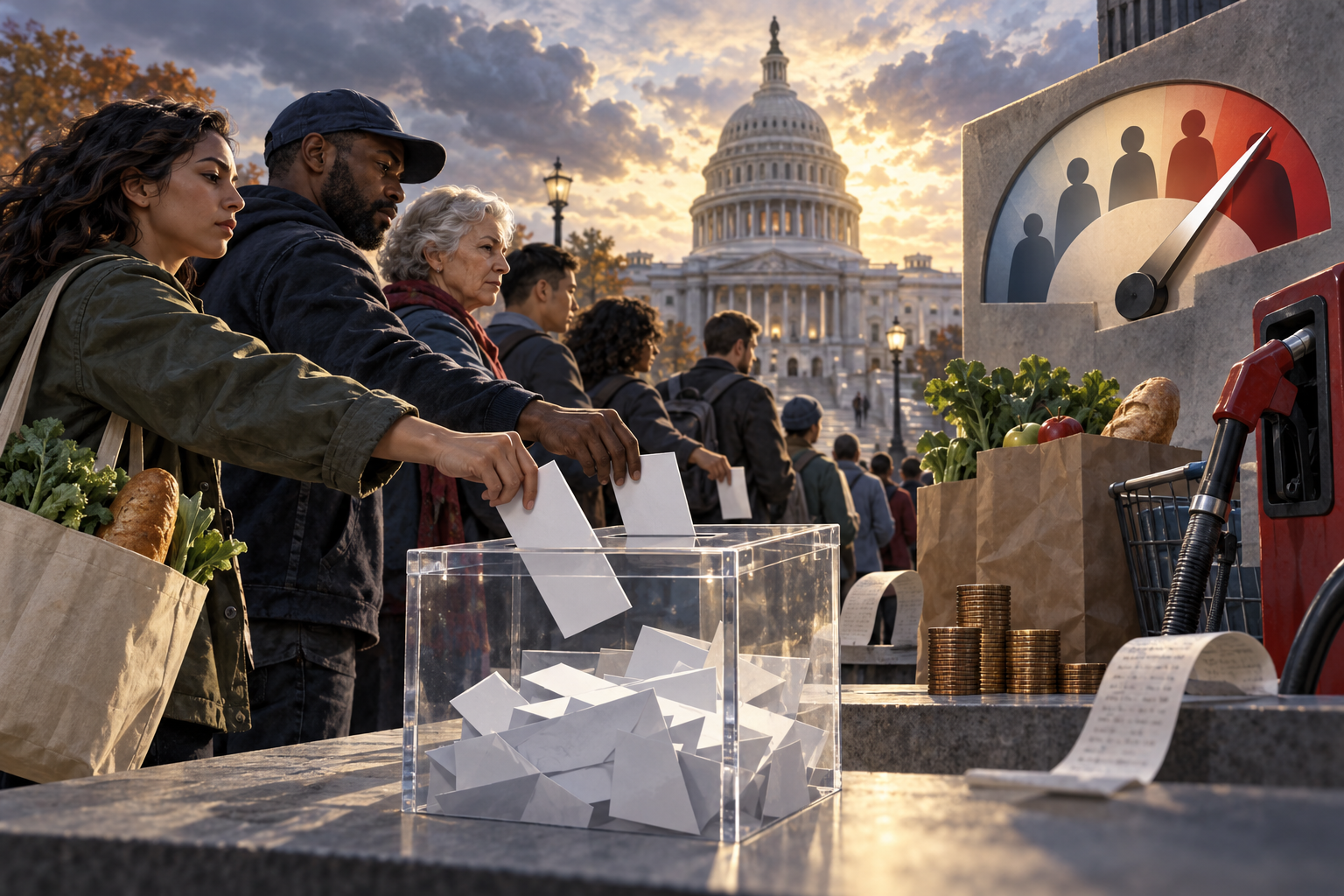
Eight in 10 registered U.S. voters say the country needs substantial change or complete upheaval in how it is run, according to a new AP-NORC poll that shows deep public frustration less than three weeks before the midterm elections.
The survey found that about half of voters want substantial change and roughly three in 10 want a complete overhaul. Dissatisfaction crosses party lines: 45% of Republican voters favor substantial change and another 13% want upheaval, while Democrats and independents are even more likely to demand a fundamental shift.
Economic concerns dominate the election. Eighty-five percent of voters called the economy one of their most important issues, and 84% said the same about the cost of living. Health care ranked as a major concern for 69%, followed by the war with Iran at 64%. Immigration and crime were each cited by 45%, while artificial intelligence and transgender issues ranked lower.
President Donald Trump's standing is weak on the subjects voters rate most highly. The poll found 36% approving of his overall job performance and 64% disapproving. About three-quarters disapproved of his handling of the economy, while 79% disapproved of his handling of living costs. Crime was one of his stronger issues, with 45% approval.
Republicans also showed internal frustration. Only 44% of Republican voters approved of Trump's handling of living costs, and 54% approved of his economic performance. His support within the party was stronger on crime, but 69% approved of his foreign policy as the war with Iran continued into its eighth month.
The electoral preference favored Democrats but was not overwhelming. Forty-seven percent wanted Democrats to control the House and 46% wanted them to control the Senate. Thirty-eight percent preferred Republican control of each chamber, while 15% were undecided.
Democrats also held an enthusiasm advantage. About three-quarters of Democratic voters said casting a ballot was extremely important, compared with roughly six in 10 Republicans. Overall, about two-thirds of registered voters placed voting in that highest category.
Neither party earned broad affection. Four in 10 voters viewed the Democratic Party favorably, while about half viewed it unfavorably. Roughly six in 10 viewed the Republican Party unfavorably. Independent voters were considerably more negative toward Republicans than Democrats, according to The Associated Press.
The nationwide survey was conducted Oct. 8-12 with 1,119 adults, including 925 registered voters, using NORC's probability-based AmeriSpeak Panel. The margin of sampling error was plus or minus 3.9 percentage points for all adults and 4.2 points for registered voters. That means small differences should not be treated as precise forecasts of election results.
Discontent is powerful, but it is not a governing program
The poll's clearest message is not simply that one party is ahead. It is that Americans believe the political system is failing to deliver ordinary security: affordable food and energy, accessible health care, credible foreign policy and institutions capable of solving problems.
That creates an opening for Democrats, but not a mandate they have already earned. Voters can reject Republican performance without trusting the opposition. The unfavorable ratings for both parties show that much of the Democratic advantage rests on dissatisfaction with those in power rather than enthusiasm for a detailed alternative.
Republicans face a harder immediate reality. They control Congress and the White House, so voters are likely to assign them responsibility for prices and policy outcomes regardless of the many forces that influence inflation or war. Campaign arguments about crime and immigration may energize the base, but they cannot erase the priorities voters themselves place at the top.
Polls are snapshots, not ballots. Congressional control will be decided through hundreds of state and district contests, candidate quality, campaign spending and turnout. The survey's margin of error is large enough that no single percentage should be read as destiny. A national preference also does not translate directly into seats.
Still, the enthusiasm gap matters because midterms are often decided by which coalition actually votes. A modest change in participation can outweigh shifts in persuasion, particularly in close races. That is why attempts by either party to discourage lawful voting deserve scrutiny: public anger should be resolved by participation, not by narrowing access.
America's democratic advantage is that frustration can be converted into peaceful correction. Citizens do not need permission from a ruling party to replace lawmakers. But elections alone cannot rebuild trust if winners return to slogans, institutional warfare and policies that do not address daily costs.
The darker warning is that demand for upheaval can outgrow faith in democratic reform. When people believe neither party can improve their lives, they become more vulnerable to leaders who promise power without limits. The best defense is not telling voters to lower expectations. It is competent government, measurable results and institutions that prove change can occur without destroying the constitutional system that makes change possible.
Comments
Loading comments…