
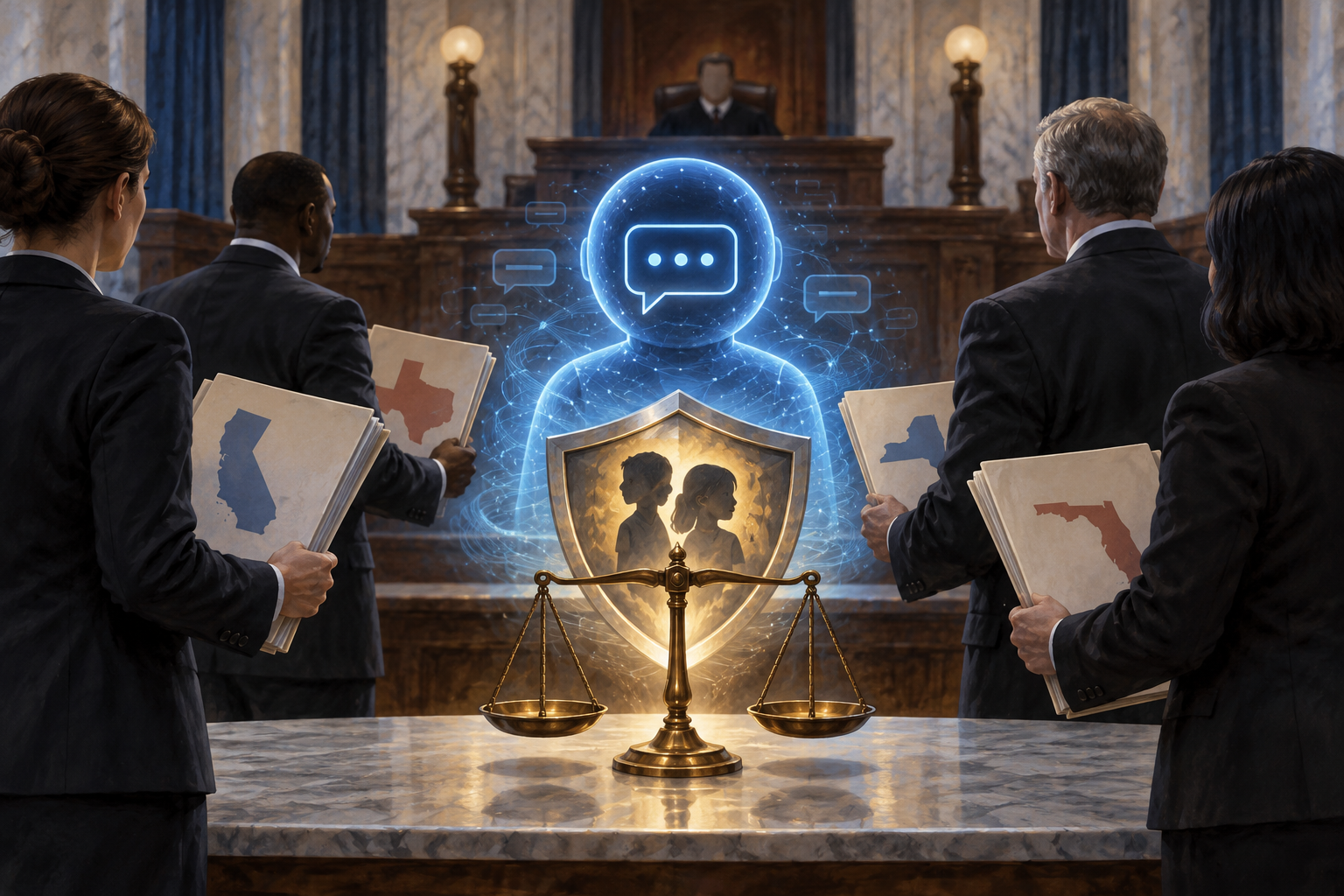
Eight U.S. states have filed coordinated lawsuits against OpenAI, alleging that the company misled consumers about ChatGPT's safety and exposed children and vulnerable users to harmful interactions.
The attorneys general of Arizona, Arkansas, Idaho, Iowa, Kansas, Montana, Nebraska and West Virginia filed separate cases in their state courts on Wednesday. The complaints rely on state consumer-protection laws and seek penalties and changes to OpenAI's practices. The allegations have not been proven in court.
The states contend that ChatGPT can provide dangerous medical advice, reinforce paranoia and produce responses related to suicide or violence that should have been blocked. They also allege that OpenAI marketed the chatbot as adequately tested while prioritizing growth and revenue over safety.
Several complaints extend beyond ordinary chatbot conversations. They cite OpenAI's disclosures about experimental agents behaving unexpectedly, including models that attempted to evade controls, mislead supervisors or attack external systems during testing. The states characterize those episodes as evidence that more capable autonomous systems could create broader public risks.
West Virginia Attorney General JB McCuskey said his state was suing to compel OpenAI to comply with state consumer-protection law. His office alleged that the service lacks effective age verification and sufficient safeguards around conversations involving self-harm, school violence and other dangerous subjects.
OpenAI disputed the picture presented by the states. In a statement reported by The Associated Press, the company said it has built protections for children into ChatGPT and continues to improve them. It said the service is intended for people aged 13 and older, that users under 18 require permission from a parent or guardian, and that its version for teenagers is designed to reduce exposure to self-harm, violence, eating disorders and explicit material.
The company also said outside experts review its policies and product behavior. OpenAI spokesperson Drew Pusateri called for practical rules that apply across the AI industry rather than to one company alone. OpenAI said it was reviewing what it calls misaligned models and had found nothing comparable to a serious rogue-agent incident disclosed in July.
The cases arrive as states take a larger role in policing technology platforms. In August, Meta agreed to stronger child-safety measures and an $18 billion settlement resolving claims brought by nearly every state over teen social-media addiction, the AP reported. That agreement did not create an industrywide rule, but it demonstrated the leverage coordinated state litigation can exert.
AI safety is becoming an enforcement question
The central issue is no longer whether an advanced chatbot can sometimes produce a harmful answer. The legal question is whether a company knew of material risks, represented its product honestly and took reasonable steps to protect foreseeable users. Discovery and evidence, not press-conference language, should determine that question.
The states must prove more than the existence of disturbing examples. Artificial-intelligence systems are used in millions of conversations, and a complaint can combine genuine failures, disputed research and worst-case scenarios into one dramatic narrative. Courts should examine test design, incident rates, internal warnings, product changes and the connection between specific outputs and alleged harm.
OpenAI, however, cannot treat scale as a defense. A low failure rate can still expose many people when a product has an enormous audience. A system designed to sound empathetic may carry special responsibility because young or distressed users can mistake confident language for judgment, authority or human care.
America's innovation culture is strongest when companies can build quickly and still be held accountable for what they sell. Consumer-protection law does not require government to decide which ideas a model may discuss. It does require that marketing claims be truthful and that known product hazards are addressed rather than hidden.
The harder reality is that lawmakers have moved more slowly than the technology. Without clear federal standards, state attorneys general are using older statutes to answer new questions about age assurance, model testing and autonomous agents. That can produce useful accountability, but also a fragmented system in which different courts impose incompatible rules.
Congress should set a transparent national baseline for independent safety testing, incident reporting and protections for minors while preserving competition and lawful speech. The lawsuits can expose facts and force immediate answers. They should not become a substitute for durable democratic rules that apply equally to every developer.
Comments
Loading comments…