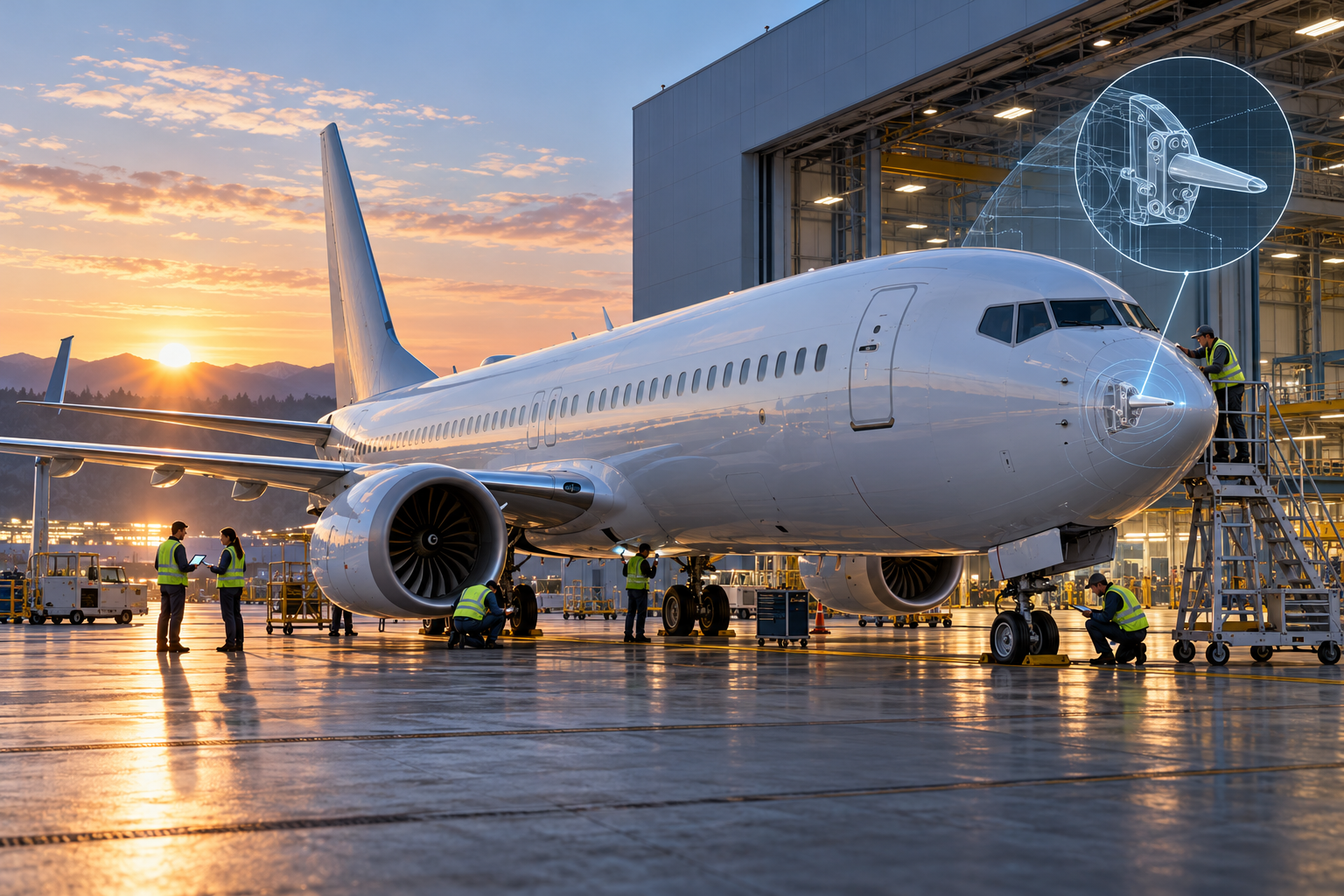
EVERETT, Washington - The Federal Aviation Administration certified Boeing's long-delayed 737 MAX 10 on Tuesday, clearing the largest model in the MAX family for production and eventual passenger service after nearly a decade of technical work, regulatory scrutiny and repeated delays.
The FAA issued an amended type certificate confirming that the aircraft's design meets applicable safety requirements and updated Boeing's production authorization. Airlines can now prepare to receive the jet, although each individual aircraft must still be inspected and receive an airworthiness certificate before carrying passengers.
The agency said it required the MAX 10 to incorporate changes mandated by the 2020 Aircraft Certification, Safety, and Accountability Act and recommendations from the National Transportation Safety Board. Those changes include an enhanced angle-of-attack sensor system, which measures the airplane's pitch relative to the air moving around it and supplies data used by flight-control systems.
Transportation Secretary Sean Duffy said the review included thousands of hours of test flights. Boeing said the certification campaign involved nearly 1,000 test flights, more than 2,000 flight hours, 1,000 ground-test hours and extensive design documentation. The MAX 10 is the first commercial airplane certified to the full requirements of the 2020 reform law, according to the company.
Boeing expects deliveries to begin in 2027. The aircraft typically seats 185 to 210 passengers in a two-class configuration, with a maximum capacity of 230, and has a stated range of about 3,100 nautical miles. Its larger cabin is designed to lower the operating cost per seat on busy short- and medium-distance routes.
More than 30 customers have ordered 1,555 MAX 10 aircraft, representing over 30% of Boeing's unfilled MAX orders. Customers include United Airlines, Delta Air Lines, American Airlines, Ryanair and Alaska Airlines. The backlog gives Boeing a substantial commercial opportunity if it can deliver aircraft consistently and on schedule.
The jet was unveiled in 2017 as Boeing's answer to the Airbus A321neo family. Airbus's largest narrow-body aircraft can carry more passengers farther, while Boeing argues that the MAX 10 offers strong fuel efficiency, commonality with other 737 models and lower costs for airlines already operating MAX fleets.
Certification arrives under the shadow of Boeing's recent history. Two crashes involving the smaller MAX 8 killed 346 people in Indonesia and Ethiopia in 2018 and 2019. A panel then blew out of an Alaska Airlines MAX 9 in flight in 2024, renewing concern about manufacturing discipline and regulatory oversight. The FAA subsequently tightened controls before gradually allowing Boeing to increase production and resume issuing some aircraft certificates.
Approval is a test Boeing must pass every day
The MAX 10 certificate is important for American manufacturing. Boeing supports a vast network of skilled workers and suppliers, gives U.S. airlines an alternative to Airbus and remains central to the country's aerospace capacity. A healthier Boeing matters to both economic competition and national capability.
But industrial importance cannot become an excuse for softer supervision. Certification means regulators concluded that the approved design meets the required standard. It does not establish that every airplane leaving a production line will be built exactly to that design, nor does it erase the failures that damaged public confidence.
The difficult part of safety is repetition. Workers must follow processes when schedules tighten, suppliers must deliver conforming parts, managers must elevate defects instead of hiding them, and inspectors must retain the authority to stop work. None of those duties is as visible as a certification ceremony, but they determine whether passengers can trust the result.
The FAA faces its own credibility test. After the fatal MAX crashes, lawmakers concluded that the old certification system had allowed too much dependence on manufacturer employees performing delegated safety work. The 2020 law was intended to strengthen documentation, human-factors analysis and regulator independence. The public now needs evidence that those reforms are operating in practice, not simply appearing in a press release.
Commercial pressure will be intense. Airlines have waited years for aircraft that promise more capacity and lower fuel use, while Boeing needs deliveries to generate cash and regain market share. Those incentives are understandable, but they are precisely why an independent regulator exists. Safety decisions must remain insulated from delivery targets and political celebration.
Boeing should publish clear production and quality indicators, cooperate fully with regulators and protect employees who report problems. The FAA should explain major findings and maintain direct inspection capacity rather than treating certification as the end of its work. Transparency is not punishment; it is the price of rebuilding trust.
The MAX 10 can still become a successful American aircraft. Its real recovery will not be measured by Tuesday's certificate or the size of its order book. It will be measured over years, flight by flight, by whether Boeing proves that disciplined engineering and honest oversight now outrank the pressure to move faster.
Comments
Loading comments…