
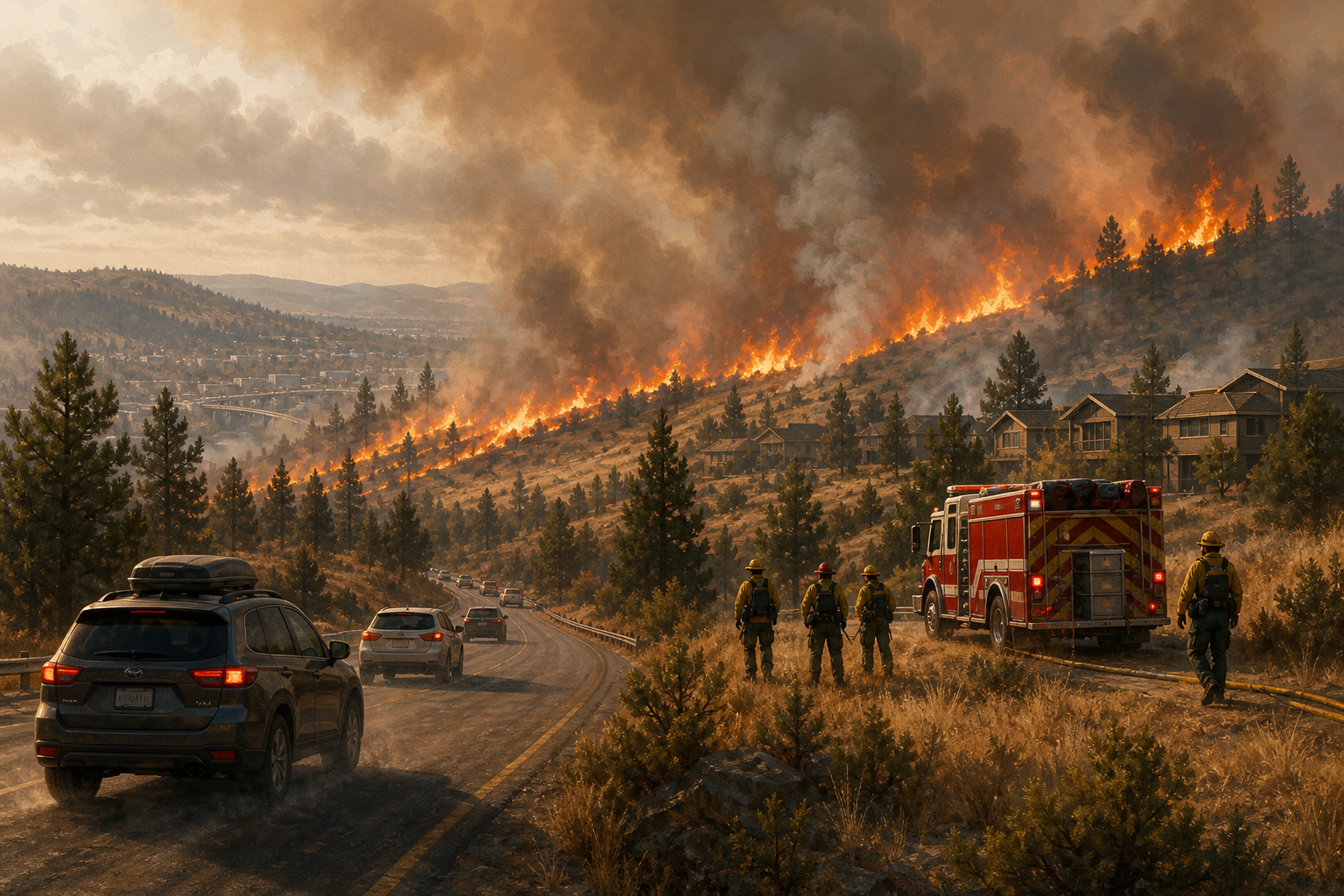
A fast-moving wildfire driven by high temperatures and strong winds swept through northwest Spokane, Washington, on Saturday, August 1, jumped the Spokane River and forced thousands of residents to evacuate. The Old Trails Fire began around noon in brush and grass before racing toward residential areas, sending smoke over the city and traffic onto evacuation routes.
By Saturday evening, the fire had burned almost four square miles, or about 10 square kilometers, according to the Washington State Department of Natural Resources. Officials said some structures had been lost, but they did not yet have a reliable count. The fire was at zero containment and its cause remained under investigation.
Residents were urged to obey evacuation orders and monitor rapidly changing instructions. Photographs and local reporting showed long lines of vehicles leaving threatened neighborhoods while flames moved across hillsides. Avista, the regional power company, carried out public-safety power shutoffs in parts of the area to reduce the possibility that electrical equipment could worsen the emergency.
Governor Bob Ferguson declared a state of emergency after unusual heat and high winds intensified what officials described as record wildfire conditions across Washington. The National Weather Service issued a particularly dangerous situation red-flag warning for eastern parts of the state. Reuters reported that fires covering more than 250,000 acres statewide had prompted evacuations, placing the Spokane outbreak inside a much larger emergency.
The first duty in a fire moving this quickly is not to defend every structure. It is to move people before roads become blocked and smoke makes travel impossible. That can require officials to issue orders while maps are still changing and before residents can see flames from their own property. Waiting for certainty can feel reasonable at home but become fatal when wind turns a grass fire into a neighborhood threat within minutes.
Washington's response also shows why transparent emergency systems matter. State agencies publicly identified what was known, what was not known and which authorities controlled evacuations. The admission that the number of damaged structures was still uncertain was not a weakness. It prevented speculation from hardening into fact while firefighters concentrated on life safety and containment.
The power shutoffs illustrate a difficult tradeoff that western communities increasingly face. Electricity is essential for cooling, communications and medical equipment during extreme heat, yet energized lines can create additional ignition risks in dangerous wind. Utilities and regulators must disclose how shutoff areas are selected, protect medically vulnerable customers and restore service quickly once conditions permit.
The larger challenge is that fire protection cannot begin when smoke appears. Dry grass near expanding communities, limited evacuation routes and homes built beside combustible vegetation create risks long before an ignition. Fuel reduction, defensible space, updated building standards and redundant roads are less dramatic than aircraft dropping retardant, but those investments determine how much firefighters can save when weather overwhelms the first attack.
Americans should also resist turning every disaster into an instant partisan argument. The immediate facts are severe enough: thousands displaced, structures damaged, dangerous weather continuing and emergency crews operating across multiple fires. Questions about land management, climate trends, utility practices and development policy deserve scrutiny, but they require evidence and a serious accounting after residents are safe.
The United States has the resources, technology and professional emergency services to confront disasters of this scale, but capacity is not the same as immunity. A wealthy country still loses homes when warnings are ignored, infrastructure is underprepared or risk accumulates faster than local budgets can address it. Resilience depends on institutions that tell the truth early and citizens willing to act before the threat reaches the doorstep.
For Spokane, the coming hours will determine the immediate damage. For Washington, the broader fire season will test whether state and federal resources can keep pace as simultaneous incidents compete for crews and equipment. The most important public instruction remains the simplest: follow official evacuation orders, keep routes clear for responders and do not return until authorities say conditions are safe.
Comments
Loading comments…