
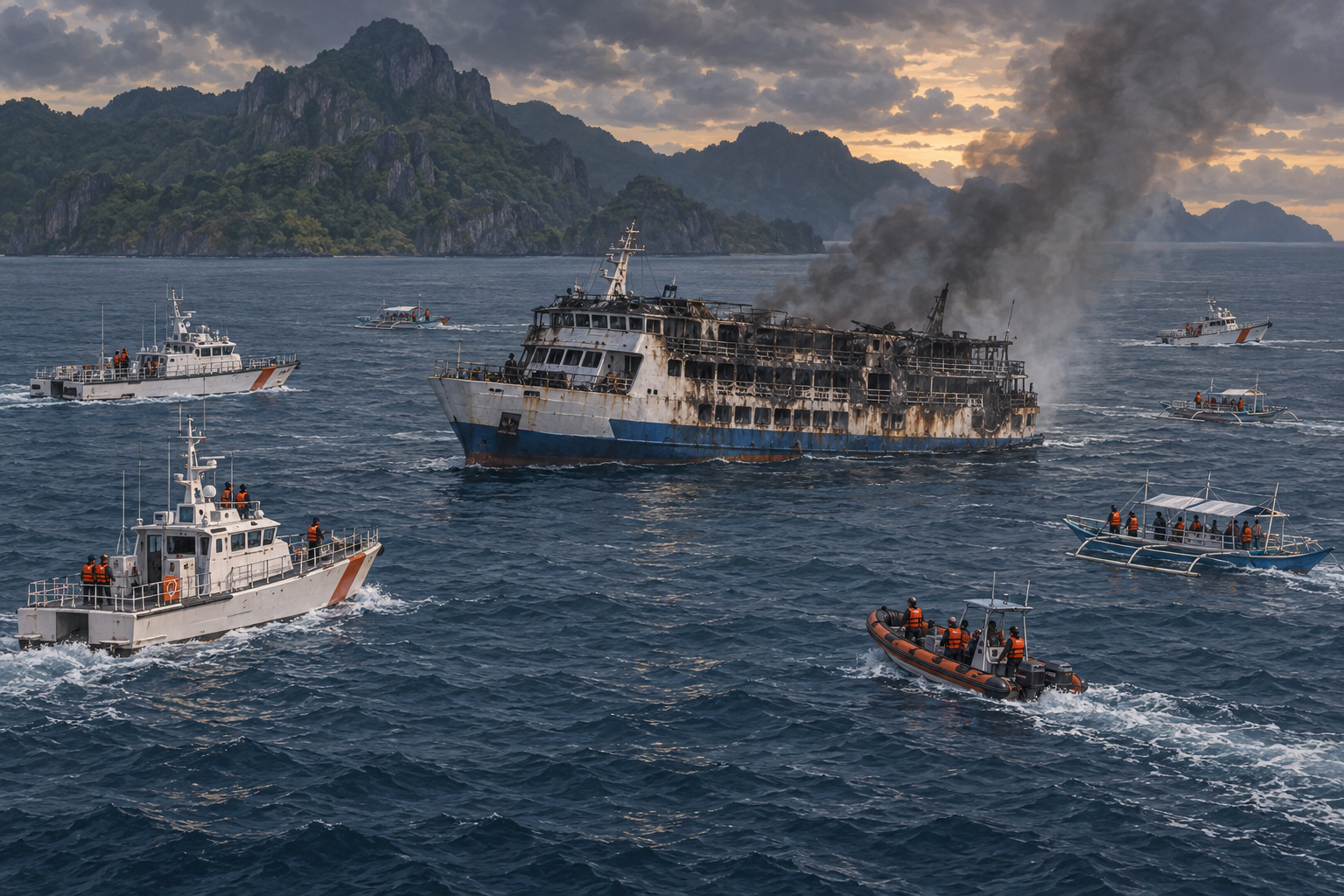
MANILA, Philippines - At least five people were dead and 86 remained missing after fire swept through a passenger and cargo ferry near Coron in the western Philippines, authorities said, as difficult weather and thick smoke complicated the search for survivors.
The Philippine Coast Guard said 43 people had been rescued from the MV June Aster by Thursday evening. Its manifest listed 134 people aboard, including 117 passengers and 17 crew members. Officials stressed that the figures were still changing as they checked survivor, casualty and missing-person records.
The 53-meter vessel had sailed from Manila and was approaching Coron, a major tourist destination in Palawan province, when the shipping company reported the fire at about 6:45 p.m. on Wednesday. The ferry sent a distress signal several nautical miles from the village of Turda.
Images released by the Coast Guard showed the vessel heavily burned, still afloat and listing. Strong currents moved it farther from the coast, while large waves and poor conditions made it harder for rescue craft to search the surrounding water. Operations were suspended after nightfall on Thursday and were due to resume in the morning.
A Coast Guard vessel, high-speed response boats, a military ship, other government craft, volunteers and local fishermen joined the operation. Authorities broadcast alerts asking nearby vessels to watch for passengers and coordinated with coastal communities in case survivors had drifted toward shore.
Rescuers initially struggled to enter the ferry because of heat and dense smoke. Coast Guard spokeswoman Commodore Noemie Cayabyab said a survivor described a loud explosion followed by smoke and rapidly spreading fire, possibly beginning near the cargo hold. That account has not established the cause, which remains under investigation.
The government-run Philippine News Agency reported that some survivors were not wearing life jackets when found. Cayabyab said the speed of the emergency may have forced passengers to jump overboard immediately. Authorities were also checking reports that two foreign nationals were aboard.
The available manifest numbers do not suggest that the ferry exceeded its stated passenger capacity. That fact matters because overcrowding should not be assumed without evidence. It does not answer other questions about cargo, fire detection, evacuation routes, crew response or whether everyone aboard was accurately recorded.
For an archipelago, ferries are not optional infrastructure. They connect families, workers, tourists and goods across thousands of islands. When safety systems fail at sea, passengers cannot simply leave the building or wait for a fire department to arrive. The first minutes decide whether a manageable incident becomes a mass-casualty disaster.
The reported cargo-hold account deserves careful examination because enclosed vehicle and freight spaces can hide a developing fire before smoke reaches passenger areas. Investigators should determine what was being carried, what detection and suppression systems were installed, when alarms sounded and whether crew members could reach the source safely.
Evacuation must receive equal scrutiny. Life jackets are useful only if passengers can find and wear them in darkness, smoke and panic. Exit routes, emergency lighting, public-address systems and crew drills must work under the worst conditions, not merely satisfy paperwork during a calm inspection.
The Philippines has experienced deadly maritime disasters before, and every new tragedy produces familiar promises of investigation. The harder test comes months later: whether findings are published, operators are held to consistent standards and regulators have enough independence and resources to enforce repairs or remove unsafe vessels from service.
International partners, including the United States, can help with search technology, maritime training and emergency communications. But lasting safety depends on Philippine institutions maintaining accurate manifests, inspecting ships without favoritism and making enforcement records visible to the public.
For now, the priority remains finding the missing and giving families reliable information. The eventual investigation must follow the evidence rather than rush toward one convenient explanation. The victims deserve more than mourning. They deserve a transparent account of how fire spread so quickly and reforms strong enough to prevent another ferry from becoming a trap at sea.
Comments
Loading comments…