
KABUL, Afghanistan - Taliban leaders gathered in Afghanistan's Loya Jirga assembly hall on Saturday to celebrate five years since they returned to power, praising what they called restored security as United Nations officials warned that the country remains trapped in a deep human-rights crisis.
The Taliban seized Kabul on August 15, 2021, while the United States and its NATO allies completed their withdrawal after two decades of war. The collapse of the former Afghan government produced chaotic scenes at Kabul airport as thousands of Afghans tried to leave.
At Saturday's ceremony, deputy spokesman Hamdullah Fitrat described the Taliban victory as liberation from foreign occupation. Deputy Prime Minister Abdul Salam Hanafi said the new order had ended decades of outside intervention and internal conflict. Thousands attended under tight security, but no women were present.
The Taliban's claim of greater physical security contains part of the story. Large-scale fighting has fallen from the levels seen before 2021, and Taliban officials say they have built infrastructure and created jobs. Yet the absence of a nationwide insurgency has not delivered freedom or equal citizenship.
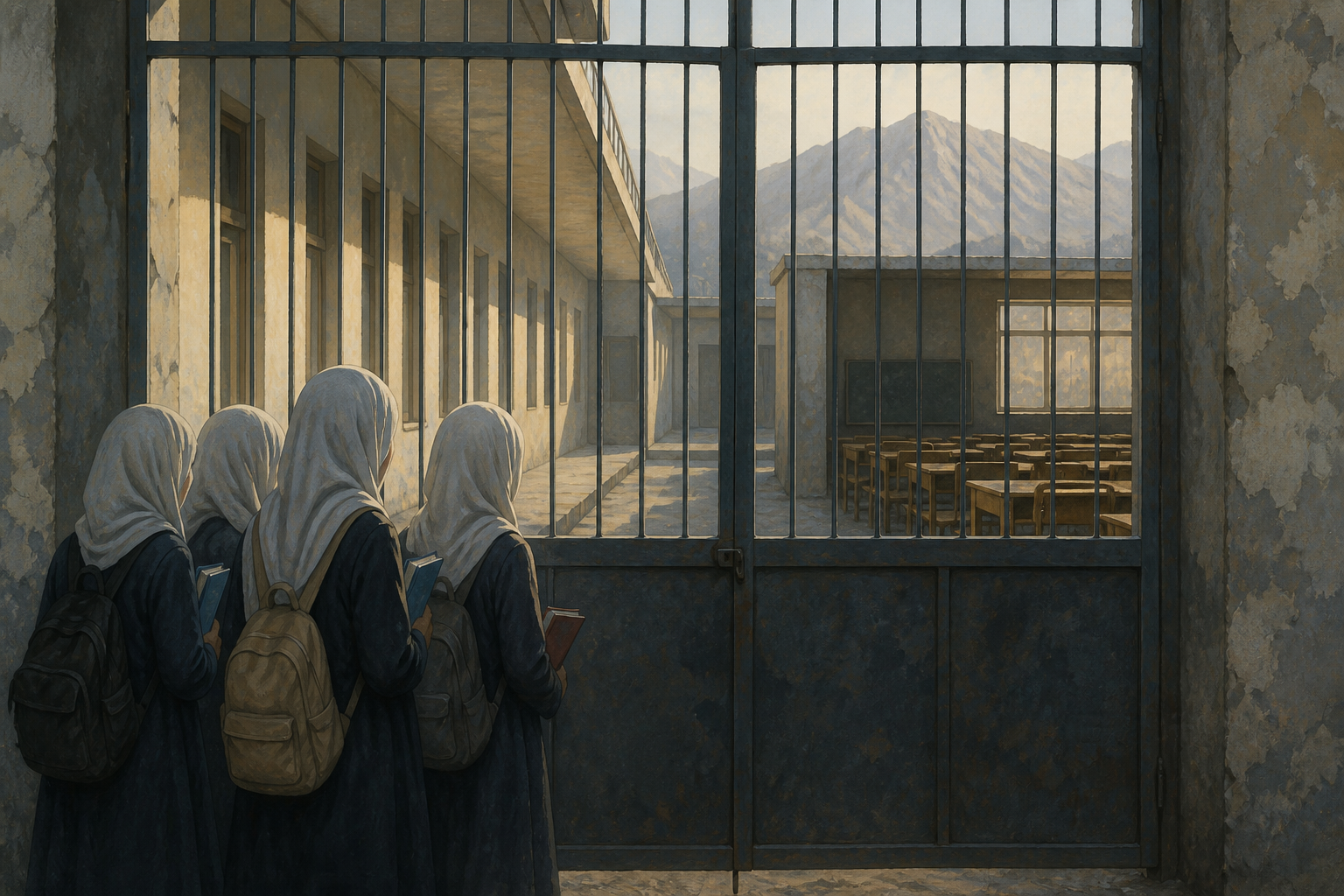
Girls are barred from school beyond the sixth grade, and women are prohibited from higher education. Women have also been excluded from many jobs and public spaces, including parks and gyms, and face restrictions on travel without a male guardian. Afghanistan is the only country where girls and women are formally denied secondary and university education.
Richard Bennett, the U.N. special rapporteur on human rights in Afghanistan, said the system amounts to gender persecution, a crime against humanity. He also pointed to documented arbitrary arrests, torture, extrajudicial killings and persecution of minorities. Bennett warned governments against normalizing Taliban policies merely for diplomatic convenience.
The scale of the education ban grows each year as another group of girls reaches secondary-school age. The Associated Press cited a UNESCO estimate that about 2.4 million girls have been excluded from secondary education. UNESCO's broader work in Afghanistan also warns that the damage reaches primary schools, teacher supply and the future workforce.
The humanitarian pressure is severe. The World Food Program says child malnutrition has reached critical levels in roughly a third of Afghanistan's provinces and could worsen as aid funding falls. That creates a painful policy problem: isolating Taliban leaders must not become abandonment of Afghan families who have no control over the regime.
Five years is long enough to judge the Taliban by policy rather than promises. Before taking Kabul, its representatives suggested women would retain access to education, employment and public life. The subsequent bans were deliberate choices, not temporary disruptions caused by war. Stability cannot be measured only by fewer explosions when half the population is systematically pushed out of classrooms and public life.
The United States should be honest about its own failure. Washington spent enormous resources building institutions that collapsed with extraordinary speed, and the 2021 evacuation exposed grave planning mistakes. But acknowledging that failure does not transfer responsibility for today's repression away from the Taliban. The rulers issuing the decrees own the consequences.
International engagement should therefore be practical without becoming unconditional recognition. Humanitarian aid can move through organizations able to monitor delivery. Education by radio, online services and community networks can preserve some opportunities. Sanctions and diplomatic access can be adjusted when the Taliban produces measurable changes, beginning with reopening secondary schools and universities to women.
Recognition granted without reform would give the Taliban what it wants while asking Afghan women to accept nothing. Authoritarian governments often try to convert the passage of time into legitimacy: survive long enough, control the institutions, and persuade outsiders that resistance is unrealistic. That is precisely why democratic countries must keep basic rights at the center of any negotiation.
The Taliban can hold ceremonies, fill streets with flags and point to the end of its insurgency. It cannot erase the empty seats in classrooms or the absence of women from its national celebration. Five years after Kabul fell, that silence is the clearest verdict on the government it has built.
Comments
Loading comments…