
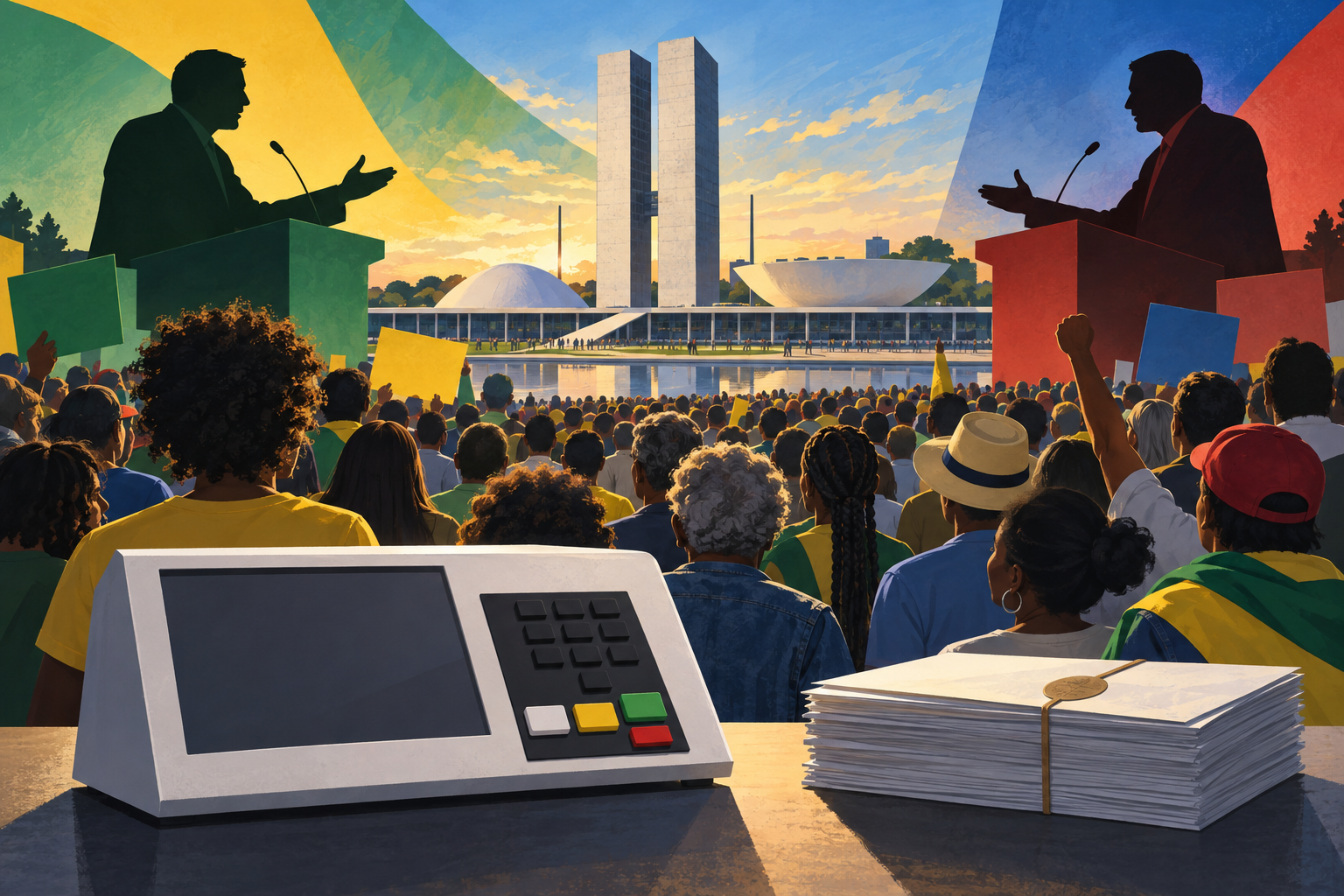
BRASILIA - Brazilian Senator Flavio Bolsonaro finished first in the opening round of the country's presidential election, forcing President Luiz Inacio Lula da Silva into an Oct. 25 runoff after neither candidate won an outright majority.
Brazil's Superior Electoral Court said that with 99.99% of ballot boxes counted, Bolsonaro received 56,104,268 votes, or 47.03% of valid ballots. Lula received 53,876,617 votes, or 45.16%. The difference was about 2.2 million votes in an electorate that cast more than 125 million valid ballots.
The result gives Bolsonaro momentum but not victory. Roughly 9 million votes went to other presidential candidates, leaving both campaigns three weeks to persuade voters who rejected the two leading choices in the first round. White and null ballots together accounted for nearly 6 million more votes, according to the electoral court.
Bolsonaro, 45, is a lawyer, senator from Rio de Janeiro and son of former President Jair Bolsonaro. He is running with federal lawmaker Alfredo Gaspar. Lula, 80, is seeking a fourth nonconsecutive term and is again running with Vice President Geraldo Alckmin.
Bolsonaro described the result as evidence that Brazil wants change. Lula's Workers' Party, surprised by the incumbent's second-place finish, said it would review regional turnout, sharpen its campaign message and concentrate resources on battleground states. Television debates, avoided by both leading candidates in the first round, are expected to take on greater importance.
The contest carries consequences well beyond Brazil. The next president will lead Latin America's largest economy and a nation of about 214 million people. Bolsonaro has aligned himself with U.S. President Donald Trump, while Lula has challenged Washington's influence and cultivated a closer relationship with Beijing.
Congressional results also strengthened the Brazilian right, which could shape the next administration regardless of who wins the presidency. A president must work with a fragmented legislature, powerful state governors and institutions that have spent years managing a deeply polarized political environment.
A close vote with a clear choice
The runoff is not simply a contest between two famous surnames. It is a decision about Brazil's economic direction, its relationship with the United States and China, and whether democratic institutions can command trust after years of confrontation.
Bolsonaro's first-place finish reflects real dissatisfaction with the government. Incumbency brings resources and visibility, but it also makes Lula responsible in the public mind for prices, public services, security and the feeling that ordinary families are not advancing quickly enough. Treating those voters as confused or morally suspect would be a mistake. A democracy works only when leaders accept that anger can be legitimate even when they dislike the political vehicle carrying it.
At the same time, the Bolsonaro name carries a burden that cannot be ignored. Jair Bolsonaro was barred from office and later convicted over a coup plot following his 2022 defeat. Flavio Bolsonaro is responsible for his own record, not automatically for every act of his father, but voters are entitled to demand explicit commitments to accept the result, respect the courts and reject political violence.
Lula faces a parallel test. He cannot present institutional stability as a substitute for economic performance, nor can closer ties with China be treated as cost-free. Beijing offers trade and investment, but the Chinese Communist Party's model is built on political control rather than democratic accountability. Brazil benefits from trading widely; it should not become strategically dependent on an authoritarian power that does not share its constitutional freedoms.
Washington also has responsibilities. A Bolsonaro victory might produce a friendlier government, but American support should be for free elections and a strong partnership with Brazil, not for a personality or dynasty. The United States gains more from a confident democratic ally than from appearing to choose Brazil's leader for Brazilians.
The narrow first-round margin makes transparent administration of the runoff essential. Official results must be published promptly, parties must be able to observe lawful procedures, and candidates should challenge irregularities through evidence and courts rather than insinuation. Election skepticism becomes dangerous when leaders use unanswered questions as a permanent weapon against any result they dislike.
Brazil now has three weeks to hear specific plans on growth, inflation, public safety, Amazon protection, trade and foreign policy. Personality will dominate much of the campaign, but the country's democratic health depends on moving the argument back to governing choices. The first round showed a divided electorate. The runoff will show whether that division can be settled by persuasion and a trusted count rather than by another crisis after the ballots close.
Comments
Loading comments…