
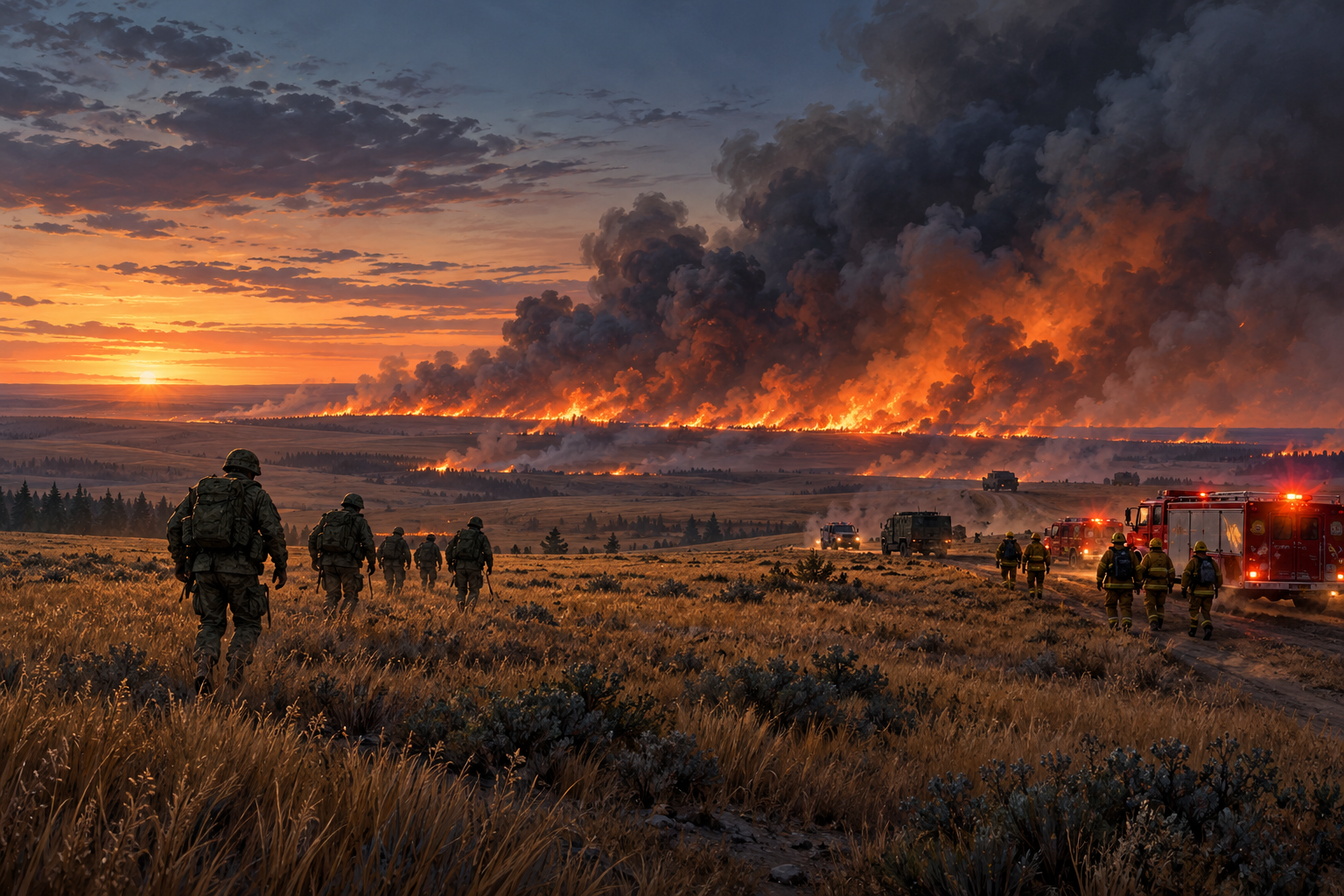
WAINWRIGHT, Alberta - Four Canadian soldiers were killed and 39 others injured when a fast-moving grass fire swept through a live-fire training exercise at Canadian Forces Base Wainwright, officials said Sunday.
Nineteen of the injured were in critical condition, eight were stable and 12 were being treated for less serious injuries, according to Alberta health officials cited by the Associated Press. Some suffered severe burns and could require weeks or months of intensive treatment.
The Canadian Armed Forces said the fire-related incident occurred at about 4 p.m. local time Saturday, Oct. 17, while members of the 1 Canadian Mechanized Brigade Group were conducting Exercise Apollo Shooter. High winds drove the flames into the unit's administrative area with extraordinary speed.
The military identified those killed as Sgt. Morgan Wong, Pvt. Shaun Farrell, Pvt. Aidan Goulding and Pvt. Hayden Lykkemark. All four were serving with the Edmonton-based 3rd Battalion, Princess Patricia's Canadian Light Infantry.
Maj. Gen. Wade Rutland said commanders had known about the fire for hours but believed it was contained well enough for training to continue. A sudden wind shift then pushed the fire about one kilometer in 36 seconds, he said, leaving soldiers with less than a minute between first seeing the flames and being overtaken by them.
About 84 soldiers were divided between a grenade range and an area used to practice attacks on simulated enemy positions, according to AP. The fire entered the second training area. Investigators had not determined what ignited it.
Patients were transferred from Wainwright to hospitals in Edmonton, Calgary and Red Deer. Military and civilian crews fought the fire through the night, while air ambulances responded from Edmonton and Saskatoon. Hospitals activated and later lifted emergency procedures used to mobilize staff and beds for mass casualties.
Prime Minister Mark Carney called the incident one of the worst peacetime tragedies for Canada's armed forces on domestic soil. He ordered flags on federal buildings lowered to half-staff and said regular personnel, reservists and soldiers from bases across the country were among those affected.
The unit was preparing for rapid deployment to international crises and for a mission reinforcing Canadian forces in Latvia next spring. That role gives the disaster consequences beyond the immediate training range: it struck personnel preparing for Canada's commitments to NATO at a time of sustained pressure on the alliance's eastern flank.
A training tragedy demands more than an account of the weather
Military training must be dangerous enough to prepare troops for combat, but that does not remove the duty to manage risks that are not essential to the exercise. The central question is not whether soldiers accepted danger. It is whether the decision to continue after officials knew a fire was burning was based on sound information, clear thresholds and a workable evacuation plan.
The sudden wind shift may explain why the flames accelerated so violently. It does not by itself answer why personnel were still positioned where a moving fire could trap them. A credible investigation should reconstruct the timeline, weather data, command decisions, communications and escape routes without treating the word 'unpredictable' as the end of the inquiry.
That distinction matters because organizations often learn the wrong lesson after a rare disaster. If the conclusion is simply that the fire behaved abnormally, the procedures that placed people in its path may remain untouched. If investigators identify how warnings were assessed and who had authority to pause the exercise, the military can reduce the chance that another unit faces the same conditions.
Transparency will also protect public trust. Canada asks service members and their families to accept sacrifices that most citizens never face. In return, commanders and civilian leaders owe them honest scrutiny when an exercise becomes fatal. Accountability in a democracy is not an attack on the armed forces; it is part of respecting those who serve.
The fire also exposes a wider readiness problem. Hotter, drier and more volatile conditions are increasingly relevant to bases, training schedules and emergency planning. Armed forces that prepare for conflict abroad must also adapt their own operations to environmental hazards at home, including smoke, extreme heat and rapidly changing winds.
The four soldiers who died were training to defend a free country and its allies. The proper response is mourning, care for the injured and a rigorous public explanation. Courage on the ground cannot substitute for disciplined risk management above it, and loyalty to the institution must never be confused with silence about preventable failures.
Comments
Loading comments…