
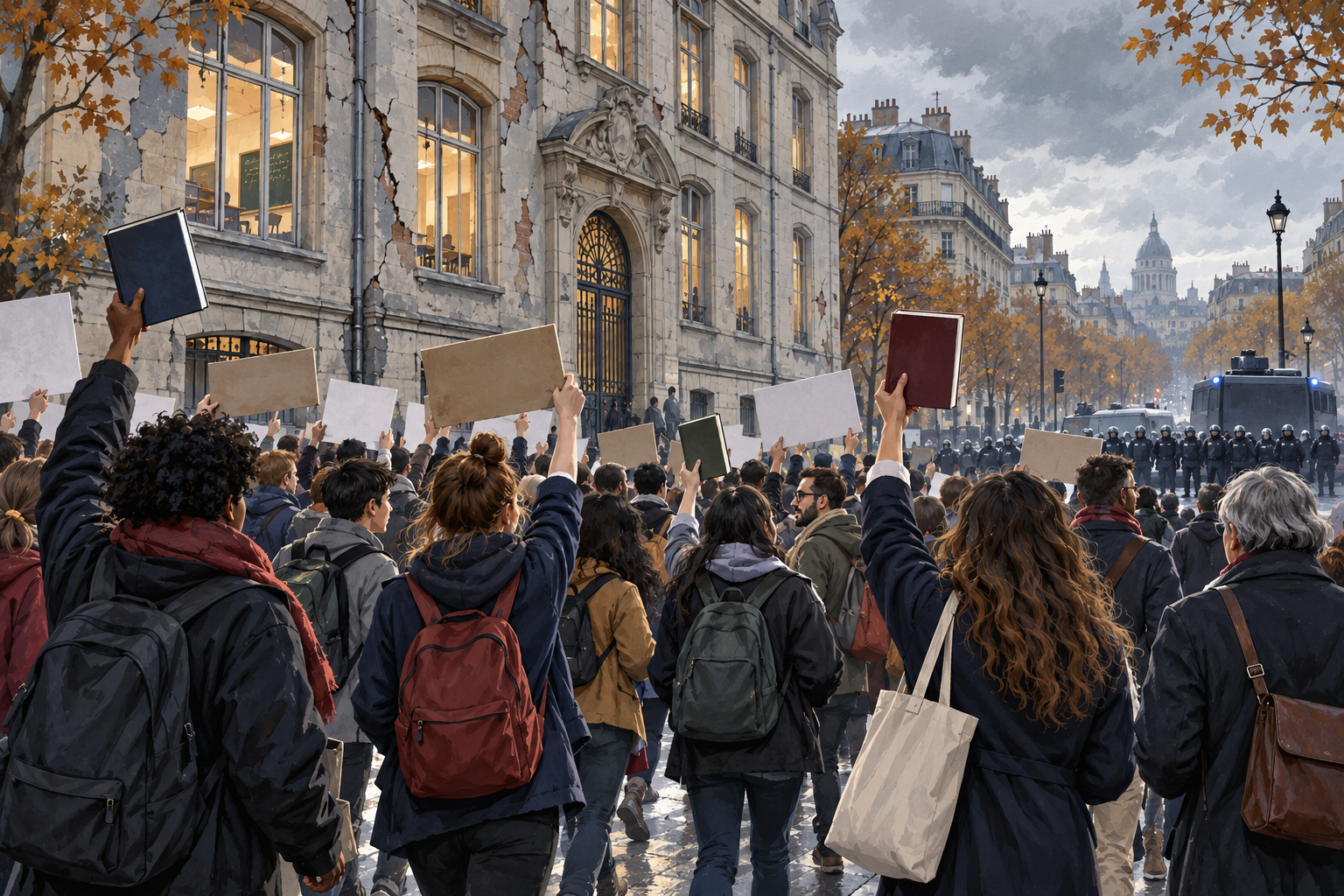
PARIS - About 266,000 people joined demonstrations across France on Tuesday in support of high school students demanding more staff, safer buildings and increased education funding, according to the Interior Ministry.
The marches marked the largest day yet in a movement that began at a school in the Paris region in mid-September and spread nationwide through class boycotts and blockades. Student organizers estimated turnout at 450,000, including 100,000 in Paris. The government counted 56,000 participants in the capital.
Students were joined by teachers, parents, university groups, public-sector unions and other supporters in Paris, Marseille, Lyon, Lille, Strasbourg, Rennes and dozens of other cities. The central complaints include staff shortages, overcrowded classrooms, deteriorating facilities and unequal conditions between affluent and working-class communities.
The Education Ministry said classes were fully or partially suspended at 891 of France's roughly 3,700 high schools on Tuesday. The Ministry of Higher Education said about 40% of public higher-education institutions were also disrupted.
Most of the major marches were peaceful, but small groups clashed with riot police in Paris and other cities. Officers used tear gas and water cannons in some locations. The Interior Ministry said nearly 500 people were detained during Tuesday's events.
The demonstrations follow more than two weeks of escalating confrontations. Authorities say more than 6,500 people, mostly minors, have been arrested since the movement began and hundreds of officers have been injured. Protesters and families have accused police of disproportionate force. A 15-year-old boy lost a hand Monday in an incident involving a police stun grenade, intensifying public anger.
Interior Minister Laurent Nunez said the police response had been proportionate in almost all cases and argued that some blockades had turned into riots requiring intervention. Prime Minister Sebastien Lecornu condemned violence against schools but also said officials must listen to students and find solutions.
The government has asked ministers for proposals on staffing and repairs to aging school buildings by the end of October. Some student groups have called for further demonstrations, leaving Lecornu's government under pressure to produce concrete measures while France prepares a difficult budget and a presidential campaign.
A democratic demand cannot excuse destruction
The scale and breadth of Tuesday's marches make it impossible to dismiss the movement as the work of a small political faction. When students from private schools, working-class neighborhoods, universities and distant cities raise similar complaints, the government has a duty to examine whether the public education system is failing basic standards.
France's fiscal constraints are real. Repairing old buildings, hiring staff and reducing class sizes require money that must come from taxes, borrowing or cuts elsewhere. Responsible leaders should explain those tradeoffs rather than offer every group an unlimited promise. But budget pressure does not justify leaving children in unsafe facilities or classrooms without enough adults to teach and protect them.
Students also have responsibilities. Peaceful protest is a democratic right; arson, assaults and destruction are not. Violence gives officials an excuse to replace a debate about education with a debate about public order. Organizers who want lasting support should isolate those who attack people or property and publish a focused list of achievable demands.
The state must meet a higher standard. Police may clear dangerous blockades and protect schools, but force against minors must be necessary, proportionate and reviewable. Severe injuries cannot be treated as routine. Every disputed use of riot weapons should be independently investigated, with findings made public and consequences imposed where rules were broken.
This is where democratic government distinguishes itself from authoritarian control. A free society does not prove strength by silencing young people. It proves strength by allowing peaceful dissent, enforcing the law against genuine violence and correcting institutional failure through transparent political action.
France also faces a wider test of social trust. Public education is one of the republic's principal promises: that a child's opportunities should not depend entirely on family wealth or postal code. When buildings decay and staffing gaps persist, that promise begins to look ceremonial. Young people then learn that official values are recited more reliably than they are funded.
Lecornu can lower the temperature by publishing a school-by-school assessment of urgent repairs, staffing vacancies and measurable timelines. Students should be represented in that process, while spending proposals should identify costs and priorities. The darker alternative is a cycle in which neglect produces protest, disorder invites repression and repression creates more anger. France has the democratic institutions to break that cycle, but only if both power and protest accept accountability.
Comments
Loading comments…