
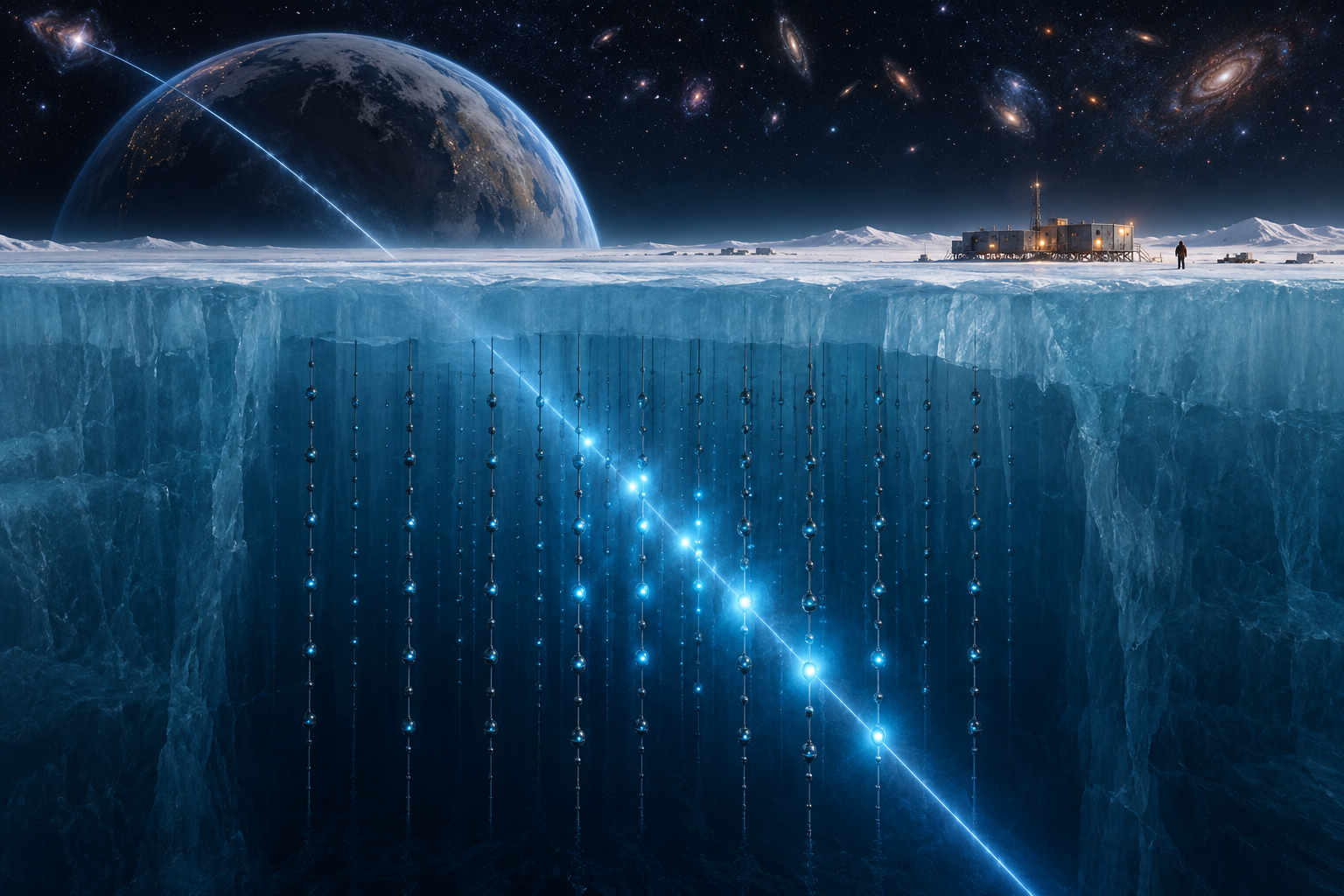
STOCKHOLM - Francis Halzen, the physicist who helped turn a cubic kilometer of Antarctic ice into an observatory for nearly undetectable cosmic particles, has won the 2026 Nobel Prize in Physics.
The Royal Swedish Academy of Sciences announced the award Tuesday, citing the 82-year-old University of Wisconsin-Madison scientist for decisive contributions to the IceCube Neutrino Observatory and the discovery of high-energy neutrinos from astrophysical sources.
Neutrinos are electrically neutral particles with extremely small mass. Trillions pass through every person and through the Earth without leaving a trace because they interact with matter so rarely. That quality makes them extraordinarily difficult to detect, but it also allows them to travel across the universe without being deflected in the way charged cosmic rays are.
Halzen and an international collaboration used the deep, transparent ice at the South Pole as an enormous detector. Thousands of light sensors were placed more than two kilometers below the surface, where they can observe tiny flashes produced when an occasional neutrino collides with matter in the ice. The depth shields the instruments from much of the interference that would overwhelm the signal closer to the surface.
The National Science Foundation, which has supported IceCube for more than two decades, said the project began as an ambitious proposal in the 1990s. Halzen helped demonstrate that Antarctic ice could serve as a detection medium and led the scientific and organizational work needed to transform that idea into a functioning observatory.
IceCube's early results established that some high-energy neutrinos reach Earth from beyond the solar system. Because those particles can escape violent environments and travel in straight lines, researchers can use them to investigate distant galaxies and the extreme processes that accelerate cosmic rays.
Halzen, who was born in Belgium and built his career in the United States, emphasized that the achievement belonged to a large international team. He said researchers must sort through thousands of ordinary particle detections every second to identify the rare signals that can be traced confidently to the distant universe.
The Nobel recognizes more than a single observation. It honors the creation of a new form of astronomy. For centuries, humans studied the sky mainly through visible light. Modern instruments added radio waves, X-rays and gravitational waves. IceCube demonstrated that neutrinos can become another messenger carrying information from places that conventional telescopes cannot fully examine.
Patient science is strategic strength
IceCube is a reminder that transformative discovery rarely follows a quarterly timetable. The proposal sounded improbable: drill deep into Antarctic ice, install thousands of sensors and wait for particles that almost never interact with anything. It required decades of engineering, public funding and cooperation among researchers who could not promise exactly what they would find.
That kind of patience is one of America's greatest strategic assets. The United States did not strengthen its scientific position by ordering a predetermined result. It funded an open institution, attracted talent from abroad, tested a risky idea and allowed evidence to determine whether it worked. Halzen's Belgian origins and American career illustrate how a free research system converts immigration, universities and public investment into shared achievement.
Authoritarian governments can build impressive laboratories, but science is not only a contest in concrete and computing power. It depends on people being able to challenge senior figures, publish inconvenient results and cooperate across borders. A culture that punishes dissent may copy equipment; it cannot easily reproduce the intellectual freedom that makes unexpected discovery possible.
The award also carries a warning for policymakers. Basic science is easy to praise after a Nobel committee validates it and easy to cut when budgets are tight. IceCube existed because officials supported a strange, long-term project before its success was certain. A country that funds only research with an immediate commercial product will eventually buy the breakthroughs of nations willing to think further ahead.
Public investment still requires discipline. Large scientific projects should publish data, explain costs and undergo independent review. International collaboration should protect sensitive technology while keeping civilian research open. Accountability and ambition are not enemies; they are what make public confidence durable.
The deeper significance of Halzen's prize is that the universe has not become less mysterious. Scientists have gained another instrument for asking better questions about violent cosmic events, the sources of high-energy particles and perhaps phenomena not yet imagined. IceCube did not close a field. It proved that a field exists.
Comments
Loading comments…