
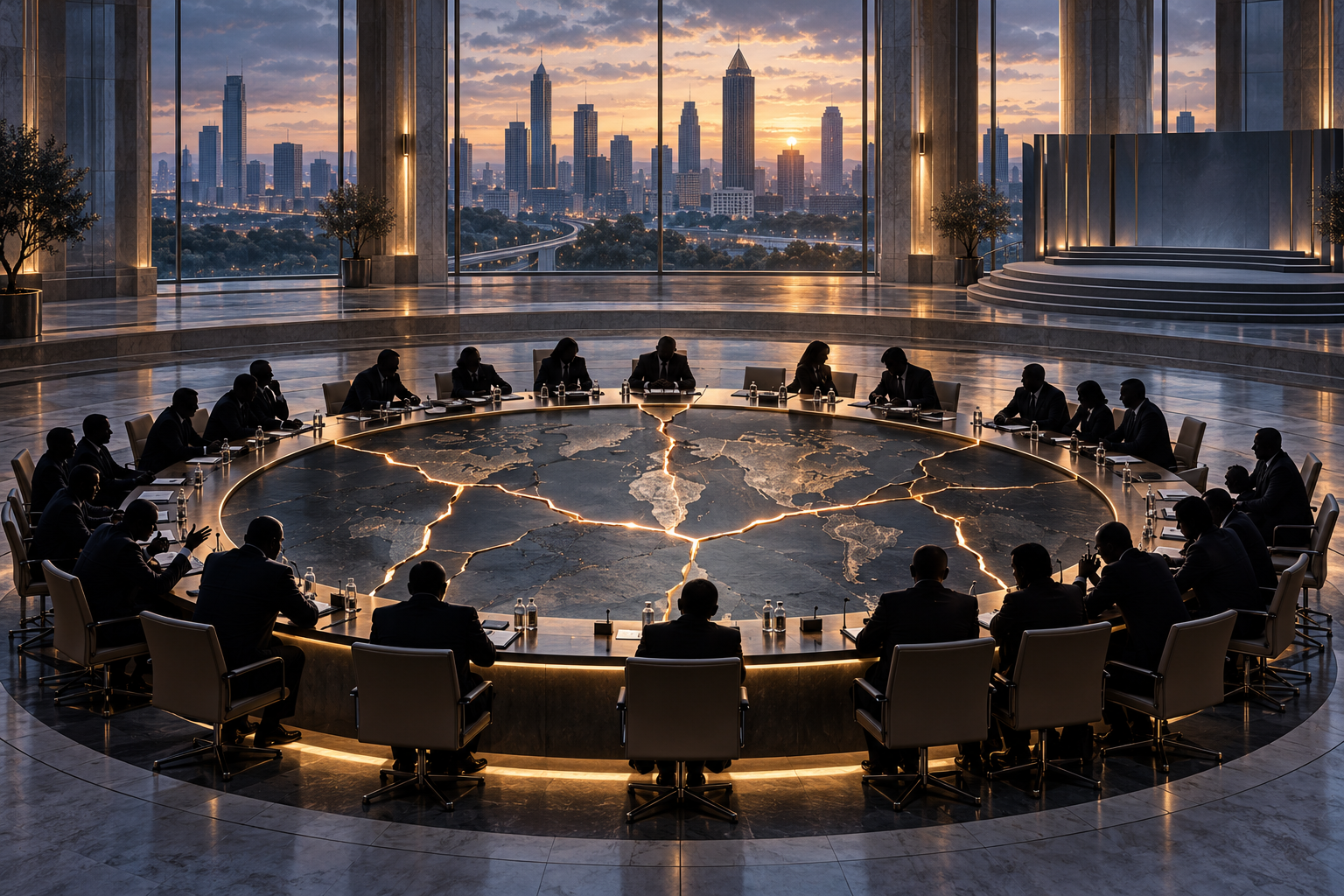
ATLANTA - Foreign ministers from the world's largest economies opened two days of talks in Atlanta on Friday without the traditional group photograph after European governments objected to appearing beside Russian Foreign Minister Sergey Lavrov.
U.S. Secretary of State Marco Rubio canceled the photograph after several European representatives threatened to boycott or walk out. The ministers proceeded into the first session, leaving a ceremonial dispute to expose the deeper divisions already surrounding the meeting.
Rubio told the gathering that interconnected economic and geopolitical crises were threatening the global order. He pointed to disruptions in energy and food supplies, trade uncertainty and dangers to freedom of navigation as issues requiring cooperation among the Group of 20.
The agenda included Russia's war in Ukraine, the U.S.-Israeli war against Iran, instability around the Strait of Hormuz and Red Sea, American tariffs, and China's coercive activity in the South China Sea. Diplomats described the opening discussion as cordial, but participants told The Associated Press that a joint statement was unlikely.
Russia's position on Ukraine remained unchanged, and Moscow objected to Poland's participation as an invited guest. Polish Foreign Minister Radoslaw Sikorski said conflicts involving countries around the table made agreement difficult and said he was not alone in refusing to be photographed with Lavrov.
German Foreign Minister Johann Wadephul said there could be no normality with Russia while still arguing that governments must confront disagreements at the negotiating table. Reuters reported that roughly one-third of participants, including Australia and Canada, opposed a photograph that included Lavrov.
British Foreign Secretary Ed Miliband challenged Russia's approach to peace in Ukraine. Lavrov, meanwhile, criticized Poland's invitation and said Kyiv's position on long-range strikes did not help preparations for planned talks involving Russia, Ukraine and the United States.
The United States announced separately that it had approved a proposed $2.1 billion sale of Patriot air-defense interceptors for Ukraine. The decision offered a material sign of support even as European governments questioned President Donald Trump's recent easing of some pressure on Moscow.
South Africa, a founding G20 member and last year's chair, was not invited because of its disputes with the Trump administration. Its government said the exclusion was not voluntary and welcomed objections from other members. Poland attended as a guest for the first time.
Japan's Foreign Ministry said the first session covered the Middle East, Ukraine and the Indo-Pacific. Foreign Minister Toshimitsu Motegi called for safe navigation through the Strait of Hormuz and Bab el-Mandeb, continued support for Ukraine, the denuclearization of North Korea and opposition to changing the status quo through force or coercion.
The ministerial meeting is intended to prepare for a leaders summit in Florida in December. Participants said they would keep working toward that gathering despite the low prospect of agreement in Atlanta.
The missing photograph reveals a larger crisis of legitimacy
A group photo is not a peace agreement, and refusing one will not stop Russian attacks. Yet diplomatic symbols matter because authoritarian governments use images of normal engagement to argue that isolation has failed and that aggression carries only temporary costs.
European ministers were therefore right to distinguish between negotiating with Lavrov and offering a picture that could be presented as restored normality. Democracies sometimes must speak with adversaries, especially when wars threaten food, energy and shipping. Dialogue does not require pretending that every government at the table respects the same rules.
The United States still demonstrated its unique convening power by bringing rival states into one room and setting an agenda that connected security with trade. That leadership is valuable. It becomes harder to defend, however, when Washington invites Russia while excluding South Africa, a formal member, because of bilateral political disputes.
A rules-based institution loses credibility when membership rights appear to depend on the host's preferences. South Africa can be criticized for its policies and Russia can be confronted for its invasion, but those judgments should be expressed through consistent principles rather than selective access.
The same consistency is needed on Ukraine. Approving Patriot interceptors strengthens a democracy defending itself from attack. Waiving pressure on Moscow while asking Europeans to maintain unity sends a less coherent signal. Deterrence depends not only on weapons but on whether an aggressor believes allied policy will survive the next negotiation or political argument.
The G20 was created to manage economic problems, not to function as a democratic alliance. Its membership includes authoritarian powers whose cooperation may be necessary on debt, trade, disease and climate. The harder reality is that economic coordination cannot be separated from wars and coercion when those conflicts close shipping lanes, raise fuel prices and weaponize food supplies.
Success in Atlanta should not be measured by whether diplomats produce a polished statement. It should be measured by whether the United States and other democracies can negotiate practical protections for trade and security without allowing consensus language to erase responsibility. The empty photo platform is a small symbol, but it captures the central challenge: remaining at the table without making aggression look ordinary.
Comments
Loading comments…