
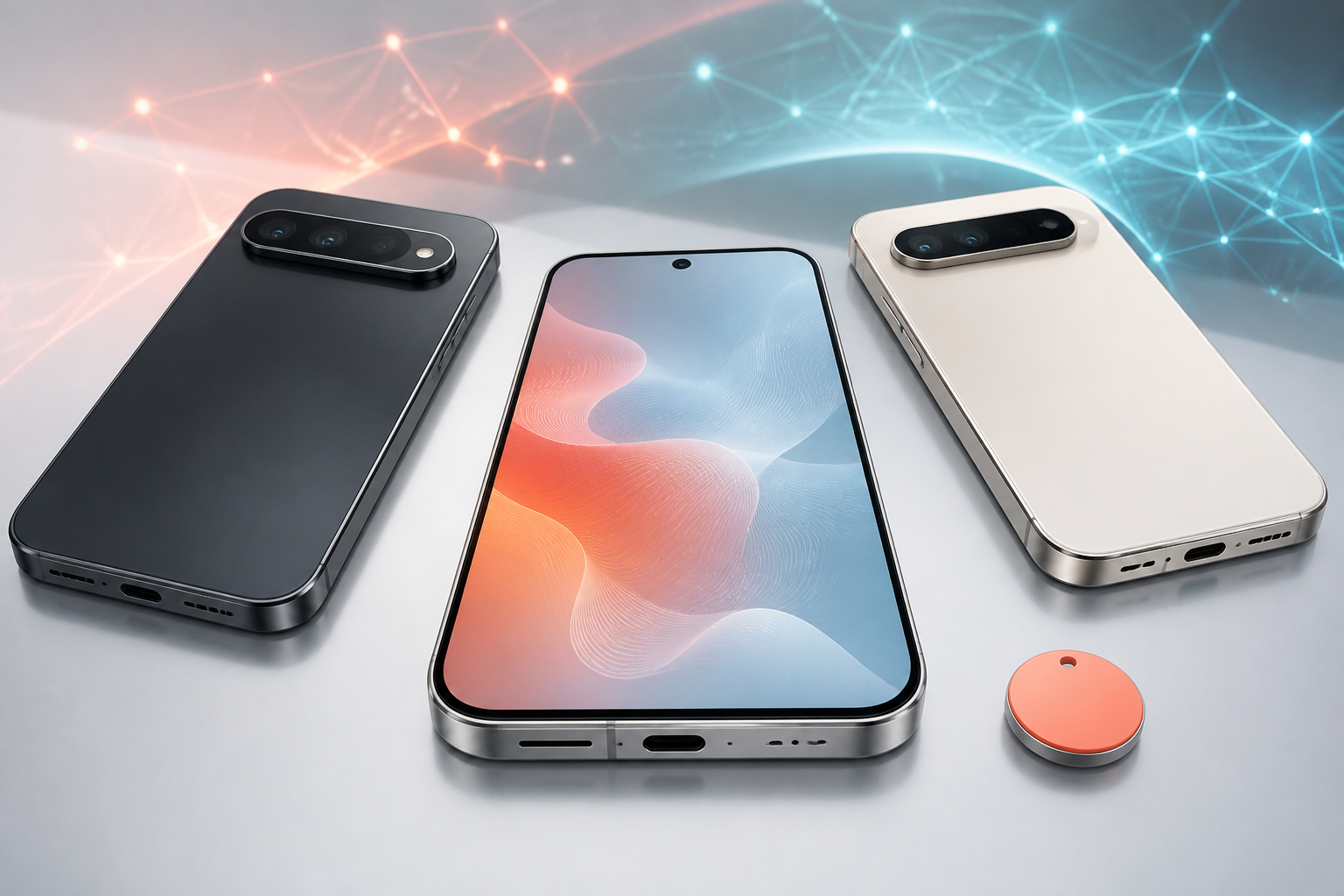
Google unveiled its Pixel 11 smartphone lineup on Wednesday, adding more artificial-intelligence tools, upgraded cameras and double the starting storage while raising the entry price of every model by $100 in the United States.
The standard Pixel 11 starts at $900, the Pixel 11 Pro at $1,100 and the Pixel 11 Pro XL at $1,300. The Pixel 11 Pro Fold starts at $1,900. Google removed the former $800 configuration with 128 gigabytes of storage, making 256GB the new minimum across the lineup.
Google said the phones offer about 30 hours of battery life, faster wireless charging and slimmer camera modules with stronger zoom performance. U.S. customers could begin ordering the standard, Pro and Pro XL models on Wednesday, according to The Associated Press.
The software pitch centers on reducing the number of taps needed to complete everyday tasks. New features include live translation for videos, podcasts and voice messages. On the Pro models, HiLight allows users to assign colors to contacts so the phone lights up differently when placed face down. It works alongside Flip to Shhh, which activates do-not-disturb mode when the phone is turned over.
Camera additions include Magic Capture, which records a sequence of photos and video with one press, and improved light sensitivity. Google says Instant Night Sight on the Pro models can take dark-environment images more quickly, reducing the time users must hold a device still.
The company also introduced Pixel Tag, its first dedicated item tracker. It costs $30 individually or $100 for four and works with phones running Android 9 or later. Google is offering six months of its AI Pro subscription at no charge to buyers of the Pixel 11 Pro and Pro XL.
The launch shows how quickly the smartphone business is moving from a hardware contest into a competition over AI ecosystems. Camera quality, battery life and storage still matter, but Google wants Gemini to become the reason a customer buys a phone, keeps using it and eventually pays for a subscription.
That strategy creates genuine convenience and a clear commercial funnel. Six free months of AI Pro lets users build habits around premium services before the bill begins. Consumers should judge the offer on the full cost after the promotion, not only on the value presented at checkout. An AI assistant becomes harder to leave once personal routines and data are organized around it.
The $100 increase also deserves a precise reading. Buyers receive twice the minimum storage, so the comparison is not simply the same phone at a higher price. Yet removing the cheaper 128GB model takes away a choice that mattered to customers who use cloud storage or do not need large local capacity. More value at the new floor does not change the fact that the door now costs more to enter.
Google's position is unusually powerful because it controls Android, develops Gemini and builds Pixel hardware. That integration can produce useful features faster than a company working across separate platforms. It can also let Google favor its own services at several layers of the mobile experience. Strong competition, understandable privacy controls and the ability to choose rival assistants are therefore essential.
For the United States, the Pixel launch is evidence that American companies remain at the center of consumer AI and advanced mobile computing. That advantage should not be taken for granted. China-backed phone makers compete aggressively on price and hardware, while governments around the world are testing how much control platform companies should have over app distribution and AI access.
The best outcome is not a protected national champion but a competitive American technology market in which Google, Apple, OpenAI and smaller developers must keep earning users' trust. Innovation moves faster when customers can compare products, move their data and reject services that do not deliver enough value.
Pixel 11 will ultimately be tested less by launch-day feature lists than by whether its AI tools remain accurate, useful and respectful of user control. The phones offer meaningful improvements, but the higher prices and subscription strategy make the bargain explicit: Google is selling not just a device, but a long-term place inside its AI ecosystem.
Comments
Loading comments…