
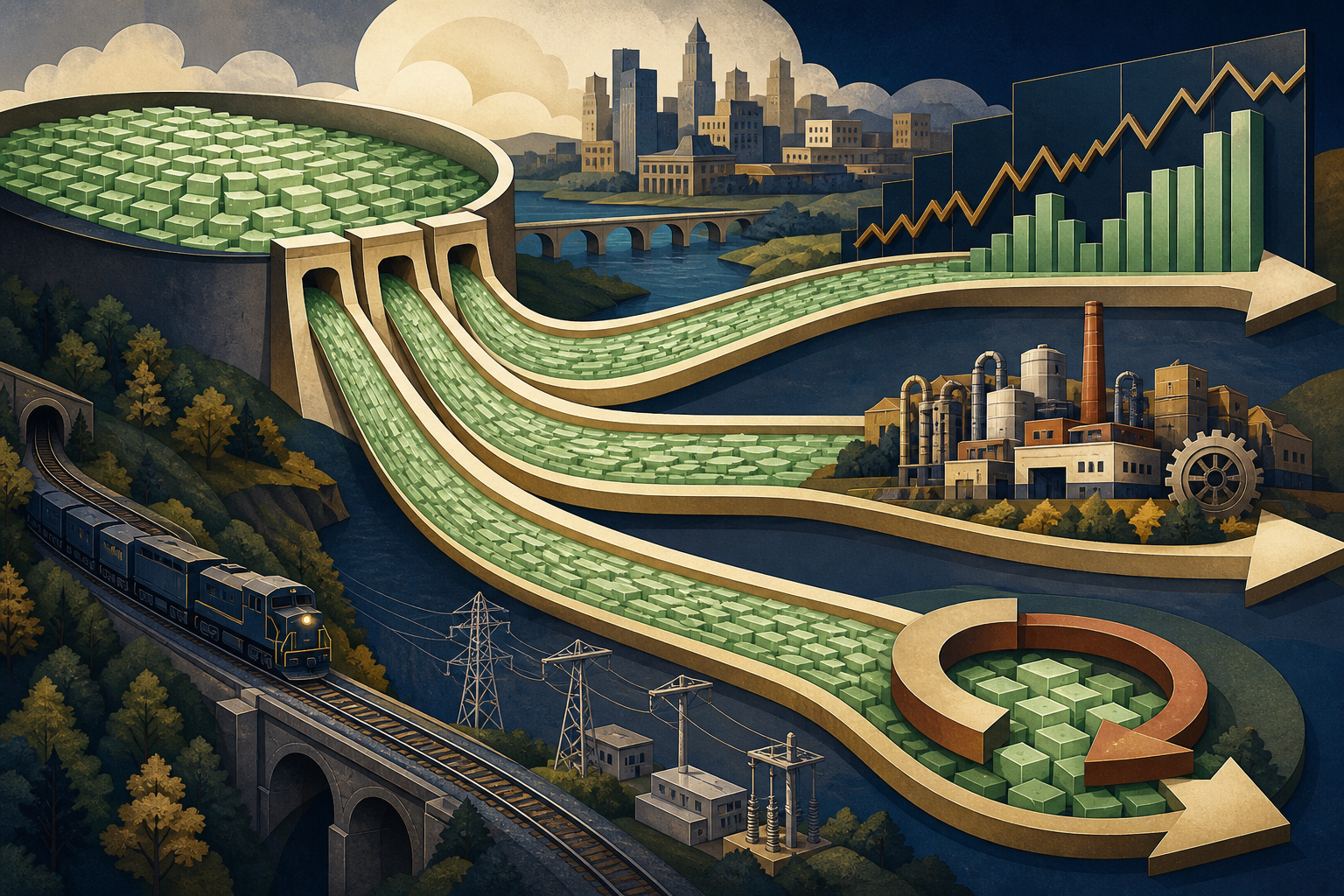
Berkshire Hathaway repurchased approximately $4.5 billion of its own shares in the second quarter and stepped up equity purchases, offering the clearest evidence yet that chief executive Greg Abel is beginning to deploy the conglomerate's vast financial reserves. Berkshire reported on Saturday that operating earnings rose to $12.983 billion from $11.160 billion a year earlier, while net earnings attributable to shareholders more than doubled to $25.667 billion from $12.370 billion.
The difference between those measures was driven mainly by Berkshire's investment portfolio. The company recorded $12.684 billion of investment gains in the quarter, including about $10.9 billion of unrealised gains from changes in market prices and $1.8 billion of after-tax realised gains. Berkshire again cautioned that investment gains and losses can make quarterly net income misleading, because accounting rules capture market movements whether or not the company sells the securities.
Results across Berkshire's operating businesses were mixed. Manufacturing, service and retailing earnings increased to $4.470 billion from $3.601 billion. BNSF railroad earnings rose to $1.558 billion from $1.466 billion, and Berkshire Hathaway Energy contributed $891 million, up from $702 million. Insurance underwriting earnings fell to $1.731 billion from $1.992 billion, while insurance investment income declined to $3.059 billion from $3.367 billion.
A sharp swing in the catch-all "other" category also lifted the comparison. That segment produced $1.274 billion, compared with just $32 million a year earlier. Berkshire said the latest figure included $326 million of foreign-exchange gains on debt denominated in currencies other than the US dollar, whereas the comparable quarter included $877 million of losses. That reversal accounts for much of the headline increase in operating earnings and makes the underlying divisional results especially important.
The capital-allocation figures marked a shift from the restraint seen before Abel became chief executive in January, with Warren Buffett remaining chairman. Berkshire bought about $4.8 billion of its shares during the first six months, meaning almost all of that activity occurred in the second quarter. Its policy allows repurchases when the chief executive, after consulting the chairman, judges the shares to be below conservatively determined intrinsic value and the transaction would not reduce consolidated cash, cash equivalents and US Treasury-bill holdings below $30 billion.
Berkshire was also a net buyer of listed equities. During the first half, it purchased $39.405 billion of equity securities and sold $27.780 billion, a net outlay of $11.625 billion. The cost of its commercial, industrial and other holdings rose to $82.142 billion at June 30 from $58.036 billion at the end of 2025. The filing did not identify the individual securities responsible for that increase. It did show Alphabet among Berkshire's five largest equity holdings, alongside American Express, Apple, Bank of America and Coca-Cola.
The group retained enormous capacity for further deals. Its insurance and other businesses held $359.2 billion of cash, cash equivalents and short-term US Treasury bills, net of Treasury purchases payable, at June 30. Berkshire completed in January its approximately $9.4 billion acquisition of OxyChem, a deal agreed in October 2025 before Abel became chief executive. Its roughly $6.8 billion purchase of homebuilder Taylor Morrison closed on July 24, after the quarter ended, and therefore was not included in the June figures.
The new pattern is meaningful, but it is not a wholesale break with Berkshire's conservative model. Share repurchases, net equity buying and the Taylor Morrison acquisition show that capital is moving on several fronts. Yet the $359.2 billion liquidity balance remains far larger than the sums deployed. Abel's first months therefore look less like a rapid drawdown and more like a measured effort to improve returns while preserving the ability to act during market stress.
The buyback carries a particularly clear message because Berkshire ties repurchases to an assessment of intrinsic value. Even so, investors should not infer a fixed pace from one quarter. The company can halt purchases when its valuation changes or when larger opportunities require cash. The unidentified equity additions deserve similar caution: the aggregate disclosure establishes that Berkshire bought more, but it does not support guesses about which companies received the money or the timing of individual trades.
The operating picture also argues for restraint in reading the 16% increase in operating earnings as a uniform acceleration. The railroad, energy and manufacturing-led businesses improved, while both major insurance profit lines weakened and currency movements flattered the year-on-year comparison. As of Ryu News's reporting cutoff at 9 a.m. Singapore time on August 9, the quarter showed a more active Berkshire under Abel, but the durability of that shift will depend on future disclosures and the performance of the businesses and investments now receiving capital.
Comments
Loading comments…