
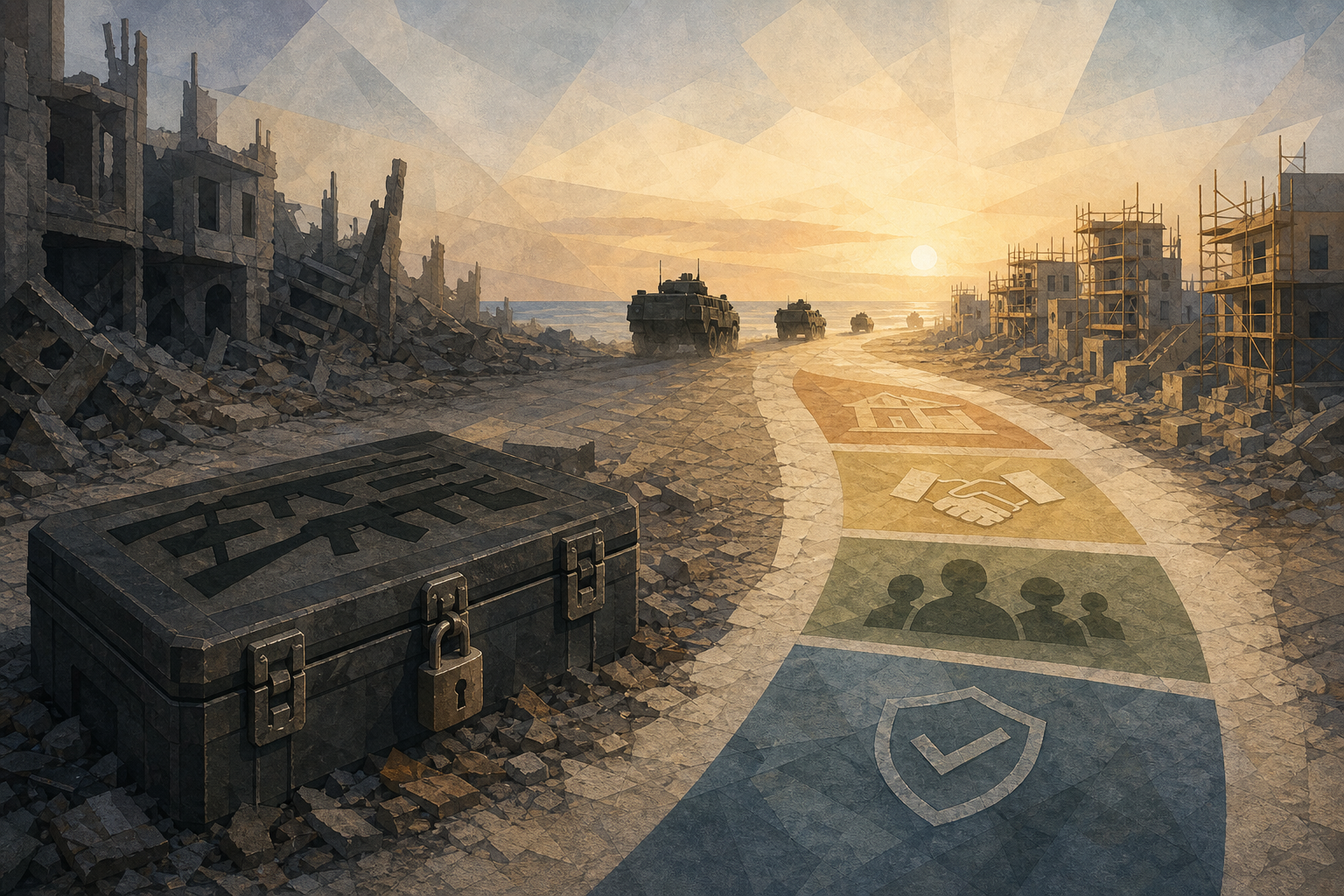
WASHINGTON — President Donald Trump announced late Thursday, July 30, a roadmap intended to disarm Hamas, replace its rule in Gaza and connect Israeli withdrawal to a wider programme of reconstruction and eventual Palestinian statehood. Hamas told the Associated Press that it had agreed to the plan. Israel, however, had not publicly commented by July 31, leaving the central question unresolved: whether the parties whose actions would determine the outcome have accepted the same obligations and timetable.
The roadmap is a framework, not a completed disarmament agreement. It calls for the phased decommissioning or secure storage of Hamas heavy weapons and for tunnels to be placed beyond military use. Those steps would be linked to stages of Israeli withdrawal rather than demanded as a single, immediate surrender. The sequencing is designed to make each side's movement dependent on verified action by the other, an approach meant to reduce the risk that one party gives up leverage while the other fails to perform.
Under the proposal, Gaza's civilian administration and internal security would pass to a technocratic National Committee for the Administration of Gaza, or NCAG. Hamas would no longer govern the territory, while the new body would be expected to provide public services and oversee a transition away from factional rule. An International Verification Committee, or IVC, would verify compliance, while a temporary International Stabilization Force, or ISF, would support security during the transition. Once all parties approve the roadmap, they would have 14 days to develop the detailed mechanisms needed to turn those institutions and commitments into an operating plan.
That two-week drafting period would be crucial because the announcement leaves many practical questions unanswered. Officials would need to define which weapons count as heavy arms, where stored weapons would be held, who would inspect tunnel closures, how violations would be documented and what happens if a dispute freezes an Israeli withdrawal stage. They would also need rules for the temporary security force, including its command, mandate, composition, duration and accountability to Gaza's civilians.
The plan further envisages reconstruction and a pathway toward Palestinian statehood, giving the disarmament provisions a political and economic destination rather than treating them only as a security exercise. Gaza's recovery will require housing, hospitals, utilities, schools, transport and functioning institutions on a vast scale. Linking those needs to a credible political horizon could give Palestinians a reason to support a transition, but aspirations in a roadmap are not financing commitments, construction contracts or diplomatic recognition.
Hamas's reported acceptance is significant because the group has long treated its armed capability as both a means of fighting Israel and a source of political power. Agreeing to a process that removes heavy weapons and tunnels, if carried out, would mark a fundamental change. Yet the precise authority behind the response, the breadth of support within Hamas and the organisation's ability to enforce compliance across its armed networks will have to be demonstrated through conduct rather than statements.
Israel's position is equally decisive. A phased bargain cannot operate if Israel does not accept the withdrawal schedule, the verification structure and the transfer of authority to the NCAG. Israeli leaders may seek stronger guarantees about weapons, tunnels and future attacks, while Palestinians will demand enforceable limits on military operations and a withdrawal that does not remain indefinitely conditional. As of July 31, the absence of a public Israeli response meant there was no verified agreement between the two sides.
The strongest feature of the roadmap is its attempt to connect security, governance and political legitimacy. Previous initiatives have often isolated one problem from the others: demanding disarmament without credible governance, proposing reconstruction without durable security, or invoking statehood without a practical institutional path. This framework at least recognises that the pieces depend on one another. Its weakness is the same interdependence: failure in any one part could stall the entire sequence.
Verification therefore cannot become a decorative acronym. The IVC would need access, technical expertise, transparent standards and the authority to report noncompliance by any party. The temporary ISF would need a narrow mission and safeguards against becoming either an open-ended occupation or a force unable to protect the institutions it is asked to support. The NCAG would need qualified Palestinian administrators, public credibility and insulation from both armed factions and outside political control.
For Washington, the announcement creates a test of disciplined diplomacy. The United States can use leverage with Israel, regional governments and international donors to push the parties toward detailed, reciprocal commitments. It should also resist presenting conditional language as an accomplished peace. Democratic accountability requires publishing the operative terms, identifying who has formally accepted them and reporting breaches consistently, including when an ally is responsible.
The roadmap offers a possible route out of a cycle in which Gaza remains devastated, Hamas retains coercive power and Israel faces continuing insecurity. But no weapon has yet been decommissioned under this framework, no tunnel has been verified closed, no withdrawal has occurred under its terms and no replacement authority has taken control. The next milestone is not the automatic expiry of a 14-day clock; it is approval by all parties, which would start the period for drafting implementation mechanisms and show whether the announcement can become a negotiated transition.
Comments
Loading comments…