
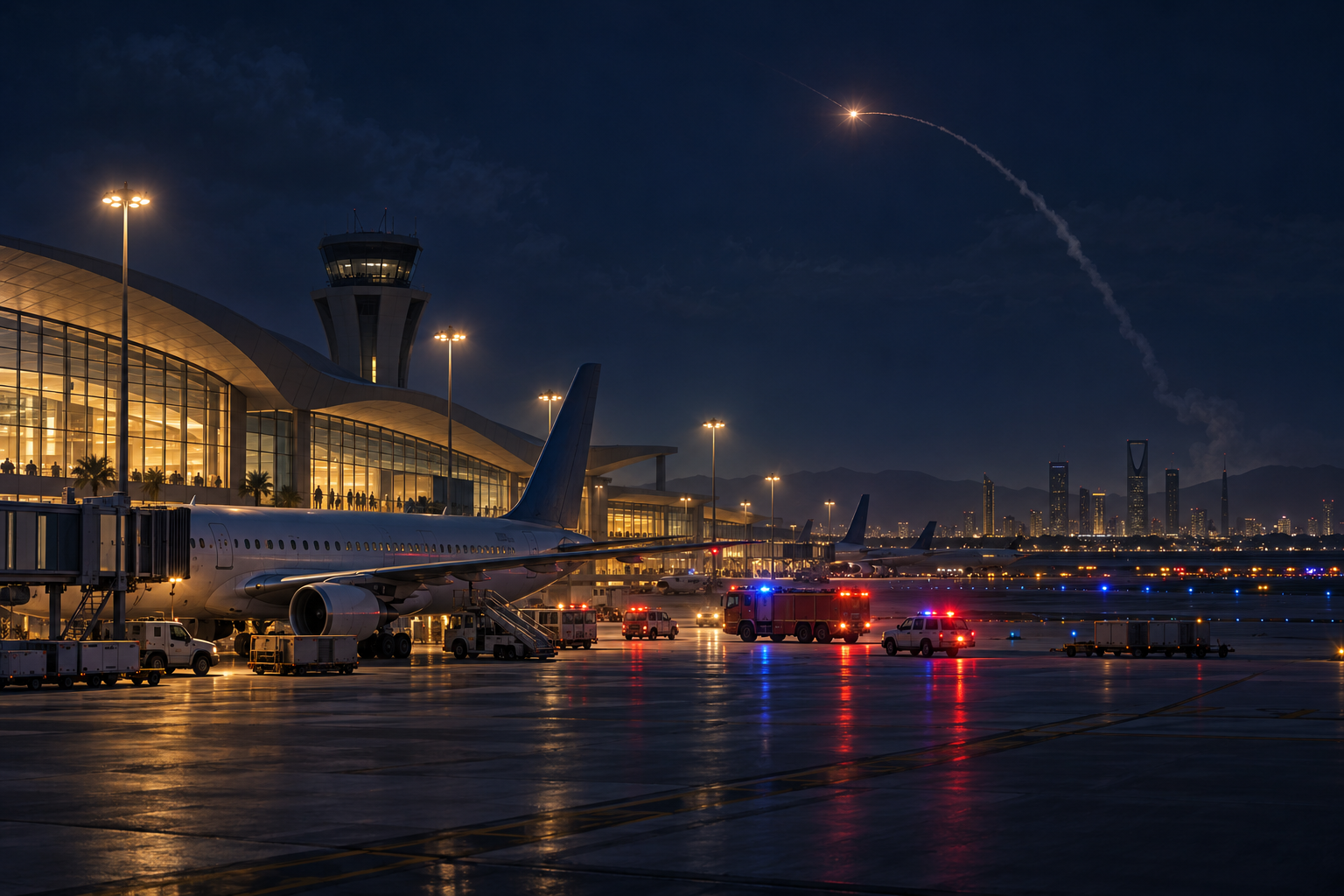
RIYADH, Saudi Arabia - Attacks on two Saudi airports killed three foreign residents and wounded 36 other people on Tuesday and Wednesday, Saudi Arabia's General Authority of Civil Aviation said, as renewed fighting with Yemen's Iran-backed Houthi movement reached civilian aviation hubs.
At Abha International Airport, two female residents from Morocco and Algeria were killed and 28 people were injured, with wounds ranging from minor to critical, the aviation authority said. At King Khalid International Airport in Riyadh, a Sudanese resident was killed and eight people were wounded.
The Saudi authority described both incidents as attacks but did not publicly assign responsibility. The Houthis claimed they had targeted the airports, though several details in their statements could not be independently verified. The group has used ballistic missiles, cruise missiles and drones in repeated attacks on Saudi territory.
Saudi-led coalition spokesman Maj. Gen. Turki al-Malki said coalition forces intercepted a ballistic missile north of Riyadh and destroyed a launch platform in the Houthi-controlled Yemeni capital, Sanaa. The Associated Press said it could not independently confirm those claims.
The airport casualties came during a sharp revival of Yemen's civil war after a four-year truce. Saudi-backed Yemeni forces have launched a ground and air offensive to recover territory taken by the Houthis along the western coast and near the Bab el-Mandeb Strait. The narrow waterway links the Red Sea with the Gulf of Aden and carries about 12% of global trade.
Both sides issued competing claims about control of Dhubab and nearby coastal areas. Houthi officials said they had regained key positions, while an official with Yemen's internationally recognized government denied that account. The Houthis also said Saudi attacks had struck civilian sites in Sanaa and several provinces.
The latest escalation has already killed nearly 1,000 people and displaced more than 200,000, according to United Nations reporting cited by the AP. The World Health Organization has warned of rising cholera and malnutrition, reduced access to trauma care and shortages of medical supplies in some hospitals.
Civilian airports are not bargaining chips
An airport is not only a runway or a government asset. It is a crowded civilian system filled with passengers, migrant workers, flight crews and families. Firing weapons toward that system creates an obvious risk of mass casualties even when attackers claim to be aiming at infrastructure or military activity nearby.
The nationalities of those killed underline who pays for proxy warfare. A Moroccan, an Algerian and a Sudanese resident died in a conflict they did not control. The wounded included Saudis and other foreign workers. Their deaths should not be reduced to a strategic message exchanged between armed leaders.
The Houthis have learned that missiles and drones can generate leverage far beyond Yemen. Threatening airports, energy sites and the Bab el-Mandeb route imposes economic costs on Saudi Arabia and raises insurance and shipping risks around the world. Iran's support has helped an armed movement turn local control into regional coercion while Tehran retains room to distance itself from each operation.
Saudi Arabia and its partners, including the United States, are justified in helping defend civilian airspace and freedom of navigation. That defense should emphasize interception, intelligence and protection of essential infrastructure. Any offensive action must still distinguish military targets from civilians and comply with the laws of war. One side's abuse never licenses the other side to abandon restraint.
There is also a political failure behind the military danger. Years of pauses and negotiations reduced some violence but did not build an enforceable settlement or disarm the systems capable of attacking neighboring states. A truce that leaves civilians exposed to renewed missile fire is an interval, not peace.
The darker lesson is that relatively cheap weapons can hold expensive public systems hostage. A single successful strike can close airspace, frighten travelers and force governments into escalation. The answer is not to normalize attacks on airports as another headline from the region. It is to treat civilian aviation as a firm boundary, strengthen defenses and impose real costs on those who deliberately cross it.
Comments
Loading comments…