
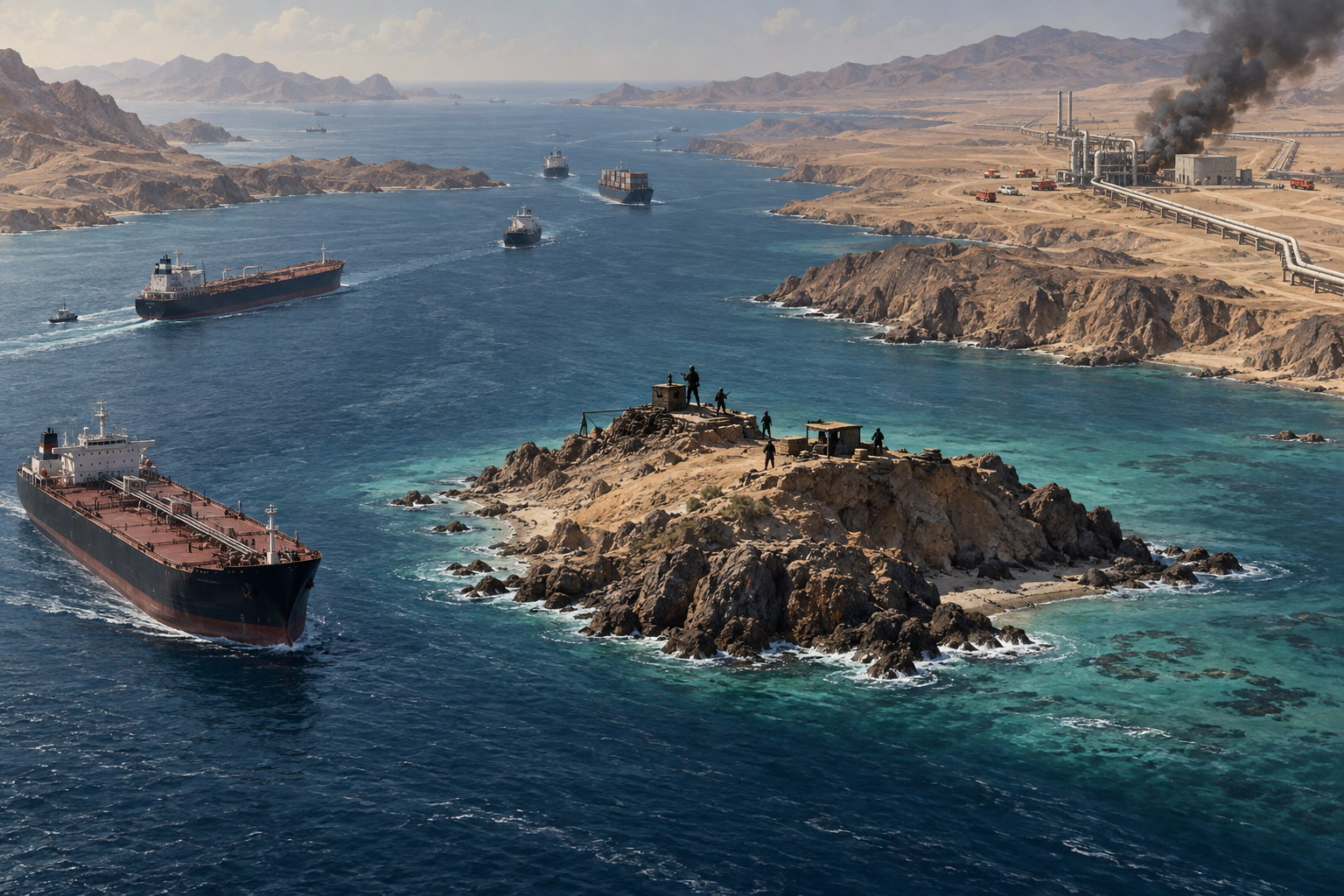
CAIRO - Iran-backed Houthi forces captured a strategic island at the southern entrance to the Red Sea as Saudi Arabia shut its East-West oil pipeline after drone attacks launched from Iraq, widening the security crisis around two of the world's most important energy routes.
Associated Press and Reuters reported that Houthi fighters seized Perim, also known as Mayun, on Friday after rapid territorial gains along Yemen's Red Sea coast. Yemeni government sources also said the group had taken the port city of Mokha, its biggest advance in the area in years.
Perim sits inside the Bab el-Mandeb Strait, the narrow passage connecting the Red Sea to the Gulf of Aden. Roughly 12% of global trade normally passes through the waterway. Control of the island does not automatically close the strait, but it gives an armed group a position close to commercial vessels using the channel.
Separately, Saudi Arabia's Energy Ministry said the East-West Pipeline was struck several times on Thursday morning in the Riyadh and Madinah regions. The attacks caused injuries and damage, and the kingdom closed the line as a precaution while emergency teams assessed its safety.
Saudi Arabia said several drones involved in the attack were launched from Iraq. Iraq's government confirmed that the operation originated from its territory, opened an investigation and dismissed a regional military commander. Public evidence has not yet established which group directed or carried out the attack.
The 1,200-kilometer pipeline moves crude from eastern Saudi Arabia to the Red Sea coast, allowing exports to bypass the Strait of Hormuz. Reuters said it had recently carried between 4 million and 5 million barrels per day, equal to about 4% to 5% of global oil supply.
The two developments intensified pressure on Saudi Arabia as conflict involving the United States, Iran and Iran-aligned groups disrupts regional shipping. Riyadh said it was giving Baghdad an opportunity to act against those responsible rather than announcing an immediate military response.
This is not one isolated battlefield success. It is a demonstration of how armed proxies can place pressure on trade routes, pipelines and governments without a conventional declaration of war. A small island and a remote launch site can create economic consequences far beyond their physical size.
The harder reality is that chokepoints give weaker forces leverage over much stronger states. Houthis do not need to defeat a navy or occupy an oil-producing region to raise insurance costs and frighten shipping companies. They need only persuade markets that every voyage may carry a new risk.
Iran has long benefited from relationships with armed groups that can threaten rivals while preserving uncertainty over command and responsibility. Tehran's support for the Houthis is well documented, but that does not prove it ordered every Houthi move or the pipeline attack. Democracies should resist both naive denial and claims that run ahead of evidence.
Saudi Arabia faces an especially difficult choice. Retaliation may deter further attacks, but it can also broaden the war and expose more infrastructure. Restraint may give Iraq time to enforce its sovereignty, yet repeated restraint can encourage militias to conclude that critical use of Iraqi territory carries little cost.
The United States and its allies have a clear interest in freedom of navigation through Bab el-Mandeb. That does not require an open-ended ground war in Yemen. It requires persistent maritime surveillance, defensive escorts when necessary, intelligence sharing and credible consequences for attacks on civilian shipping.
Iraq must also prove that its territory is governed by the state rather than by armed networks with foreign patrons. Dismissing one commander is not enough if investigators cannot identify launch teams, secure drone sites and prosecute those who endangered a neighboring country.
Markets will watch how quickly the Saudi pipeline returns and whether commercial ships continue using the Red Sea route. The strategic warning is already clear: when authoritarian regimes and proxy forces can threaten the infrastructure on which open economies depend, energy security becomes inseparable from military readiness and political resolve.
Comments
Loading comments…