
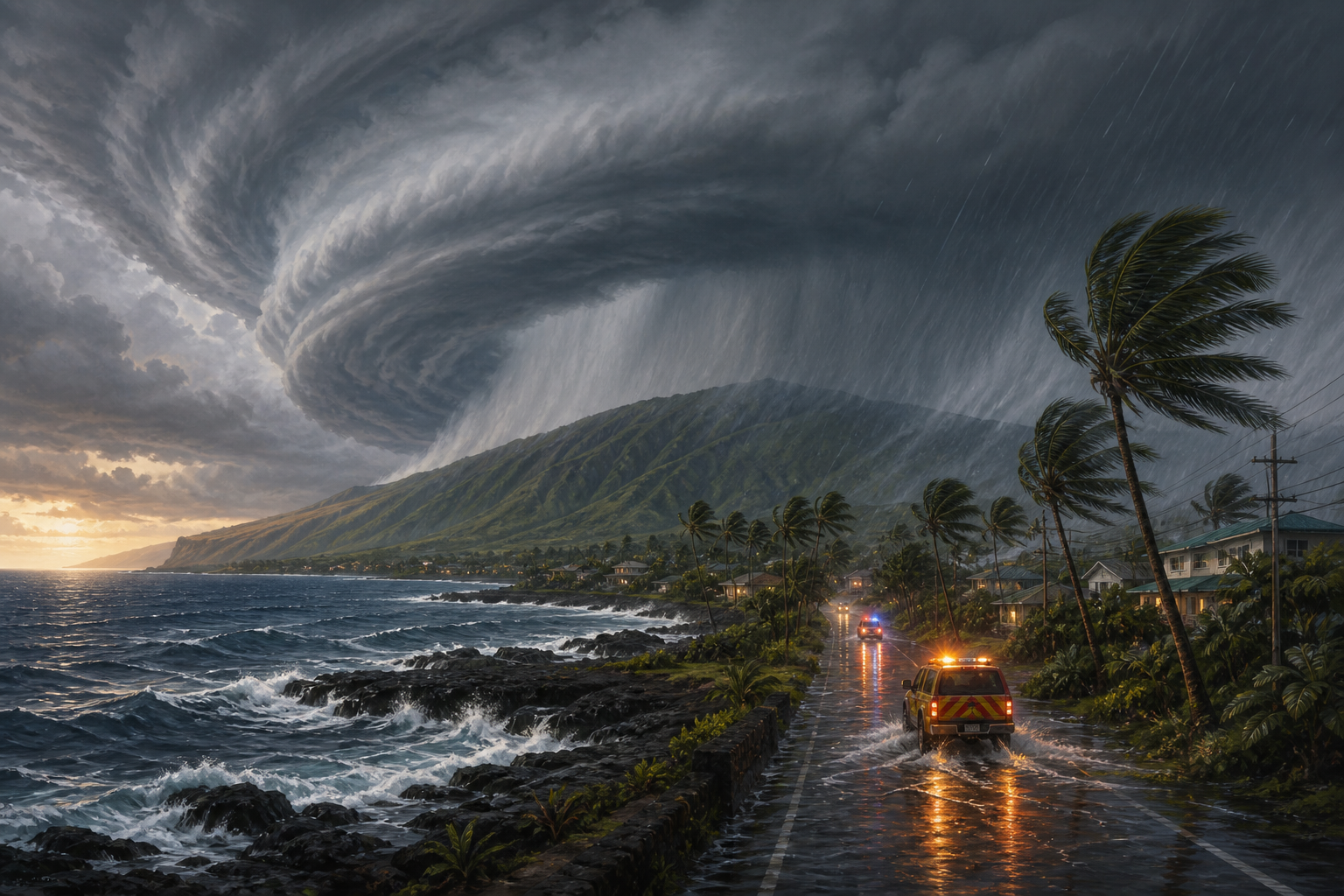
HONOLULU - Hurricane Lala passed just south of Hawaii's Big Island on Saturday without making landfall, sparing the island a historic direct hit but bringing damaging wind, torrential rain, flooding and widespread power outages.
Lala strengthened into a Category 1 hurricane as it approached the island, with maximum sustained winds of 75 mph. Its center moved past South Point while heavy rainbands crossed the Big Island and warnings remained in effect across the Hawaiian chain.
Governor Josh Green said at least one person died in a vehicle crash in the South Point area. He also reported 19 roofs lost and 190 flights postponed. Tens of thousands of homes were without electricity as wind brought down utility equipment and floodwater covered roads.
The National Hurricane Center warned that hurricane-force winds could continue into Saturday night, especially over higher terrain. Forecasters said the storm could deliver 8 to 12 inches of rain across Maui and the lower elevations of the Big Island, with isolated totals near 25 inches at higher elevations. Other islands could receive 4 to 6 inches.
Those totals created a threat of flash floods and mudslides on steep volcanic terrain. Rivers rose rapidly, surf struck exposed coastlines and officials urged residents to stay off roads. Shelters opened, public events were canceled and ranchers were advised to keep cattle outside structures that could collapse in high winds.
The eye's offshore track ended the immediate possibility of the Big Island's first direct hurricane strike in 155 years. Research based on historical newspaper accounts indicates that a Category 3 hurricane hit the island in 1871, decades before modern satellite observation.
Hawaii's last hurricane landfall was Hurricane Iniki on Kauai in 1992. The Category 4 storm killed six people, destroyed thousands of homes and caused about $3 billion in damage. That memory explains why officials treated Lala's uncertain path as a statewide emergency before its closest approach.
A narrow miss is not the same as a harmless storm. Tropical systems push dangerous weather far from their center, and Lala demonstrated that the line on a forecast map cannot describe every community at risk. Homes can flood, trees can fall and power can fail even when the eye never crosses the coast.
The preparation also mattered. Forecast warnings gave residents time to fuel generators, fill water tanks, secure property and reach shelters. Emergency officials canceled gatherings before conditions deteriorated. Those decisions impose inconvenience and economic cost, but waiting for certainty would have left the public moving around during the most dangerous hours.
Hawaii's geography makes resilience unusually difficult. Supplies, repair crews and replacement equipment must move between islands or arrive across the Pacific. Mountain slopes intensify rainfall, coastal roads provide few alternatives, and some rural residents live far from utilities and emergency services. A damaged bridge or blocked road can isolate a community quickly.
The state is also recovering from destructive flooding earlier this year. Repeated emergencies expose weak drainage, vulnerable power lines and housing that cannot easily absorb another loss. Rebuilding to the previous standard may be cheaper in the moment, but it preserves the same failure for the next storm.
The recovery should be measured publicly. Officials should report where outages lasted longest, which roads repeatedly flooded and whether shelters had enough capacity. That record can guide investments before the next warning, while transparent damage assessments help residents understand why some repairs and resilience projects must take priority.
No single hurricane proves a specific climate trend, and officials should resist using one event as a shortcut for claims that require broader evidence. The practical conclusion does not depend on that debate: severe rain, wind and coastal flooding are known Hawaiian risks, and public infrastructure must be built for the conditions communities now face.
Lala's turn away from land was fortunate, but fortune is not a preparedness plan. Hawaii avoided the catastrophic direct strike feared on Friday. The flooding, damaged roofs and darkened homes left behind are a reminder that the outer edge of a hurricane can still test every part of an island's emergency system.
Comments
Loading comments…