
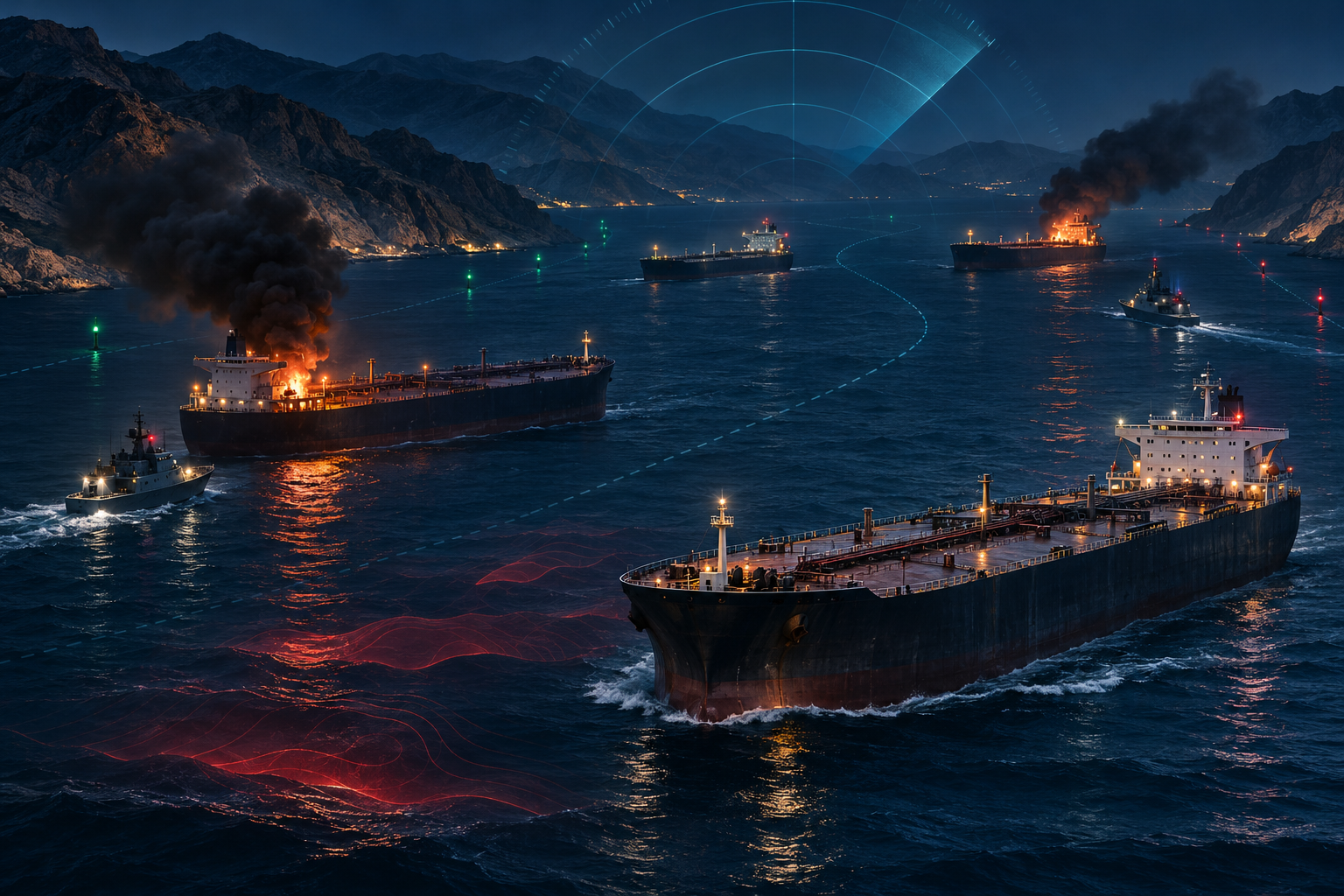
DUBAI - Iran's military said four oil tankers were hit by explosions in and around the Strait of Hormuz over two days, deepening the threat to a shipping corridor that carries a critical share of the world's energy trade.
Iran's Revolutionary Guards Navy said two supertankers were disabled Wednesday after ignoring warnings against using what Tehran calls an unauthorized route. Iranian state media said the vessels struck naval mines. The regular army later said two additional tankers hit mines Thursday after entering a restricted area and disabling their radar systems.
Reuters said it could not independently verify Iran's account, including the number of vessels, the use of mines or the claim that the tankers ignored warnings. Iran has not publicly provided enough independently verifiable evidence to establish the sequence described by its military.
Separate reporting from the United Kingdom Maritime Trade Operations center confirms that commercial ships have been attacked across the region, although its incident descriptions do not fully match Tehran's version. A Joint Maritime Information Center advisory listed four tanker attacks reported between November 10 and 12.
One tanker, whose name was withheld, reported being struck by an unknown projectile northeast of Limah, Oman. The NCC Fajr was attacked north of Khasab the following day, with its crew reported safe. The advisory did not identify the weapon or provide an environmental damage assessment.
The Fujairah Energy was struck by an unknown projectile while traveling east in the Arabian Gulf, according to the advisory. Multiple casualties were taken ashore for treatment, while the remaining crew members were accounted for.
The Dominica Prosperity was hit in its engine room northwest of Ras al-Khaimah, prompting an evacuation as firefighting continued. No casualties were reported in that incident. Maritime authorities again described the cause as an unknown projectile rather than a mine.
The Joint Maritime Information Center kept the regional threat level at severe. It said Iranian harassment, surveillance, drone activity and radio challenges continued around key shipping lanes. Commercial traffic remained below its 2025 level even as U.S.-assisted transits averaged about 34 per day during the latest reporting period.
Reuters reported that at least 10 ships were hit during the first 10 days of November after 37 attacks in October, citing data from the Washington Institute for Near East Policy. The figures illustrate a sustained campaign rather than an isolated maritime accident.
International tankers increasingly rely on U.S. naval escorts to move through the strait. Secretary of State Marco Rubio has urged other Group of Seven governments to contribute more to protecting commercial shipping, but said this week that the appeal had not produced a breakthrough.
Iran is trying to rewrite the rules of a global waterway
The distinction between a vessel striking a mine and being struck by a projectile is not academic. It determines responsibility, the military response and the insurance risk faced by every company considering passage through Hormuz.
Earlier in the war, the Revolutionary Guards openly announced attacks on tankers. Iran now more often describes explosions as consequences of ships entering routes it has unilaterally declared unsafe or unauthorized. That language attempts to transform coercion into traffic enforcement.
No state should be allowed to create its own toll gate across an international waterway through threats, mines or ambiguous attacks. Freedom of navigation is not an American slogan invented for one conflict. It is a practical rule that protects every country dependent on open trade, including nations that criticize Washington.
Tehran benefits from uncertainty. If every explosion can be blamed on a mine, an unknown projectile or a captain who supposedly ignored a warning, Iran can impose costs while making retaliation politically harder. Commercial operators do not need courtroom certainty before rerouting a vessel or raising a premium.
The United States and its partners therefore need disciplined transparency. Maritime authorities should release verified locations, damage assessments and recovered fragments when security permits. Escort operations should be paired with mine detection, rapid rescue capacity and clear instructions that do not depend on Iranian permission.
That response must avoid exaggeration. Iran's claim of four vessels should not be presented as confirmed merely because attacks are plainly occurring. Credibility is a strategic asset, and democratic governments lose it when they repeat an adversary's account without qualification.
The harder reality is that Tehran can threaten a vast portion of the global economy with comparatively cheap weapons and a few carefully worded statements. Until attacks carry a predictable cost and diplomacy produces enforceable rules, every tanker entering Hormuz will remain part of the battlefield.
Comments
Loading comments…