
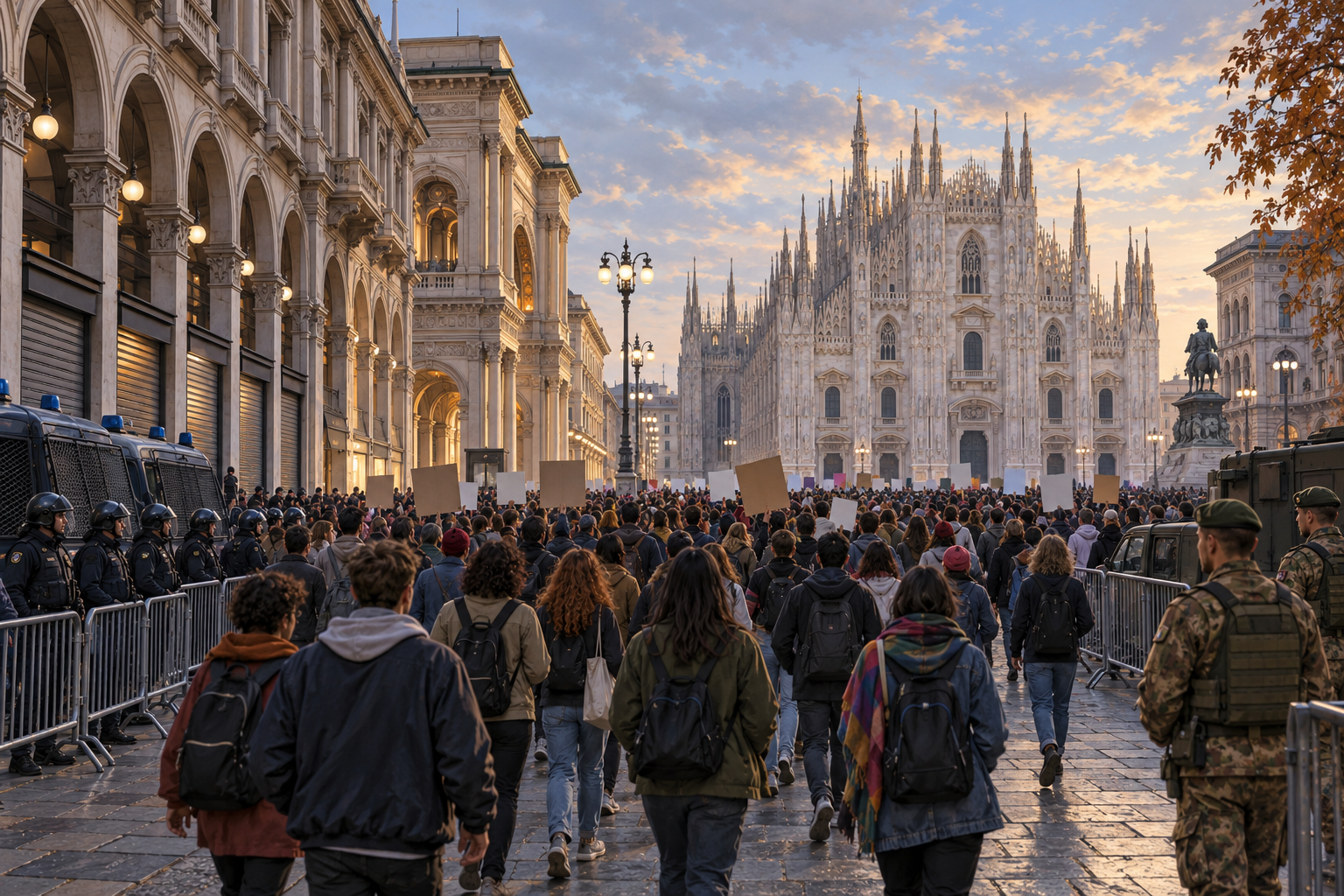
MILAN - Thousands of mostly young demonstrators marched through major Italian cities Saturday over rising living costs, war, education and housing, while authorities deployed soldiers, police and surveillance measures to prevent a repeat of last weekend's looting and clashes.
The largest march in Milan remained largely peaceful. Crowds moved through the city center toward Milan Polytechnic as soldiers guarded transport hubs, police lined the route and luxury stores boarded their windows. Many shops reopened by late afternoon, and Reuters witnesses reported no looting or property damage during the demonstrations they observed.
Brief confrontations unfolded elsewhere. Police clashed with demonstrators in Rome and Turin, while Reuters also reported violence in Bologna. In Rome, officers used tear gas and prepared a water cannon after an anti-war march pressed toward police lines. A small group also tried to enter the Colosseum before guards moved them out.
Prime Minister Giorgia Meloni's government sent 500 additional soldiers to Milan, adding to troops already stationed there and supporting about 5,000 police and other security personnel. Authorities used drones, checks at railway stations, rapid-response teams and monitoring of public online calls for violence.
Defense Minister Guido Crosetto said the deployed soldiers were permitted to use plastic restraint ties only around train stations. He said they were not authorized to carry pepper spray or Tasers. The distinction underscored that the military presence was intended to support police rather than take over ordinary crowd control.
Saturday's demonstrations followed unrest a week earlier, when rioters fought police, broke into stores and damaged property in several northern cities. Milan police said about 2,000 very young people were involved in that violence. Officers arrested 45 people over two days, including 34 minors.
Authorities said they were questioning a person allegedly connected to organizing the newly formed October 17 Movement. Officials and news reports have described that person as a possible organizer, but no court finding has established responsibility for the disorder.
The protest wave does not have one simple demand or political identity. Participants have raised the cost of electricity, housing pressure, school funding, tuition, pensions, corruption and opposition to war. In Milan, demonstrators dumped manure outside the energy regulator and burned an oversized symbolic electricity bill. A small far-right group also appeared separately and was isolated by police after chanting anti-immigrant and anti-Muslim slogans.
Meloni has announced tougher penalties for minors involved in violence and defended the expanded security operation. Opposition figures and civil-liberties advocates face a different question: how to protect peaceful assembly without allowing organized destruction to consume the public debate.
Security cannot answer the price crisis
Italy's government had a duty to prevent another weekend of smashed shops and attacks on police. Peaceful demonstrators also needed protection from violent groups capable of hijacking their cause. By those immediate measures, Milan's operation largely succeeded: a huge crowd marched, the city remained open and widespread looting did not return.
But soldiers and boarded windows are symptoms, not solutions. Young Italians confronting high rents, weak wage growth and expensive energy will not become more confident because more uniforms stand outside a railway station. When daily life feels less affordable while opportunity appears narrower, anger moves from private frustration into the street.
The protesters also carry responsibility. Violence hands the government its strongest argument for broader surveillance, preventive detention and harsher penalties. Burning property does not punish distant elites; it damages neighborhoods, workers and small businesses. A democratic movement that cannot isolate those seeking chaos will lose public sympathy and make genuine reform harder.
Meloni should resist treating every angry student as a security threat. The fact that last week's disorder involved many minors makes accountability necessary, but it also demands an honest examination of why so many young people were available for mobilization. Punishment without opportunity can quiet one weekend while deepening the next grievance.
Europe's democracies are being tested by a volatile mix of expensive energy, housing scarcity, war fatigue and distrust of institutions. Authoritarian governments answer such pressure by crushing dissent and controlling the story. A democracy must do something harder: protect the right to protest, enforce the law against violence and respond to legitimate economic pain with policy rather than contempt.
Saturday showed that those goals can coexist. Milan was tense, but thousands marched without the city descending into destruction. Italy's next test is whether its leaders and protest organizers can preserve that boundary. If politics offers only riot images on one side and armored security on the other, the people struggling to pay their bills will remain unheard.
Comments
Loading comments…