
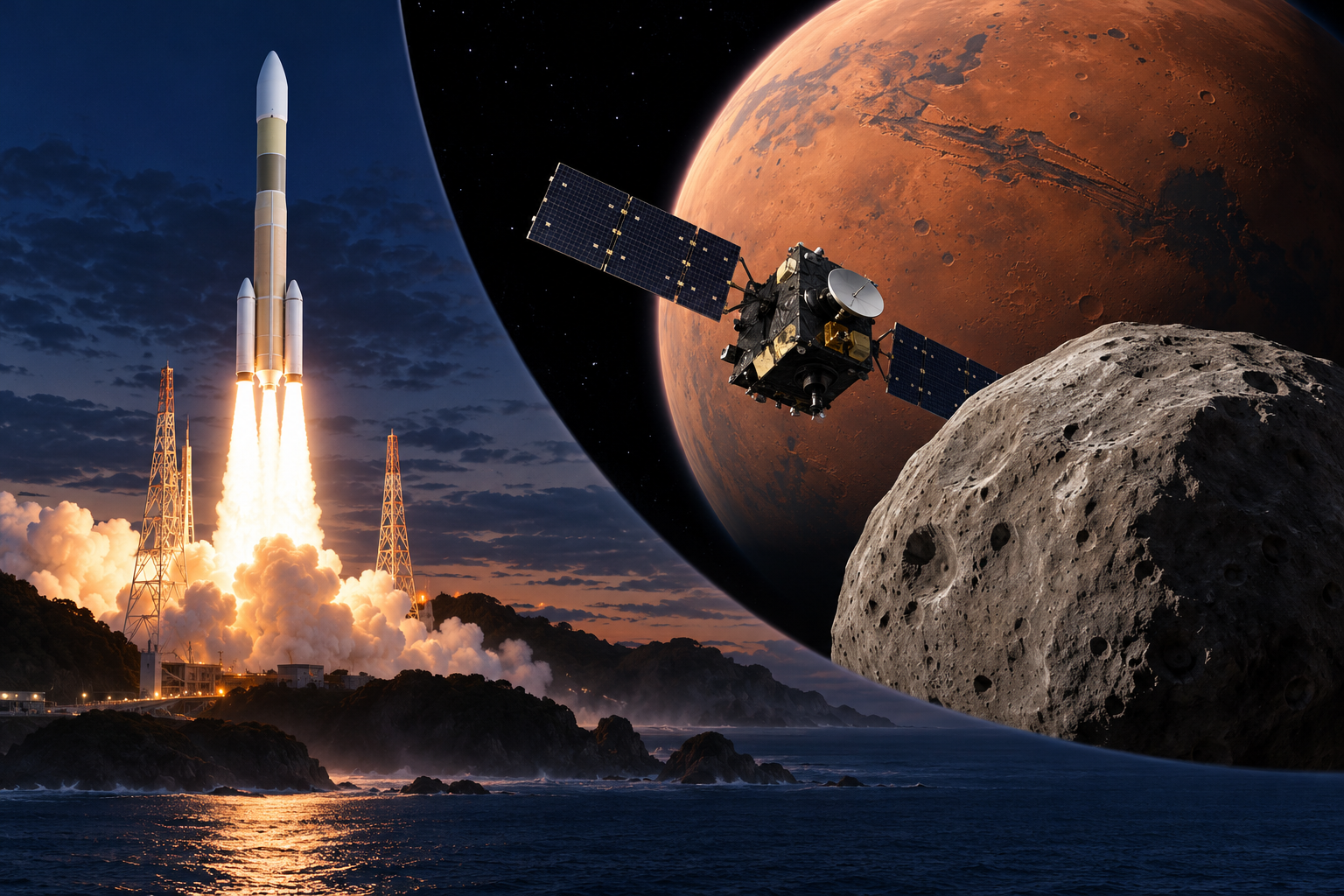
TOKYO - Japan launched an ambitious mission to Mars early Tuesday that is designed to collect material from the moon Phobos and return it to Earth, opening a new route into the unresolved history of the Red Planet and its two small satellites.
The Japan Aerospace Exploration Agency said its Martian Moons eXploration spacecraft, known as MMX, lifted off aboard H3 Flight No. 10 from the Tanegashima Space Center at 4:41:03 a.m. Japan time on Oct. 20. The Associated Press reported that controllers confirmed the spacecraft had separated from the rocket's upper stage roughly an hour after launch.
MMX is scheduled to reach the Mars system in 2027 and spend about three years studying Phobos and the smaller moon Deimos. The spacecraft will operate in a special orbit around Phobos, conduct two planned landing operations and attempt to collect at least 10 grams of surface material. It is due to leave Mars in 2030 and return a sample capsule to Australia in 2031.
No mission has previously returned material from Mars or either of its moons. Phobos, an irregular body about 22 kilometers across, offers scientists a chance to investigate whether the Martian moons are captured asteroids or debris assembled after a large object struck ancient Mars. The answer would reshape scientists' account of how planets and moons formed in the early solar system.
The approximately five-ton spacecraft carries instruments to map Phobos, measure its composition, study its internal structure and observe the circulation of dust around Mars. A small French-German rover named Idefix is expected to descend to the moon before the main spacecraft lands, test the surface and help reduce the risk of the sample operation in Phobos's extremely weak gravity.
The mission is led by JAXA with contributions from NASA, France's CNES, Germany's DLR and the European Space Agency. JAXA puts the project cost at about $578 million, according to AP. Its international instruments and rover make MMX more than a national demonstration: the scientific return will depend on partners sharing engineering, navigation and laboratory expertise.
The launch is only the beginning of a long and unforgiving journey. Russia's previous attempts to investigate Phobos ended in failure, while Japan's first Mars orbiter was unable to enter Martian orbit. MMX must survive interplanetary travel, navigate near a tiny low-gravity moon, touch down, collect uncontaminated material, depart Mars and deliver a capsule safely through Earth's atmosphere.
A small sample could answer a large question
The value of this mission is not measured by the weight of the cargo. Ten grams sounds modest, but material sealed and returned to terrestrial laboratories can be examined with instruments too large and sensitive to fly in space. Researchers can preserve portions for future techniques that do not yet exist, as they have done with samples from earlier missions.
Phobos may also contain particles blasted from the Martian surface by ancient impacts. If those fragments are present, MMX could deliver indirect evidence about Mars itself without attempting the still harder task of launching from the planet's surface. JAXA says the wider goal includes tracing how water and organic material moved through the region where the rocky planets formed.
This is the harder reality behind spectacular launch images: serious exploration is patient infrastructure, not a single morning's performance. The spacecraft will not reach its destination for many months, and the sample will not return for five years. Public institutions must sustain funding, specialist teams and political attention long after the launch broadcast ends.
The mission also shows what open scientific alliances can accomplish. Japan is leading, but American and European agencies are contributing equipment and knowledge, while the eventual samples are expected to support research beyond one country. That model is a strategic strength for democratic nations. Transparent methods, published results and international review make scientific claims more durable than prestige announcements controlled by a government.
Competition is still accelerating. China plans its own Mars sample-return effort, while the United States is reconsidering how to retrieve samples already collected by the Perseverance rover. Rivalry can push engineering forward, but it should not turn planetary science into a race for headlines. The standard must remain verifiable data and responsible handling of material from another world.
MMX now has to earn the promise carried by its launch. If the spacecraft returns from Phobos in 2031 with an intact sample, Japan will have delivered a world first and scientists will hold a physical record from a place humanity has never touched before.
Comments
Loading comments…