
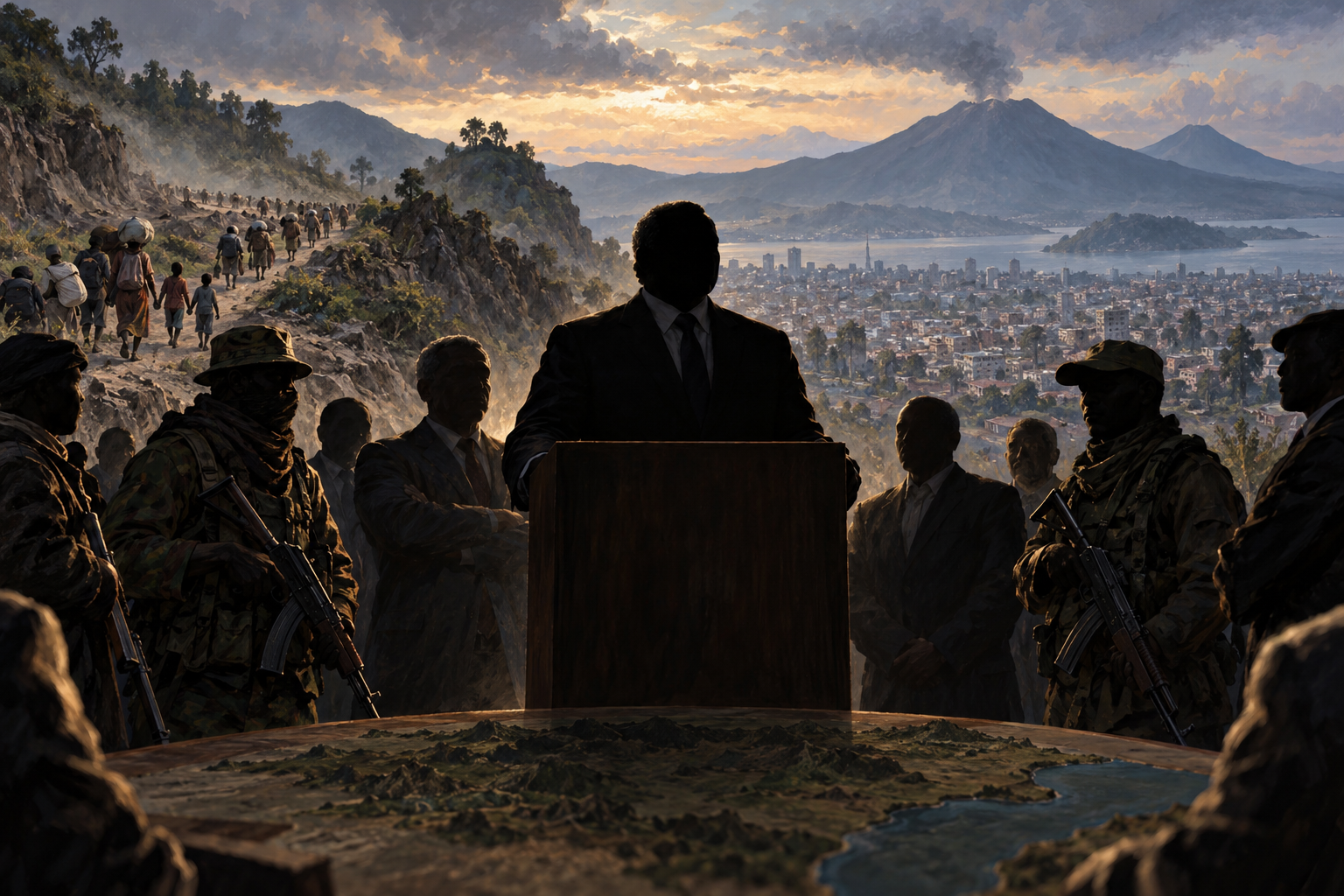
Former Democratic Republic of Congo president Joseph Kabila has launched a political-military coalition with figures from the M23 rebel movement, deepening his confrontation with President Felix Tshisekedi's government and adding a new complication to efforts to end the war in eastern Congo.
The Front for the Refoundation of the Nation was announced on Monday in Goma, the eastern city seized by M23 forces. The coalition brings together Kabila's political allies and organizations associated with the Congo River Alliance, known by its French initials AFC, whose armed wing includes M23.
Corneille Nangaa, the former head of Congo's electoral commission who now leads the AFC, was named as one of the new front's vice presidents. Reuters reported that M23 president Bertrand Bisimwa, military commander Sultani Makenga and Kabila ally Freddy Kaniki were also appointed as deputies.
Claude Ibalanky, a former official who is serving as the coalition's executive secretary, said the group would unite resistance against the current government and use all available means, including force. Kabila did not attend the launch ceremony in person, but allies presented the organization as operating under his leadership.
Tshisekedi's government did not immediately issue a detailed response to the announcement. It has previously accused Kabila of supporting the rebellion, an allegation the former president has denied while describing legal action against him as political persecution.
A Congolese military court sentenced Kabila to death in absentia last year after convicting him of treason, war crimes and crimes against humanity. Earlier in 2026, the United States imposed sanctions on him over alleged financial and political support for armed groups. Kabila has rejected the accusations.
M23 captured Goma and other major eastern cities during a rapid offensive last year. Congo, the United States and United Nations experts have accused neighboring Rwanda of supporting the group. Rwanda denies backing the rebels, although Western governments and UN investigators have repeatedly described Rwandan involvement in M23 operations.
Kabila became president in 2001 after the assassination of his father, Laurent Kabila, and remained in power until 2019. His final years in office were marked by a prolonged election delay. Tshisekedi ultimately succeeded him after the disputed 2018 vote and has since become his bitter political rival.
A coalition that blurs politics and armed rebellion
The new front is more than a change of name. It attempts to give an insurgency a national political identity under a former president who still has supporters and networks inside Congo. That combination can make a local security crisis harder to contain because the battlefield is now tied more explicitly to a contest over the legitimacy of the national government.
Kabila and his allies are entitled to criticize corruption, governance failures and the performance of Tshisekedi's administration. Democratic opposition is necessary in a country with Congo's history of concentrated power. But attaching political opposition to an armed movement that controls territory creates a darker reality: civilians living under rebel rule become part of the leverage used in a national struggle.
The distinction matters. A party can lose an election and continue organizing. A newspaper can investigate the government. Courts and civil society can challenge abuses. An armed coalition works by coercion, and its advances can uproot families regardless of which leader claims the better political argument. Eastern Congo already has roughly 100 armed groups and millions of people exposed to repeated displacement and insecurity.
The announcement also tests international diplomacy. Talks backed by the United States and hosted in Doha have sought to turn military gains into a ceasefire and political settlement. A new umbrella organization may broaden the people at the table, but it can also let participants rearrange titles while preserving the same weapons, command structures and territorial ambitions.
Washington and its partners should insist that any agreement be judged by verifiable conduct: an end to attacks, civilian access to aid, withdrawal from occupied areas and disclosure of outside military support. Rwanda's denial must be weighed against evidence gathered by UN experts, while accusations against Kabila should be tested through credible legal processes rather than used as a shortcut around proof.
Congo's government also has obligations. It cannot answer rebellion by treating every critic as an enemy or by allowing courts to become instruments of political revenge. The United States should support accountable institutions, not personalities. The central question is whether Congolese citizens regain security and a meaningful democratic choice, not whether one powerful faction replaces another.
Comments
Loading comments…