
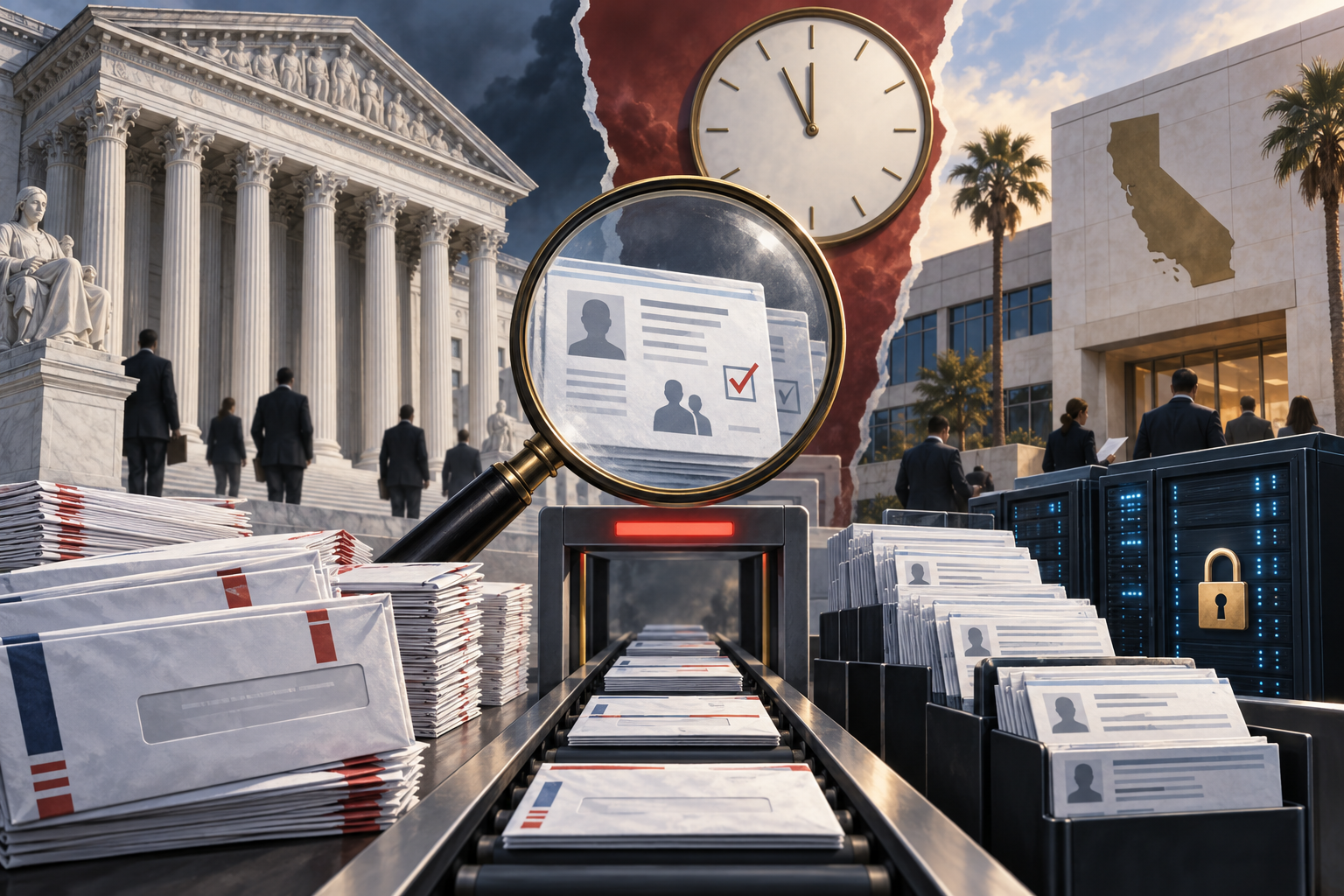
The Justice Department has given California 48 hours to review a list of people alleged to be noncitizens who received mail ballots, threatening to seek emergency court action if the state does not comply just weeks before Election Day.
In a letter sent Tuesday, acting Deputy Attorney General Trent McCotter directed state officials to determine whether the listed voters are U.S. citizens, according to The Associated Press and Reuters. The department told California to segregate ballots belonging to people whose citizenship could not be verified and to withhold ballots that had not yet been sent.
Noncitizens are prohibited from voting in federal elections. California, which automatically mails a ballot to every active registered voter, also requires applicants to affirm under penalty of perjury that they are U.S. citizens. The dispute is not over whether the law exists, but whether the federal list is accurate and whether the demanded process gives eligible voters adequate protection.
California Secretary of State Shirley Weber said her office was not given the list directly. According to her statement, it was delivered to the Los Angeles County registrar on a password-protected thumb drive, with the password written on a sticky note. State officials said they were not provided evidence or methodology explaining how the names were selected.
Weber called the 48-hour demand unreasonable and said the state could not responsibly determine citizenship under that deadline. She also argued that federal officials were asking California to disrupt an election without first showing that the people identified were improperly registered.
The Justice Department said it received the list from an unnamed source and is responsible for enforcing federal voting laws. Its letter warned that failing to take the requested steps could lead the government to seek immediate judicial relief. The department did not publicly release the names, the number of people on the list or the process used to classify them.
The confrontation is part of a broader federal campaign to obtain detailed voter information from states. The AP reported that the Justice Department has sued 30 states and the District of Columbia over access to voter data, while courts so far have rejected its claims in cases that have been decided.
Previous mass allegations also counsel caution. The AP said federal officials asserted during the summer that California had about 190,000 noncitizens on its rolls, a figure state officials described as unsupported. In Nevada, a federal list of more than 1,500 suspected noncitizens was eventually narrowed to no people who were both registered and ineligible on that basis, according to the report.
Election integrity requires evidence and due process
Every verified instance of a noncitizen registering or voting should be investigated. Citizenship is a clear legal requirement, and public confidence suffers when governments appear indifferent to whether voter records are accurate. California should not use hostility toward the Trump administration as an excuse to dismiss credible evidence.
But a demand becomes credible through its evidence, not through the authority printed on the letterhead. Citizenship cannot safely be inferred from a name, birthplace, database mismatch or outdated record. Naturalized Americans and other lawful voters are especially vulnerable to broad matching systems that do not account for changed status or clerical errors.
The timing makes the standard of proof more important. Removing, separating or withholding ballots shortly before an election can prevent lawful votes from being counted even if an error is corrected later. A process designed to protect election integrity can damage it when the government imposes an impossible deadline and provides no transparent basis for the accusation.
California also owes the public more than a blanket refusal. Officials should preserve the data, seek the methodology, compare the records using established procedures and disclose aggregate results as quickly as accuracy permits. If the list identifies genuine violations, the state should act and explain how they occurred. If the list is defective, the public should see evidence of that failure too.
This conflict exposes a darker reality of election politics: allegations can travel much faster than verification. A dramatic number or emergency letter may shape public belief even when later examination finds little behind it. By the time a careful review is complete, the political damage may already be done.
The American answer should be neither blind trust nor partisan defiance. Courts can require the government to show its evidence, states can protect eligible voters while maintaining accurate rolls, and investigators can prosecute actual violations. The rule should be simple and demanding: no illegal vote should be accepted, and no citizen's lawful vote should be discarded on an unsupported suspicion.
Comments
Loading comments…