
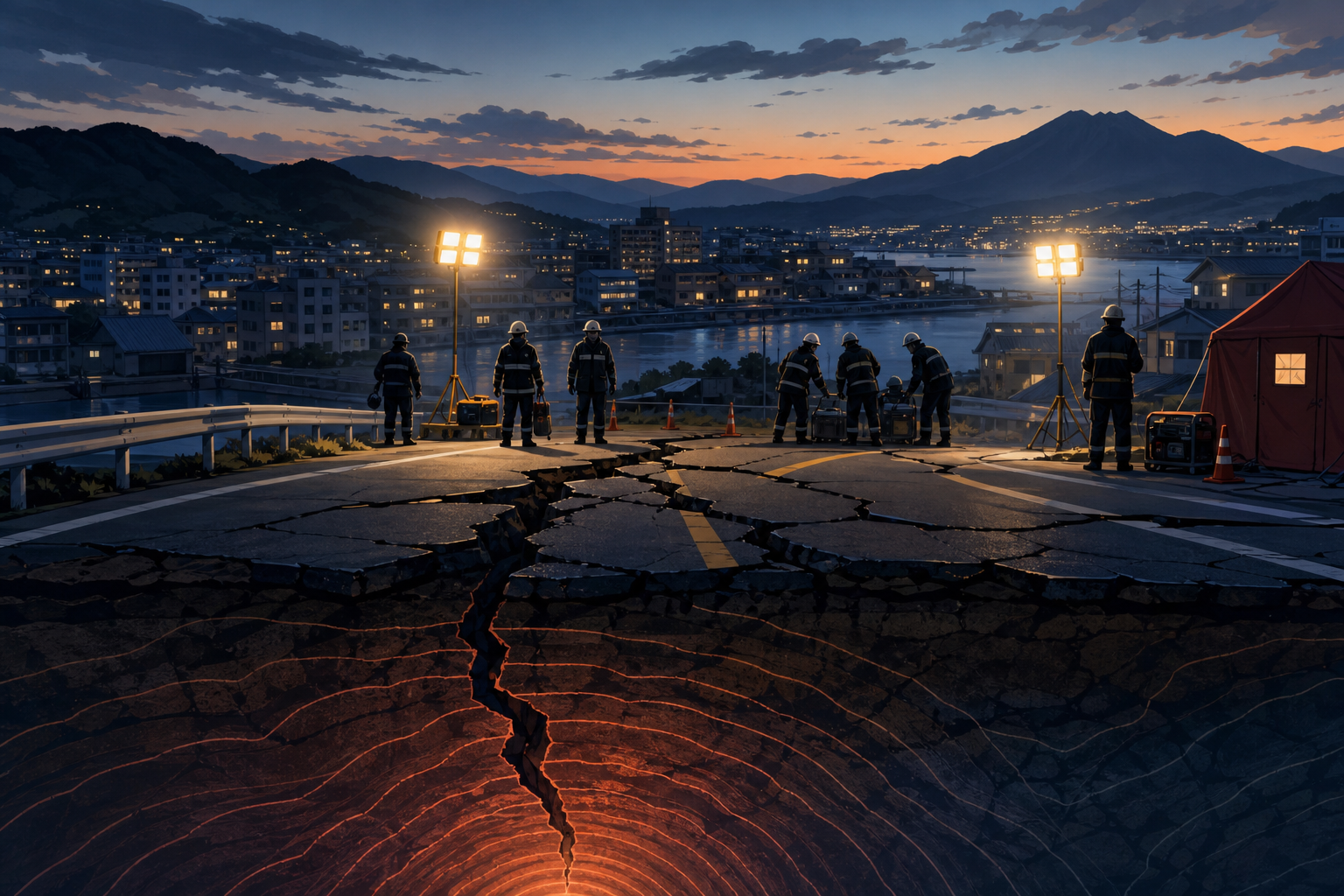
KUMAMOTO, Japan — Soldiers and emergency workers searched a damaged shopping mall, collapsed homes and industrial sites on Wednesday after a powerful earthquake killed at least 18 people in southwestern Japan, with an uncertain number still missing.
Japan’s Meteorological Agency measured the earthquake at magnitude 7.1, with a shallow focus about 10 kilometres below the Kumamoto region. It struck at about 4:27 p.m. local time Tuesday, producing violent shaking across parts of Kyushu. The Kumamoto prefectural government reported at least 62 injuries, including six serious cases, according to The Associated Press.
Some of the gravest damage was concentrated at an Aeon Mall in Kashima. The company said roughly 3,000 customers reached a parking area before a gas explosion hit another section where people were still working. Part of the second floor collapsed. By Wednesday, four deaths had been confirmed at the mall and three people remained missing, Aeon President Akio Yoshida said.
In nearby Yatsushiro, the collapse of a chimney at a Nippon Paper Industries factory killed five people. Seven were rescued from debris and four others were believed trapped, the prefectural disaster team said. A Vietnamese technical intern was killed in a separate factory accident when a crane fell, according to the Vietnamese government.
The disaster also disrupted basic services across the prefecture. Nearly 34,900 homes remained without electricity and about 15,000 lacked running water. More than 8,800 residents had moved into over 400 shelters, where authorities were adding power supplies for air conditioning as rescuers and survivors endured intense summer heat.
A tsunami advisory for the Ariake and Yatsushiro seas was issued after the earthquake and later lifted. Japan’s government said no abnormality had been reported at the Sendai nuclear power plant. Prime Minister Sanae Takaichi ordered agencies to gather damage information quickly, coordinate closely with local authorities and put the rescue of lives first.
A disaster made more dangerous by cascading failures
The earthquake itself was only the first emergency. The mall explosion, factory collapse, power outages, water disruption and extreme heat show how one shock can activate several hazards at once. That combination complicates rescue work and places older people, hospital patients and families sheltering in vehicles at particular risk.
Japan’s preparedness is among the world’s most developed. Strict construction standards, public drills, rapid alerts and professional response forces save lives. The evacuation of thousands of mall customers before the explosion is one example of preparation working under pressure. Taiwan’s dispatch of firefighters to support Japanese teams also demonstrated the value of practical cooperation among democratic partners in the region.
But national competence cannot become a reason for complacency. The failures at crowded commercial and industrial sites will require transparent investigation: whether gas shutoff systems operated as intended, whether emergency exits remained usable, whether older structures met current standards, and whether maintenance and evacuation plans reflected the risk of a major inland quake. Those questions should be answered with evidence, not early blame.
The next week will test resilience as much as rescue
Authorities warned residents to remain alert for further strong shaking. Aftershocks cannot be predicted precisely, and damaged buildings can fail under forces smaller than the initial earthquake. People should follow official instructions, avoid unstable structures and resist online rumours that present speculation as forecasts.
The most urgent work remains finding people who may still be alive. Close behind it comes the less visible task of sustaining shelters: restoring water, keeping medical supplies refrigerated, providing cooling, checking isolated households and making reliable information accessible to foreign residents as well as Japanese citizens.
Kumamoto experienced a deadly earthquake sequence in 2016, a memory that shaped both public fear and institutional preparation. Tuesday’s disaster is a reminder that resilience is not a fixed achievement. It must be renewed through enforcement, infrastructure investment and candid after-action reviews.
Open societies have an advantage in that work when officials release timely data, companies account publicly for failures and independent reporting tests official claims. Japan’s immediate priority is rescue, not politics. Yet the quality of the recovery will ultimately depend on the same democratic habits: transparency, local trust and the willingness to learn in public before the next emergency arrives.
Comments
Loading comments…