
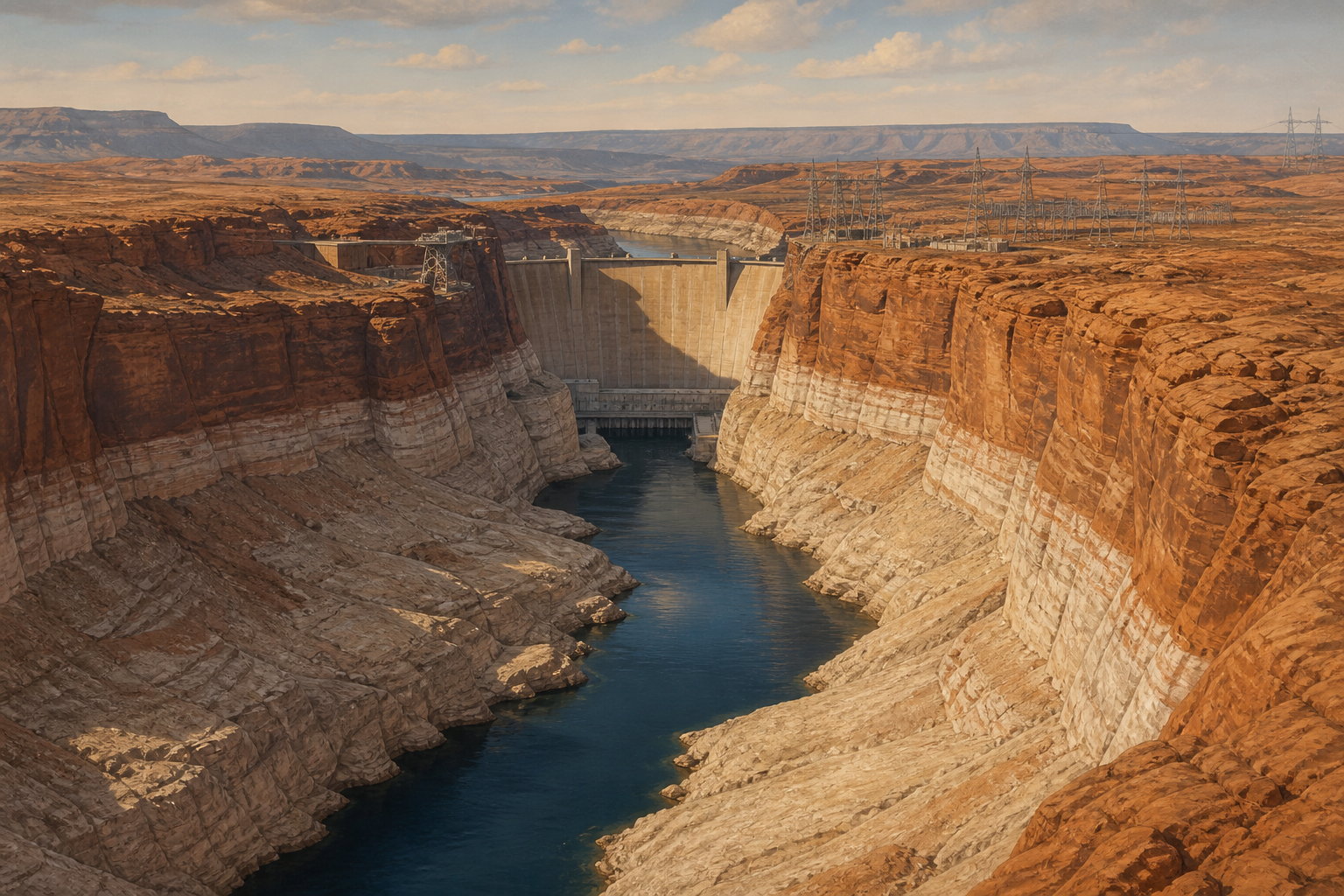
LAKE POWELL - The United States' second-largest reservoir fell to a record low over the weekend, bringing the Colorado River system closer to an energy and water emergency that could affect tens of millions of people across the American West.
Lake Powell's surface reached 3,519.91 feet above sea level on Saturday, according to Bureau of Reclamation data reported by The Associated Press. That level was slightly below the previous record set in April 2023 and more than 20 feet lower than at the beginning of this year.
The reservoir is now roughly 30 feet above the elevation at which water could no longer pass through Glen Canyon Dam's hydropower turbines, AP reported. Federal officials warned in April that a major intervention could be needed to prevent the reservoir from reaching that threshold by the end of 2026.
Lake Powell and Lake Mead are the two main storage reservoirs on the Colorado River, a system that supplies water to more than 40 million people in Arizona, California, Colorado, Nevada, New Mexico, Utah and Wyoming. The river also supports farms, tribal communities, wildlife, recreation and power generation across a region whose population and economy grew around assumptions of a more abundant water supply.
The latest federal data show how severe the shortfall has become. Lake Powell ended June at 3,525.17 feet and about 24 percent of live capacity. Unregulated inflow during June was only 12 percent of average. The Bureau's July outlook projected total water-year inflow at 3.5 million acre-feet, about 36 percent of average, and placed the reservoir near 3,516 feet at the end of the water year.
Lake Mead reached its own historic low about a week before Powell. The combined decline reflects several pressures operating at once: persistent overuse, a record-dry winter and hotter conditions that reduce snowpack, increase evaporation and dry soils before runoff reaches the river.
Federal officials and the seven basin states have not yet agreed on a durable plan for operating the system after current rules expire. A federal proposal released in July included scenarios with substantial potential cuts for Arizona, California and Nevada. Every state accepts that the river has less water than existing promises assume; the political fight is over who must surrender how much, and when.
The threat to hydropower is especially important because Glen Canyon Dam does more than produce electricity. Hydroelectric output can respond quickly when demand changes, helping stabilize the wider grid. Losing that flexibility would force utilities to replace energy at a difficult moment and could increase costs for customers served by the federal system.
The reservoir's decline is already changing life around it. Marinas have moved into deeper water, boat ramps have closed or been relocated, and tourism businesses have had to adapt to shorelines that keep retreating. Those visible disruptions are warnings of the much larger allocation decisions still ahead.
No engineering project can negotiate with a river. Pumps, tunnels and conservation programs can stretch supply, but they cannot permanently deliver water that does not exist. The hard reality is that legal entitlements and political expectations were built during a wetter period and now compete with a climate and consumption pattern that the old rules did not anticipate.
A credible response requires more than emergency releases designed to protect one elevation marker. Cities need continued conservation and reuse. Agriculture, which consumes most basin water, needs incentives to reduce use without casually destroying rural economies. Tribal nations must have a genuine role rather than being asked to absorb decisions made around them. States must also stop treating every concession as a victory for a rival.
This is a test of American federalism. Democratic governments are often slower than authoritarian ones because affected communities can challenge decisions and demand accountability. That process is a strength only if it eventually produces action. Delay that drives reservoirs toward operational failure is not consensus; it is avoidance.
Lake Powell's record can still be reversed by wet years, but one good snow season would not repair the structural imbalance. The Colorado River needs rules designed for scarcity, transparent data and burden-sharing that survives the next election cycle. The white mineral ring around the canyon records where the water once stood. The shrinking blue channel below shows how little time remains for promises to become policy.
Comments
Loading comments…