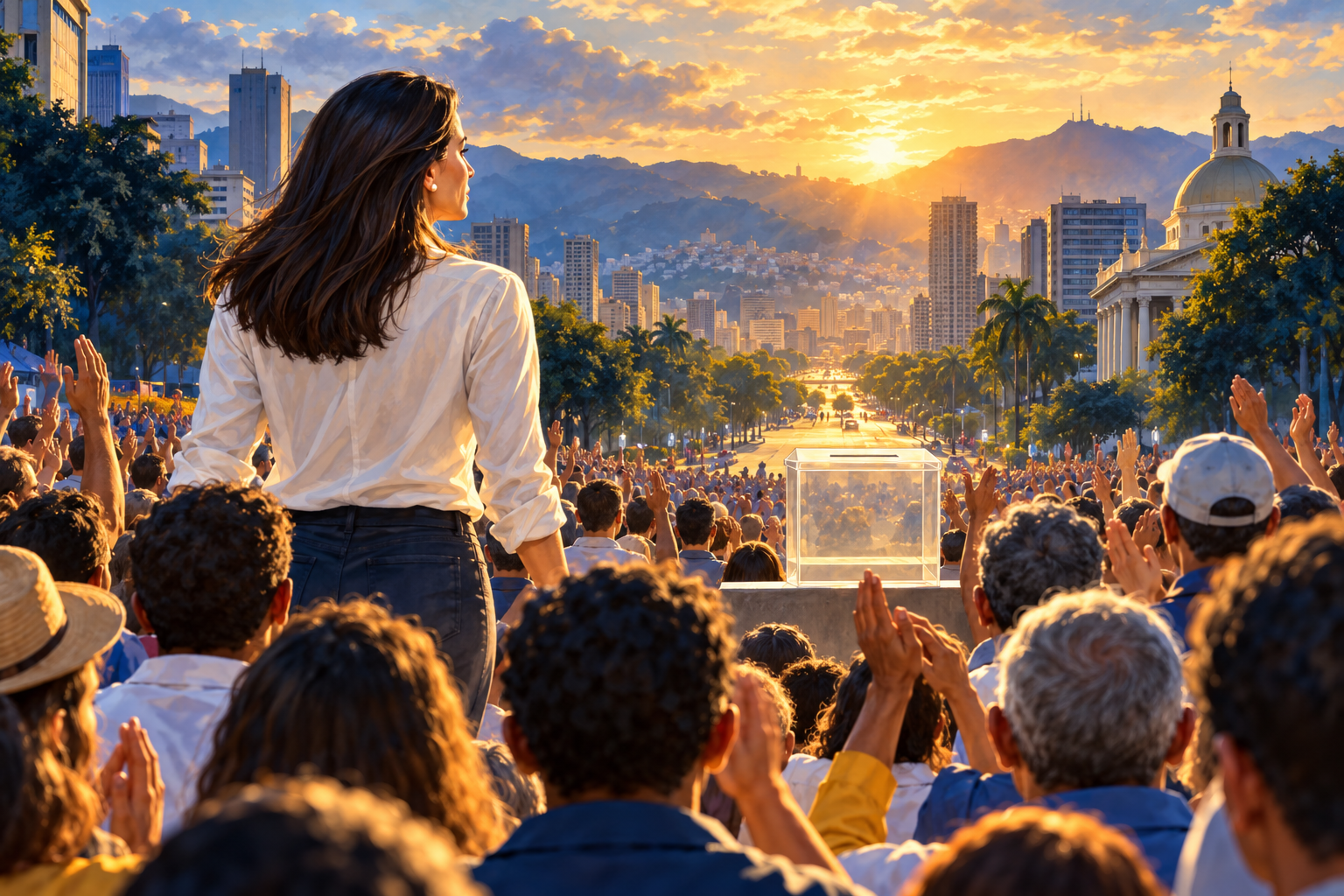
CARACAS, Venezuela - Opposition leader Maria Corina Machado returned to Venezuela after nearly 10 months abroad, drawing thousands of supporters into the streets and renewing demands for an election that the country's open-ended interim government has not yet scheduled.
Machado first appeared Sunday at a church in western Lara state before traveling toward Caracas in a convoy slowed by crowds. Supporters surrounded her route, sang the national anthem and called for freedom as she entered the capital late Sunday.
The return was her first public appearance inside Venezuela since leaving clandestinely in December 2025 to receive the Nobel Peace Prize in Norway. She had spent much of the previous year in hiding after a disputed presidential election and said several earlier efforts to come home had failed.
U.S. Secretary of State Marco Rubio said Monday that Washington told Venezuela's interim authorities weeks ago that Machado, as a Venezuelan citizen, should be allowed to return without interference. Acting President Delcy Rodriguez's government replied that she was free to enter, Rubio said.
Machado's arrival comes after the United States captured Nicolas Maduro in a military operation in January and transferred him to New York to face drug-trafficking charges, which he denies. Washington then backed Rodriguez, Maduro's former vice president, to lead an interim administration.
Rodriguez was initially authorized to serve for 90 days but remains in office months later. Venezuela still has no presidential-election date, although government representatives and one opposition faction agreed last week on a framework to reform the electoral council and top court before a possible vote in 2027.
Machado's Vente Venezuela movement is not participating in those talks. Rodriguez said Monday that she hoped the dialogue would provide space for all voices, while also criticizing people who had supported sanctions and foreign intervention.
Rubio said the U.S. goal was a durable electoral system trusted by all sides. He argued that Venezuela must rebuild courts, the electoral council, press freedom and space for political expression before voting. Washington says its leverage over the interim authorities will be used to keep the process moving.
Venezuela's last presidential vote explains the distrust. Machado won an opposition primary in 2023 but Maduro's government barred her from running. Retired diplomat Edmundo Gonzalez replaced her on the ballot in 2024. Credible evidence collected by the opposition indicated Gonzalez defeated Maduro by more than two to one, but a National Electoral Council dominated by government loyalists declared Maduro the winner.
The crackdown after that vote included more than 2,000 detentions, according to reporting compiled by the Associated Press, along with allegations of torture, forced disappearances and other abuses. Machado later went into hiding, while Gonzalez left the country.
A safe return is not the same as a democratic transition
Machado's return matters because authoritarian systems depend on making opposition feel permanently absent. A leader who can re-enter the country, travel openly and draw crowds breaks that image of inevitability. The public response showed that Venezuela's democratic movement did not vanish when Maduro was removed or when Washington chose Rodriguez as its partner.
Yet symbolism can be used as a substitute for power. An interim government may permit speeches and opposition rallies while delaying the only test that can authorize it: a free election. Allowing Machado to come home is progress, but it does not give Venezuelans the right to choose their president.
The United States faces its own credibility test. Removing Maduro created an extraordinary responsibility. Washington cannot claim democracy as the purpose of intervention while treating oil production, commercial agreements and short-term stability as sufficient outcomes. Supporting an unelected former Maduro deputy may have prevented immediate disorder, but temporary necessity becomes complicity if no deadline follows.
Rubio is correct that trustworthy elections require functioning courts, a credible electoral council, open media and protection for every campaign. Those institutions cannot be rebuilt overnight. But reform without a public calendar gives incumbents a reason to move slowly and allows foreign governments to decide when Venezuelans are supposedly ready for democracy.
Machado also must prove that her movement is larger than one personality. It needs a transparent program for economic recovery, reconciliation, security-sector reform and protection of political opponents. Venezuela does not need to replace one leader-centered system with another.
The hardest issue is inclusion. Talks that exclude the country's most visible opposition movement cannot easily claim to represent all democratic forces. At the same time, Machado's supporters will have to negotiate with institutions and officials tied to the old order. A peaceful transition requires accountability without collective revenge and compromise without surrendering the truth about 2024.
Venezuelans have already cast ballots that were denied. They have watched an authoritarian president fall, only to see an unelected successor remain under foreign protection. Machado's homecoming has reopened political space. The next step must be measurable: independent reforms, a firm timetable and an election in which every qualified candidate can compete.
A cheering crowd can welcome a democratic leader. Only a credible vote can create a democratic government.
Comments
Loading comments…