
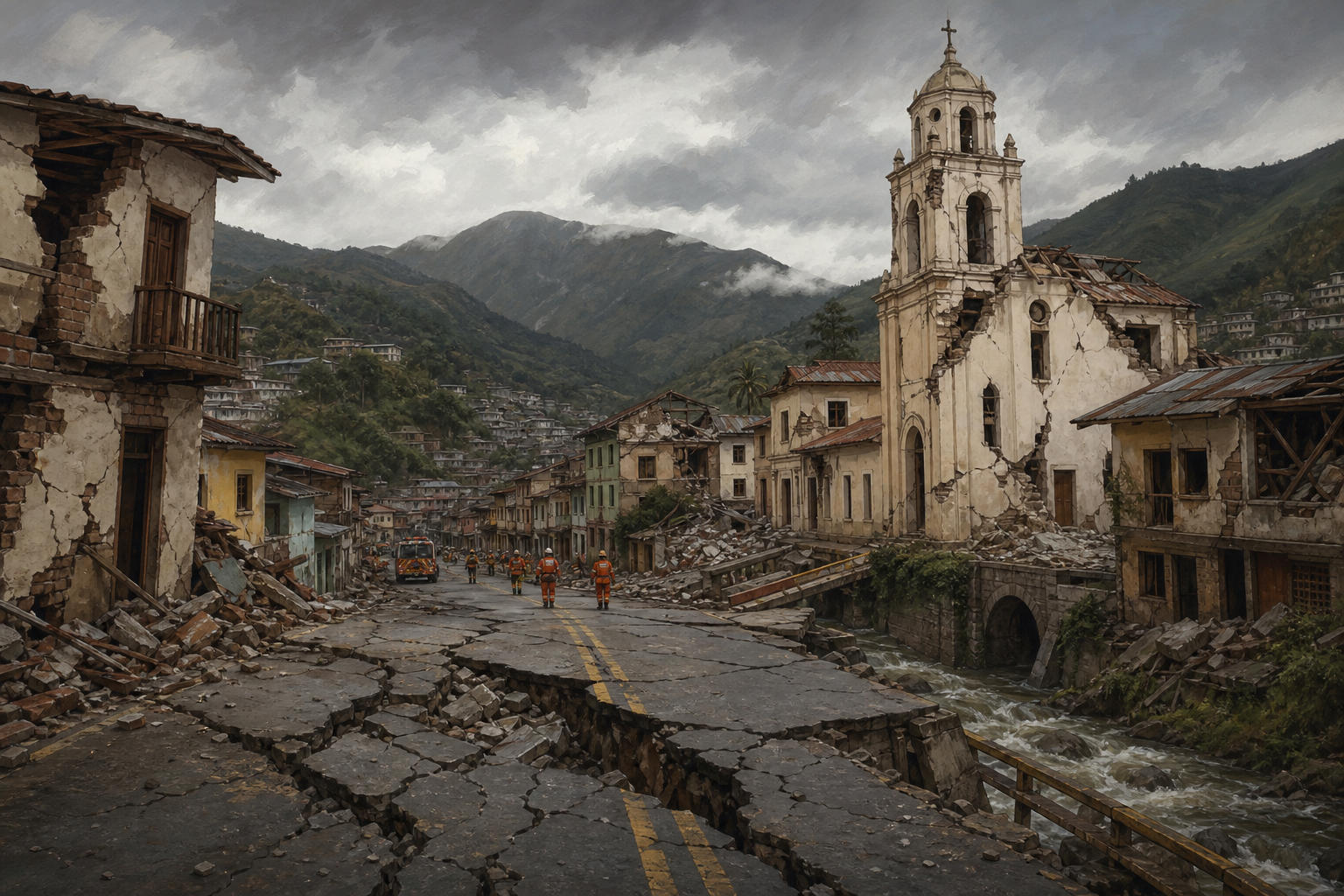
A magnitude 7.4 earthquake struck western Colombia on Monday morning, collapsing buildings, trapping residents and prompting a large rescue operation across several cities. El País, citing municipal mayors, reported 18 deaths in Pereira, three in Manizales and one in Buenaventura, for a combined local tally of at least 22. No national consolidated toll appeared in the cited reports by 10 a.m. local time, so that sum remained provisional.
The earthquake hit at 7:34 a.m. local time, with its epicentre near San José del Palmar in the Pacific department of Chocó. The Colombian Geological Service and the United States Geological Survey both measured the quake at magnitude 7.4. Their early depth estimates differed: Colombia’s service reported about 96 kilometres, while the USGS placed it at roughly 110 kilometres and five kilometres south of the town. Such figures are routinely refined as more seismic data is reviewed.
The destruction extended well beyond the sparsely populated epicentral area. El País reported that Cali Mayor Alejandro Eder said roughly 20 structures had collapsed in his city and people were trapped, prompting him to request additional rescuers from Bogotá and Medellín. The same outlet cited Chocó Governor Nubia Córdoba as reporting injuries and serious building damage in Quibdó, but no verified injury total was available at the reporting cutoff.
The broad shaking sent residents out of high-rise buildings in Bogotá, hundreds of kilometres from the epicentre, and was also felt in neighbouring Ecuador. Reports of damage across Cali, Pereira, Manizales and Quibdó show why a relatively deep earthquake can still create a dispersed emergency: officials must inspect many locations at once while early information arrives through separate municipal systems.
Transport disruption quickly became part of the response. Colombia’s civil aviation authority initially suspended operations at airports in Pereira, Manizales, Quibdó, Armenia, Cartago and Buenaventura while engineers assessed structural damage. A second official bulletin added Cali’s Alfonso Bonilla Aragón airport to the list, taking the quake-related suspensions to seven. The closures protect passengers from unsafe terminals, but they also narrow routes for specialist rescue teams, medical transfers and relief supplies.
No tsunami warning was issued. President Abelardo de la Espriella said he was heading to Bogotá to concentrate on the response and had convened a Unified Command Post through the national disaster-management system. The immediate task is to combine national coordination with reliable municipal information while firefighters, police, hospitals and residents continue working through rubble.
USGS analysis says the rupture probably occurred inside the Nazca slab as it descends beneath South America. Its depth broadened the area in which shaking was felt while generally limiting peak surface motion compared with an equally large shallow earthquake. The agency issued an orange PAGER alert, an automated estimate signalling the possibility of significant casualties and economic losses. That alert is a modelled risk assessment, not a confirmed death count.
The hardest phase now is not measuring the earthquake but finding who is missing. Urban search-and-rescue teams must prioritise sites with signs of life while engineers triage hospitals, schools, bridges and densely occupied buildings. Road inspections are equally important. Landslides or damaged bridges in Colombia’s mountainous west could isolate communities even when their buildings remain standing, and Chocó’s difficult terrain makes incomplete early reporting especially likely.
Clear accounting will matter. Municipal death announcements should be identified by city and time rather than casually merged, because duplicated names and later corrections are common during disasters. Authorities should publish rolling, reconciled lists of casualties, inspected structures and reopened transport links. That discipline is not bureaucracy for its own sake: families need dependable information, and rescue commanders need to know where crews and equipment will save the most lives.
Colombia has a painful benchmark for the risk. A magnitude 6.2 earthquake near Armenia in 1999 killed nearly 1,000 people, according to El País, and exposed weaknesses in construction and emergency access across the coffee-growing region. Monday’s deeper earthquake is different, but damage in several western cities again tests whether building standards, retrofits and response planning have kept pace with urban growth.
The local casualty reports remain provisional. The next hours will be shaped by searches in Cali and Pereira, information from Quibdó and smaller Chocó communities, hospital capacity and the pace of structural inspections. Airport operations should resume only after engineers certify the terminals, while the government keeps alternative land and air corridors open. For now, rescue is the priority and every casualty figure requires cautious, time-stamped attribution.
Comments
Loading comments…