
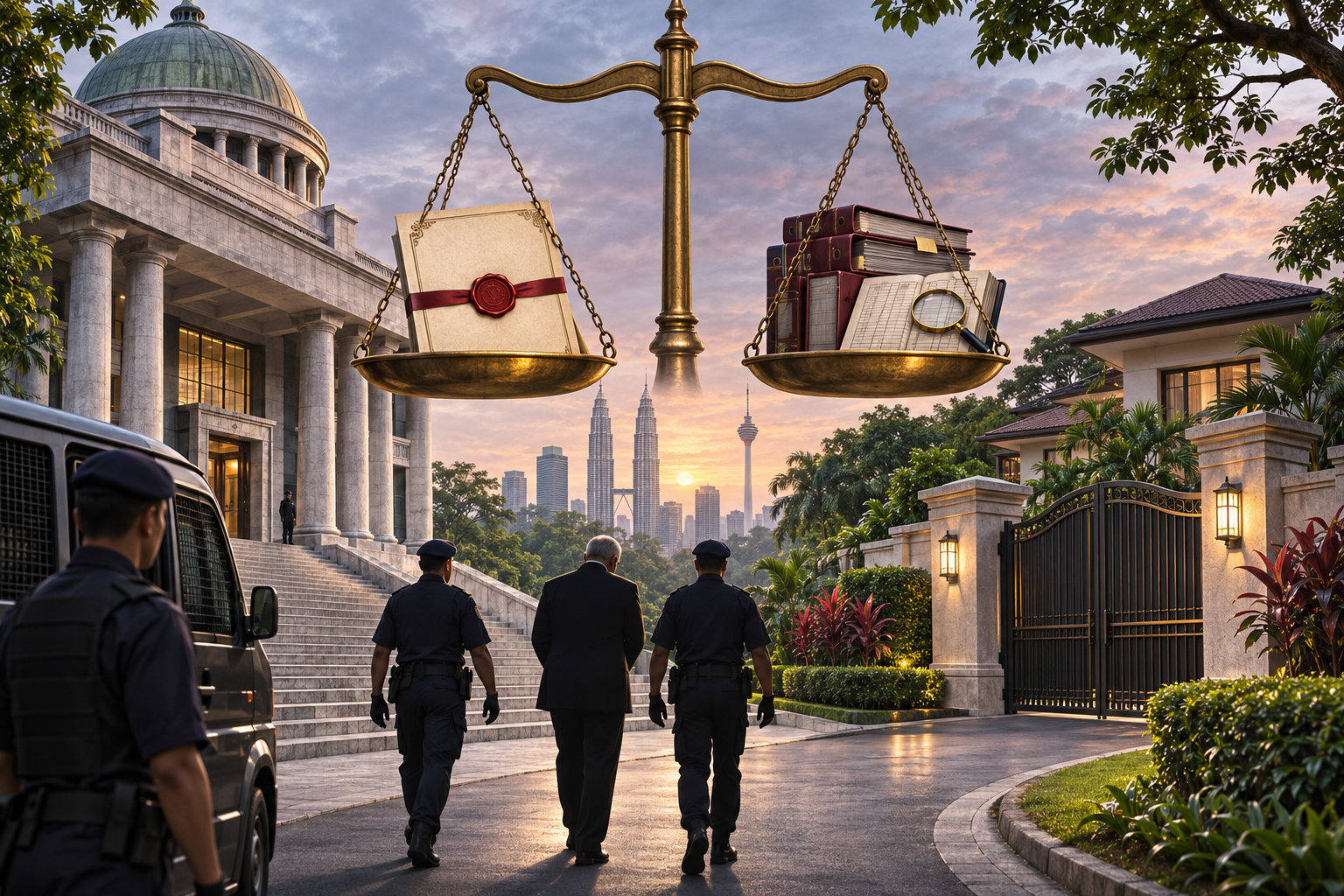
KUALA LUMPUR - Malaysia's former prime minister Najib Razak was transferred from prison to his Kuala Lumpur residence on Tuesday after the High Court ordered that the remainder of his first corruption sentence be served under house arrest.
The court said the order took effect immediately and will keep Najib at his Langgak Duta home until August 23, 2028. The ruling resolved a dispute that briefly sent him back to prison after officials questioned how a royal clemency order should be implemented.
Najib has been imprisoned since August 2022 for abuse of power, criminal breach of trust and money laundering involving 42 million ringgit that moved into his accounts from SRC International, a former unit of the 1Malaysia Development Berhad fund.
He was originally sentenced to 12 years and fined 210 million ringgit. Malaysia's Pardons Board cut the sentence to six years and the fine to 50 million ringgit in 2024. King Sultan Ibrahim Iskandar granted conditional clemency in September 2026 that allowed Najib to serve the remaining term at home after paying the reduced fine.
Najib's political party raised the money, and the 50 million ringgit fine was paid on November 6. He briefly left prison before the attorney general halted the transfer and sought clarification, arguing that an initial discharge document could be interpreted as ending the remaining SRC sentence entirely rather than converting it to house arrest.
High Court Judge Aslam Zainuddin set aside that document and replaced it with an order matching the conditional pardon. Najib was then taken to his home, where security had been prepared for his arrival.
The house arrest does not erase a separate 15-year prison sentence imposed in December 2025 for corruption and money laundering in another major case tied to 1MDB. Najib is appealing that conviction. If the appeal fails, he could return to prison after the house-arrest term ends.
Investigators say at least $4.5 billion was stolen from 1MDB and moved through banks and shell companies in several countries. The scandal produced investigations in the United States and elsewhere and helped end the long rule of Najib's coalition in Malaysia's historic 2018 election.
Najib, who led Malaysia from 2009 to 2018, has denied wrongdoing in the 1MDB scandal. He remains influential in the United Malays National Organization, which is part of the current governing coalition.
Clemency may be legal and still weaken public trust
Malaysia's constitution gives the monarchy a legitimate role in pardons. The court was therefore right to clarify the order through law rather than leave prison officials, prosecutors and political parties to improvise its meaning.
But legality does not settle the democratic question. House arrest in a comfortable private residence is not equivalent to imprisonment, even when both are formally described as custody. Ordinary Malaysians convicted of serious financial crimes are unlikely to receive the same conditions.
That perception matters because 1MDB was not a technical accounting offense. The scandal involved public wealth, global laundering networks and money that could have supported schools, transport and health care. Its political consequences reshaped Malaysia.
Prime Minister Anwar Ibrahim warned that paying Najib's fine should not create the impression that corruption involving billions can be overlooked. That concern is justified. A democratic system loses credibility when punishment appears to become more negotiable as a defendant's wealth and political influence increase.
Najib's supporters can correctly say that he remains under sentence and has not been acquitted. They can also argue that the pardon power exists precisely to temper judicial punishment. Neither point answers why this case deserved extraordinary leniency or how the decision advances equal justice.
The temporary conflict between the palace and attorney general exposed another institutional risk. Royal authority, prosecutorial interpretation and court administration appeared to pull in different directions over a politically sensitive prisoner. Clear published rules for house arrest and pardons would reduce the space for private pressure and public confusion.
Malaysia's democracy has shown resilience. Voters removed a coalition once considered untouchable, investigators pursued a former leader and courts imposed convictions despite enormous pressure. Those achievements should not be weakened by an elite settlement that appears to soften accountability after the difficult work is done.
Democratic governments in Asia face constant claims from authoritarian neighbors that elections and courts are merely theater for powerful interests. The strongest rebuttal is visible equality before the law, including when the defendant once controlled the government.
Najib's move home is not freedom, and his separate 1MDB appeal remains consequential. Yet the image of a former prime minister leaving prison after his party paid a reduced fine will shape public judgment. Malaysia now must prove that clemency is an exceptional constitutional act, not a second justice system reserved for the connected.
Comments
Loading comments…