
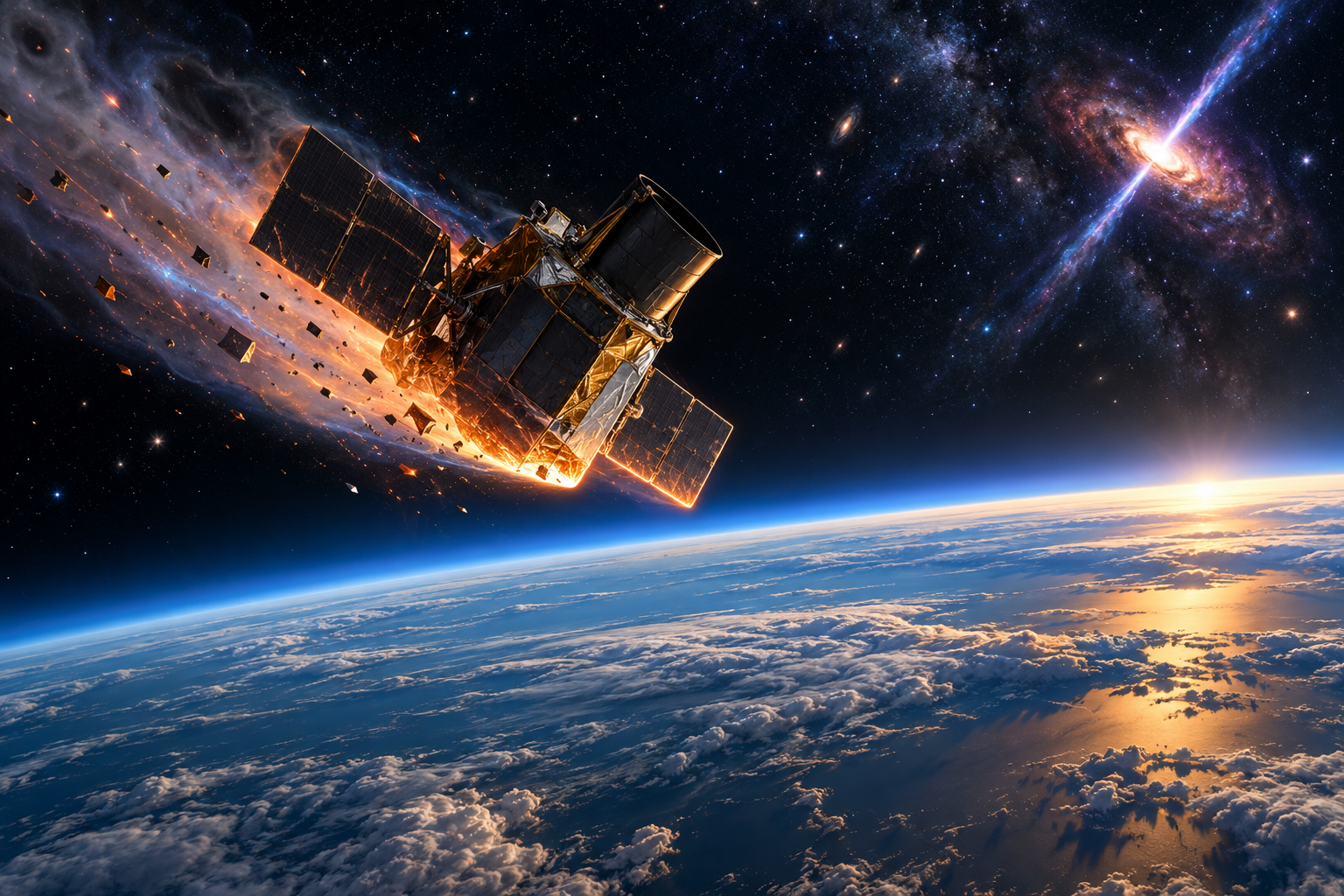
CAPE CANAVERAL, Fla. - NASA's Neil Gehrels Swift Observatory is expected to fall from orbit within days, ending a 22-year mission that transformed the study of gamma-ray bursts and other violent events in the universe.
The U.S. Space Force projects that the 1.5-ton spacecraft will reenter Earth's atmosphere on or around Friday, according to the Associated Press. The exact time and location will remain uncertain until the telescope moves much closer to the atmosphere because small changes in solar activity and air density can alter its final path.
Most of Swift is expected to burn up during reentry. NASA officials said a limited number of dense tungsten components and parts of its mirrors could survive the descent, although any debris is most likely to fall into the ocean.
The reentry corridor passes over broad areas between the observatory's orbital limits, including parts of Africa, Australia, India, Southeast Asia and Central and South America. Space Force trackers are monitoring the orbit and will refine the forecast as the spacecraft descends.
NASA ended Swift's science operations in October after its orbit dropped below 171 miles, or 275 kilometers. By late October, the telescope was too low to remain stable enough for observations, and controllers sent commands to shut down its systems and prepare it for reentry.
The mission had been threatened for years by atmospheric drag. NASA and Katalyst Space Technologies attempted an unusual commercial rescue using the LINK spacecraft, which was designed to rendezvous with Swift and boost it to a higher orbit.
That plan was curtailed after LINK developed an attitude-control problem. NASA announced in August that the spacecraft would not capture or raise Swift as planned, although the company continued work intended to demonstrate rendezvous and proximity operations. The effort could not prevent the observatory's orbital decline.
Swift launched in November 2004 to detect gamma-ray bursts, brief flashes produced by some of the universe's most energetic explosions. It could rapidly turn toward a burst and alert observatories around the world, allowing scientists to study the event across different wavelengths before the signal faded.
Over its lifetime, Swift observed more than 2,000 gamma-ray bursts and roughly 1,400 exploding stars. It also helped scientists investigate comets, asteroids and black holes tearing apart stars. NASA said the mission leaves a large archive that researchers will continue to use.
The observatory was renamed in 2018 for Neil Gehrels, the mission's founding principal investigator. Its final descent closes a productive scientific mission while opening a practical debate about how future spacecraft should be maintained and retired.
A failed rescue can still shape the next generation of spaceflight
Swift's return is not a failure of its original mission. A spacecraft designed for a much shorter lifetime continued producing science for more than two decades. Its teams stretched public investment far beyond the initial expectation and built a rapid-alert system that changed how astronomers respond to fleeting events.
The unsuccessful boost attempt does reveal the difficulty of servicing satellites that were never designed to be grabbed, refueled or raised. Autonomous rendezvous must solve navigation, control and safety problems around an aging object moving thousands of miles per hour. A single fault can consume the limited time left before atmospheric drag becomes irreversible.
Commercial servicing remains worth pursuing. The United States has a strategic advantage in combining NASA's engineering discipline with private companies willing to test new spacecraft quickly. Successful inspection, repair and orbit-raising systems could extend expensive missions, reduce debris and make space infrastructure more resilient.
But future observatories should not depend on an improvised rescue. Designers can add standard grapple fixtures, refueling interfaces, modular components and reliable end-of-life systems. Those features cost mass and money at launch, yet they may save far more than a last-minute mission built under orbital pressure.
There is also a public-safety obligation. The chance of surviving debris harming anyone is extremely small, but governments should publish tracking updates and explain uncertainty plainly. Transparency prevents a normal, monitored reentry from becoming a source of rumor or unnecessary fear.
Swift spent 22 years teaching scientists to react quickly when the universe changed without warning. Its final lesson is similar: space agencies must prepare before a problem becomes an emergency. The telescope's science will survive in its archive, and the rescue attempt should survive as engineering knowledge for missions still to come.
Comments
Loading comments…