
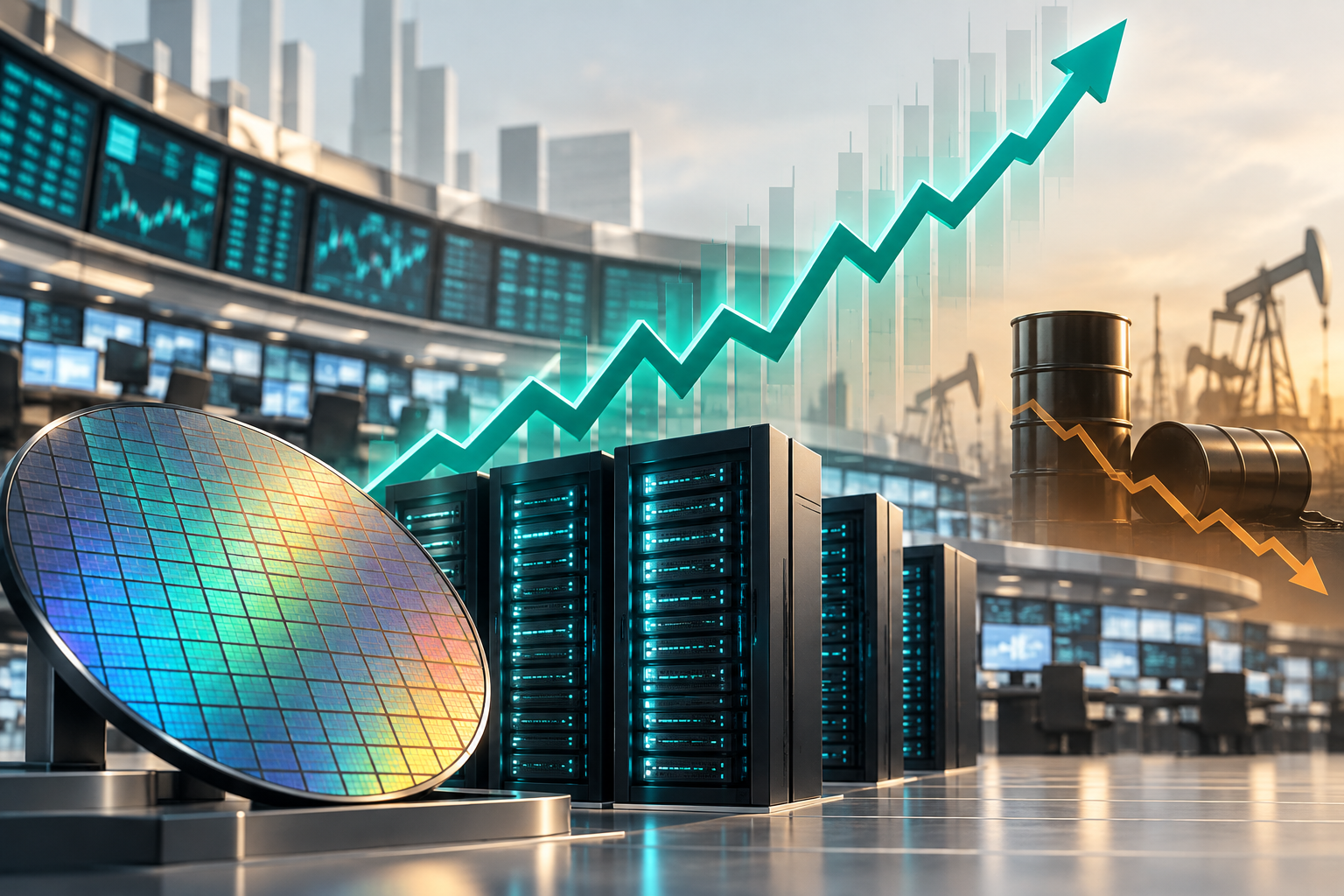
NEW YORK - The Nasdaq Composite closed at a record high Monday as a rally in semiconductor and other artificial-intelligence shares combined with falling oil prices and Treasury yields to lift U.S. stocks.
The Nasdaq gained 2.26% to 27,122.09, its first record close since June 2, according to Reuters. The S&P 500 rose 1.49% to 7,764.70, ending roughly 0.4% below its August record. The Dow Jones Industrial Average advanced 0.71% to 52,048.83. All three indexes finished higher, but the technology-heavy Nasdaq led by a wide margin.
Oil's retreat was another major part of the session. Brent crude futures briefly traded below $100 a barrel before settling at $100.34, according to Reuters. The Associated Press reported that the settlement was about 3.4% lower on the day, though still far above the roughly $72 level seen earlier in the summer.
The yield on the benchmark 10-year U.S. Treasury note fell to about 4.95% from 5.01% late Friday, according to the Associated Press. That move mattered because higher yields increase borrowing costs for households, companies and the federal government, while also making expensive growth stocks less attractive relative to bonds.
Chipmakers supplied much of the stock-market momentum. Reuters reported that Advanced Micro Devices rose about 10% and reached a market capitalization of $1 trillion for the first time. Intel gained 12.2%, Arm Holdings rose 17%, and the PHLX semiconductor index climbed 4.3%. The gains followed a recent selloff linked partly to warnings from AI leaders about the pace and safety of frontier development.
Investors also reacted to hopes that diplomacy during United Nations meetings might ease tensions in the Middle East. President Donald Trump said he was open to meeting Iranian President Masoud Pezeshkian, according to Reuters. That possibility helped market sentiment, but no agreement to end the conflict or normalize traffic through the Strait of Hormuz had been announced.
The market's optimism therefore rests on several moving parts that can reverse quickly. Oil remains elevated because shipping through Hormuz is still constrained by the Iran war. A tanker was struck by an unidentified projectile in the strait on Monday, injuring two crew members. That incident did not stop the day's stock rally, but it showed why one lower oil settlement does not resolve the underlying supply risk.
Inflation is another constraint. The Federal Reserve raised interest rates last week for the first time in three years, responding to price pressures that have proven difficult to tame. Lower bond yields on one trading day provide relief, but they do not mean the central bank has changed course or that consumer prices have returned to its target.
For American investors, the session displayed both the strength and concentration of the AI boom. U.S. firms still command world-leading chip design, data-center infrastructure and software distribution. That edge supports earnings and national technological power. But when a few large technology companies provide much of the index's upside, the market also becomes more vulnerable to a disappointment in spending, product demand or regulation.
A record Nasdaq is not the same as a broadly secure economy. Gasoline prices, borrowing costs and household budgets remain exposed to a conflict thousands of miles away. The Associated Press put the average U.S. price for regular gasoline near $4.48 a gallon, above both the prior week and the same period a year earlier. A portfolio may recover faster than a family's fuel budget.
The harder reality is that financial markets price expectations, not guarantees. Investors bought the prospect of cheaper energy, easier borrowing conditions and continued AI growth. They may be right about all three. But a renewed shipping disruption, another inflation surprise or weaker returns from enormous AI capital spending could change the calculation just as quickly.
Monday's rally was a genuine vote of confidence in American innovation and corporate resilience. It was also a reminder that confidence is conditional. The United States can strengthen the foundation beneath the market by protecting trade routes, maintaining credible inflation control and building technology that produces durable productivity rather than relying only on the next surge in share prices.
Comments
Loading comments…