
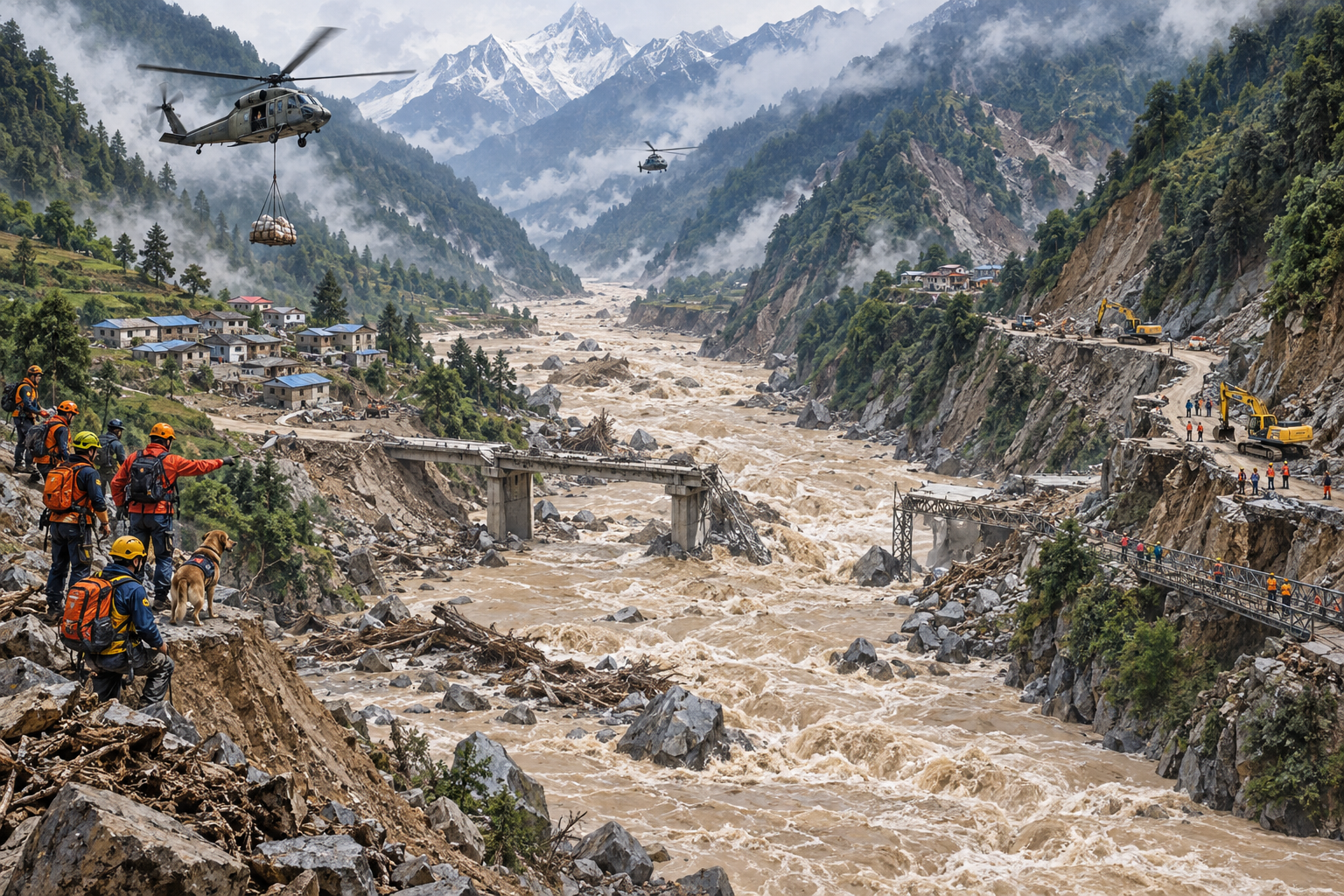
KATHMANDU, Nepal - Nepalese authorities said 1,355 bodies had been recovered and about 5,000 people remained missing after catastrophic flooding along the Bhote Koshi River, as international teams expanded one of the country's largest rescue and recovery operations.
The floods struck on August 26 and caused severe damage across Rasuwa, Nuwakot and Dhading districts and communities along the river corridor. Nepal's Ministry of Foreign Affairs said in a September 7 update that roads, electricity networks and telecommunications had been damaged, complicating the effort to reach isolated areas.
The official figures remain subject to revision as rescue teams gain access to affected valleys and authorities reconcile missing-person reports. The Associated Press reported that Nepal observed a national day of mourning on Monday, with flags lowered on the 13th day after the disaster.
Nepal's government said 13,396 people had been rescued, including more than 300 foreign nationals. It estimated that roughly 600 foreigners from 35 countries were among those still missing. Families awaiting news have pressed authorities to intensify searches and provide clearer information about the fate of relatives.
Officials said four people were found alive during the preceding four days, including survivors recovered from areas near the Upper Trishuli hydropower tunnels and Betrawati. Those rescues offered rare hope as the operation increasingly shifted toward recovery, identification and restoring access to cut-off communities.
Nepal's army, police, Armed Police Force and disaster-management agencies have been mobilized. Specialist teams from India, China and South Korea joined the effort, while the United Arab Emirates and Malaysia also sent assistance. Authorities requested high-capacity drones, mapping equipment, temporary bridges, medical supplies and DNA identification kits.
A temporary bridge has been installed on the Galchhi-Trishuli road, according to the government, but the destruction of transport links continues to slow the movement of rescuers and supplies. The United States and other international partners have offered support as Nepal confronts both the immediate human toll and the risk of disease in flood-hit settlements.
This disaster is first a story of people, not statistics. Every number in an official update represents a family waiting for a name, a body or a survivor. That is why the missing-person registry, recovery records and identification process must be transparent, frequently updated and open to scrutiny.
The darker lesson is that spectacular rescue operations cannot substitute for preparation. Himalayan communities live beside rivers that can change with terrifying speed, while roads, bridges, power lines and construction sites often occupy narrow corridors with few escape routes. When one route fails, an entire valley can become inaccessible.
The reported presence of workers around hydropower tunnels also raises a basic question that should not be lost in the scale of the tragedy: whether major infrastructure projects had realistic evacuation plans for an extreme flood. Economic development is necessary, but workers should not bear hidden risks created by poor warning systems, inadequate shelters or pressure to remain at vulnerable sites.
No single event can be attributed to climate change without careful scientific analysis. Yet a warmer atmosphere can hold more moisture, and mountain regions face added danger from intense rain, unstable slopes and changing glacial systems. Governments do not need perfect certainty about the next disaster to strengthen monitoring, enforce safer construction and pre-position rescue equipment.
Nepal also needs international cooperation that lasts after television crews leave. American and allied support can help with satellite imagery, emergency communications, engineering and identification technology. Assistance should reinforce Nepalese institutions rather than create a temporary parallel system that disappears once the immediate crisis passes.
Accountability is not an attack on rescuers working under brutal conditions. It is the obligation that follows a loss of this magnitude. Authorities should publish a clear timeline of warnings, evacuation orders, infrastructure failures and response decisions, then allow independent experts to examine where systems worked and where they did not.
The Bhote Koshi floods have exposed how quickly geography, fragile infrastructure and limited state capacity can combine into a national catastrophe. The humane response is to continue searching for the missing. The responsible response is to ensure that the same vulnerabilities are not rebuilt in the same places and left to fail again.
Comments
Loading comments…