
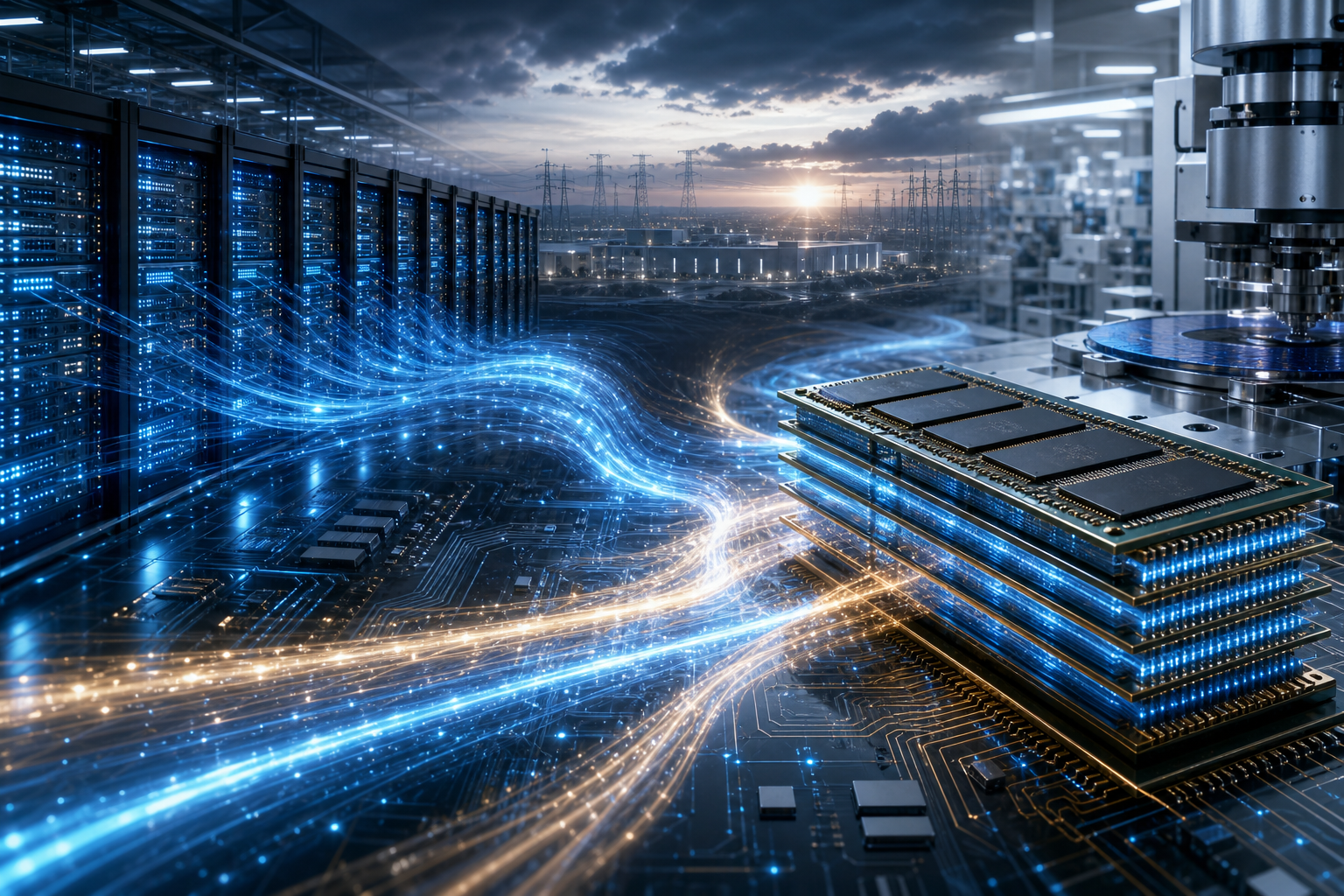
American chipmaker NVIDIA and South Korea’s SK Group announced plans in San Francisco on Friday, July 24, for a $500-billion-plus artificial intelligence partnership spanning massive data centers and next-generation memory. The companies said the program would combine NVIDIA computing systems with SK Telecom’s infrastructure and SK hynix’s high-bandwidth memory, tying one of the world’s leading AI-chip designers more closely to one of its most important memory suppliers.
The headline number needs careful reading. NVIDIA and SK said they signed letters of intent to formalize the arrangement. The $500 billion represents projected business over the life of the initiative—not cash already invested, a single construction budget, or a completed transaction. NVIDIA chief executive Jensen Huang told Bloomberg that the total includes memory NVIDIA expects to buy from SK and NVIDIA supercomputers SK expects to purchase. Its final scale will depend on binding contracts, financing, construction and customer demand.
The infrastructure centerpiece is an AI cloud of up to two gigawatts being planned by SK Telecom in South Korea. It would use NVIDIA’s Vera Rubin accelerated-computing systems and DSX platform, paired with SK hynix HBM4 memory. The first AI factory is planned to come online in 2027. The companies say the infrastructure will support sovereign, enterprise, agentic and physical AI services across South Korea and the wider Asia-Pacific region.
NVIDIA and SK hynix also plan a long-term memory partnership intended to secure supply and jointly develop and optimize future high-bandwidth memory products. HBM places multiple memory layers close to AI processors, allowing enormous quantities of data to move quickly while models are trained or used. It has become one of the most important constraints in the AI supply chain, giving South Korean manufacturers substantial leverage over an industry often discussed mainly through the success of American processor designers.
The SK announcement formed part of a broader NVIDIA push in South Korea. Bloomberg reported that NVIDIA also plans to invest $1 billion in Naver to help expand an AI data center being developed with Brookfield. Brookfield has signed a non-binding term sheet that could provide up to $9 billion for that separate project. Together, the announcements position South Korea as more than a supplier of components: they envision the country as a major host and operator of computing infrastructure.
That ambition is strategically important. NVIDIA brings the dominant computing platform, while SK brings memory manufacturing, telecommunications infrastructure and large-scale industrial capacity. Joining those strengths could shorten development cycles and reduce the risk that shortages in one part of the supply chain delay entire AI systems. It also gives South Korea an opportunity to capture more of the economic value created after semiconductors leave the factory, including cloud services, industrial automation and domestic AI applications.
For the United States, deeper integration with South Korea strengthens a democratic-allied technology network at a time when China is spending heavily to reduce its dependence on Western chips. No supply chain can be made immune to geopolitical shocks, and concentrating vital capacity in any one region carries risk. But a U.S.-South Korean partnership rooted in treaty ties and rule-of-law systems offers customers a more transparent alternative to infrastructure shaped by Beijing’s state-security and data-access laws.
The physical challenge, however, is as serious as the technology. A two-gigawatt computing buildout will require extraordinary grid connections, reliable generation, cooling systems, land and transmission investment. South Korean officials and the companies will eventually need to explain where that electricity will come from, who will pay for supporting infrastructure and how ordinary consumers will be protected from higher costs. AI leadership cannot rest on impressive chip specifications while treating energy as an unlimited resource.
The financial structure also deserves scrutiny. NVIDIA buying SK memory while SK buys NVIDIA systems can create genuine industrial coordination, but it also means the $500-billion figure counts commerce flowing in both directions. It should not be presented like a single outside investor placing half a trillion dollars into new Korean facilities. Investors have become increasingly wary of circular AI deals in which suppliers help finance customers that then purchase their products. Transparency about contracts, financing and real end-user demand will matter as the initiative develops.
The partnership is therefore both substantial and unfinished. Its importance lies in the alignment of two companies controlling critical layers of the AI stack, not in pretending that $500 billion has already been spent. The milestones to watch are binding purchase agreements, disclosed financing, confirmed sites and grid connections, and whether the first factory enters service in 2027. If those pieces arrive, the initiative could deepen South Korea’s role as an AI power and widen America’s allied technology base. If they do not, the announcement will remain another enormous number from an industry already crowded with promises.
Comments
Loading comments…