
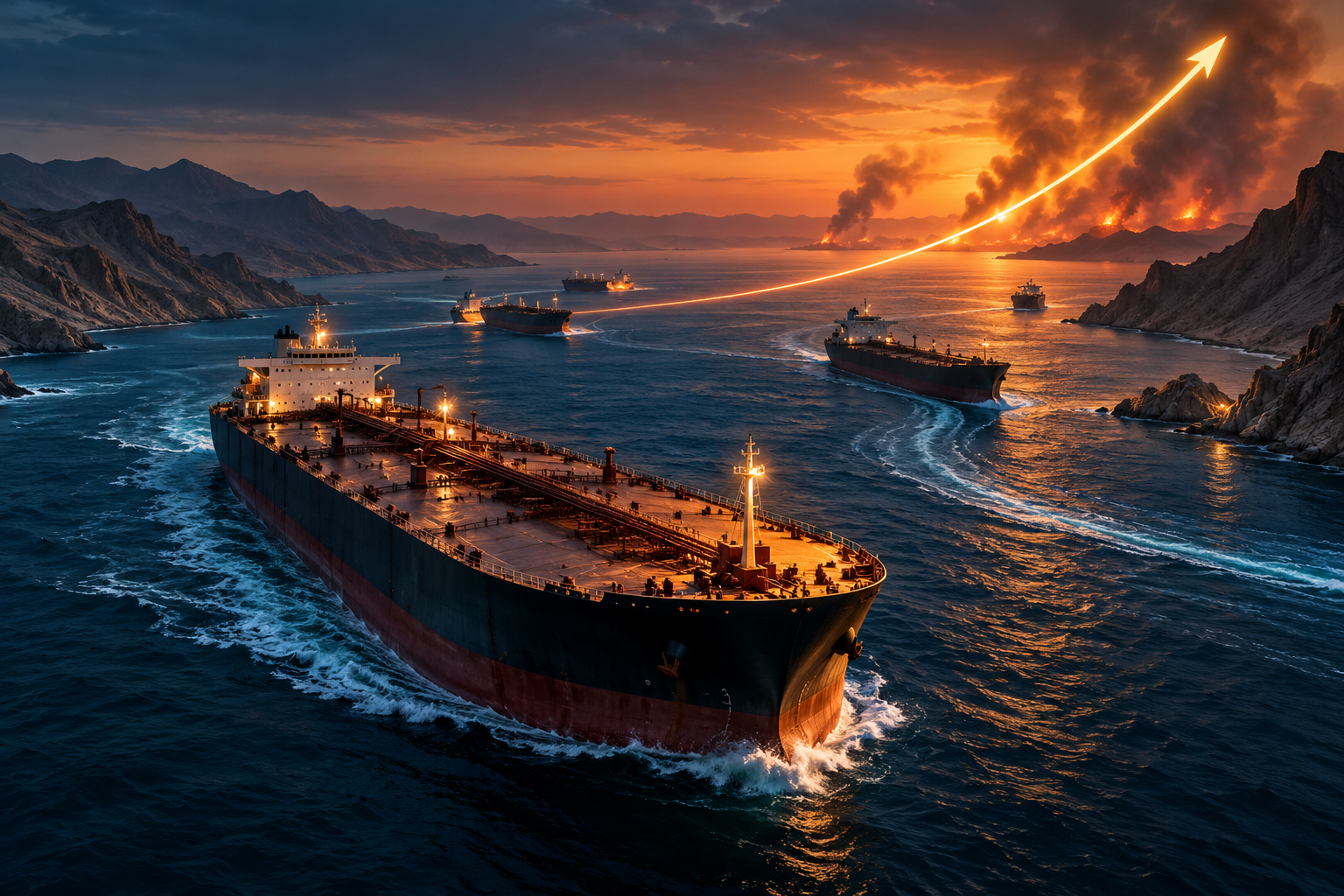
Brent crude touched $110 a barrel on Friday for the first time since May as escalating attacks around the Strait of Hormuz and fresh disruption at a Russian refinery renewed fears that the world could lose more oil and fuel supply.
The international benchmark settled $3.94 higher, or 3.7%, at $109.86 a barrel, its highest close since May 19, Reuters reported. U.S. West Texas Intermediate rose $3.44, or 3.5%, to $101.41, its highest settlement since Sept. 17. For the week, Brent gained 4.9% while WTI jumped 10.4%.
The immediate concern is the Strait of Hormuz, the narrow waterway linking Persian Gulf producers to global markets. Attacks on vessels have intensified over the past 10 days. Iran has said it is increasing strikes in response to a U.S. blockade of its ports and tougher sanctions, while maritime reports have not assigned responsibility for every incident.
The Associated Press reported that the United Kingdom Maritime Trade Operations center said at least three vessels were struck by unknown projectiles in the strait on Sunday. There were no immediate claims of responsibility. Mohsen Rezaei, secretary of Iran's top security body, separately told Iranian state television that Iranian forces were attacking ships Tehran described as smuggling vessels.
Analysts at the Institute for the Study of War said the pattern appeared designed to disrupt ship-to-ship transfers used to move energy through the strait. Kpler analysts said intensified Iranian attacks had driven Gulf crude flows sharply lower and warned that recovery would probably remain slow and uneven without a broader political agreement.
Pressure also spread to Saudi Arabia's alternative export route. A Saudi-led coalition said it intercepted a ballistic missile heading toward Yanbu, a Red Sea port critical to the kingdom's effort to bypass Hormuz. Initial reports indicated that the port infrastructure was not damaged, according to Rapidan Energy Group.
Supply risks are no longer confined to the Middle East. Russia's Ryazan refinery suspended a primary crude-distillation unit after a drone strike on Thursday, industry sources told Reuters. That disruption raised doubts about how much diesel Russia could supply as tight refining capacity pushes fuel prices higher.
Governments are using reserves to limit the damage. The International Energy Agency agreed to release more than 20 million barrels of fuel, while the U.S. Department of Energy sought offers to exchange as much as 17 million barrels of crude from the Strategic Petroleum Reserve. Washington had already agreed to lend 172 million barrels as part of a wider coordinated release of 400 million barrels by about 30 countries.
A shipping choke point is becoming a weapon against households
The rise above $110 is not simply a number on a trading screen. Oil is embedded in freight, food production, aviation, manufacturing and nearly every supply chain. A sustained increase reaches consumers through diesel, delivery charges and electricity costs, often long after the first market spike.
That is what makes attacks on commercial shipping politically powerful. A relatively small force does not need to destroy the world's oil supply. It only needs to make sailors, shipowners and insurers believe that the next voyage may be unsafe. Delays, rerouting and higher insurance premiums then multiply the economic effect.
Iran presents its actions as resistance to American pressure, but threatening civilian trade routes shifts the cost toward workers and families far beyond the conflict. Countries with the least fiscal room to subsidize fuel or food are often hit hardest. Coercion at sea is still coercion when the target is an insurance market rather than a city.
The United States and its partners face an uncomfortable balance. They must protect freedom of navigation and prevent Tehran from controlling a route central to the global economy, while avoiding steps that widen the war and make supply losses permanent. Reserve releases can buy time, but they cannot substitute for secure shipping lanes or functioning refineries.
The lesson is broader than one week's price move. Democracies built efficient energy networks on the assumption that vital sea lanes would remain open. Authoritarian states and armed groups study those dependencies because disruption can create political pain at low direct cost. Energy security therefore requires more than emergency barrels: it requires diversified supply, resilient refining, alternative routes and credible collective defense of commercial navigation.
Markets may fall quickly if tensions ease. But the vulnerability exposed this week will remain. When nine-figure economies depend on a narrow channel surrounded by conflict, every tanker becomes part of the geopolitical contest, and ordinary consumers end up paying for decisions they never made.
Comments
Loading comments…