
MADRID - A personalized mRNA cancer vaccine developed by Moderna and Merck reduced the risk of melanoma returning or causing death by 42% when added to standard immunotherapy after surgery, according to the first phase-three trial of its kind.
The INTerpath-001 trial enrolled 1,137 people with stage IIB through IV melanoma whose tumors had been completely removed but who remained at high risk of recurrence. Participants were randomly assigned to receive Merck's pembrolizumab, sold as Keytruda, with either the individualized vaccine intismeran or a placebo.
After a median follow-up of 24.6 months, the combination produced a hazard ratio of 0.58 for recurrence or death compared with Keytruda alone. The result was statistically significant. It also reduced the risk of distant metastasis or death by 38%, the companies reported at the European Society for Medical Oncology congress.
The absolute two-year results help explain the relative-risk figure: 82% of participants in the vaccine group were alive without a recurrence, compared with 70% in the Keytruda-only group, according to The Associated Press.
Overall-survival data are not yet mature. The study remains underway to determine whether the treatment ultimately helps patients live longer, and regulators have not approved intismeran for routine use. Moderna and Merck said they are discussing the findings with regulatory authorities.
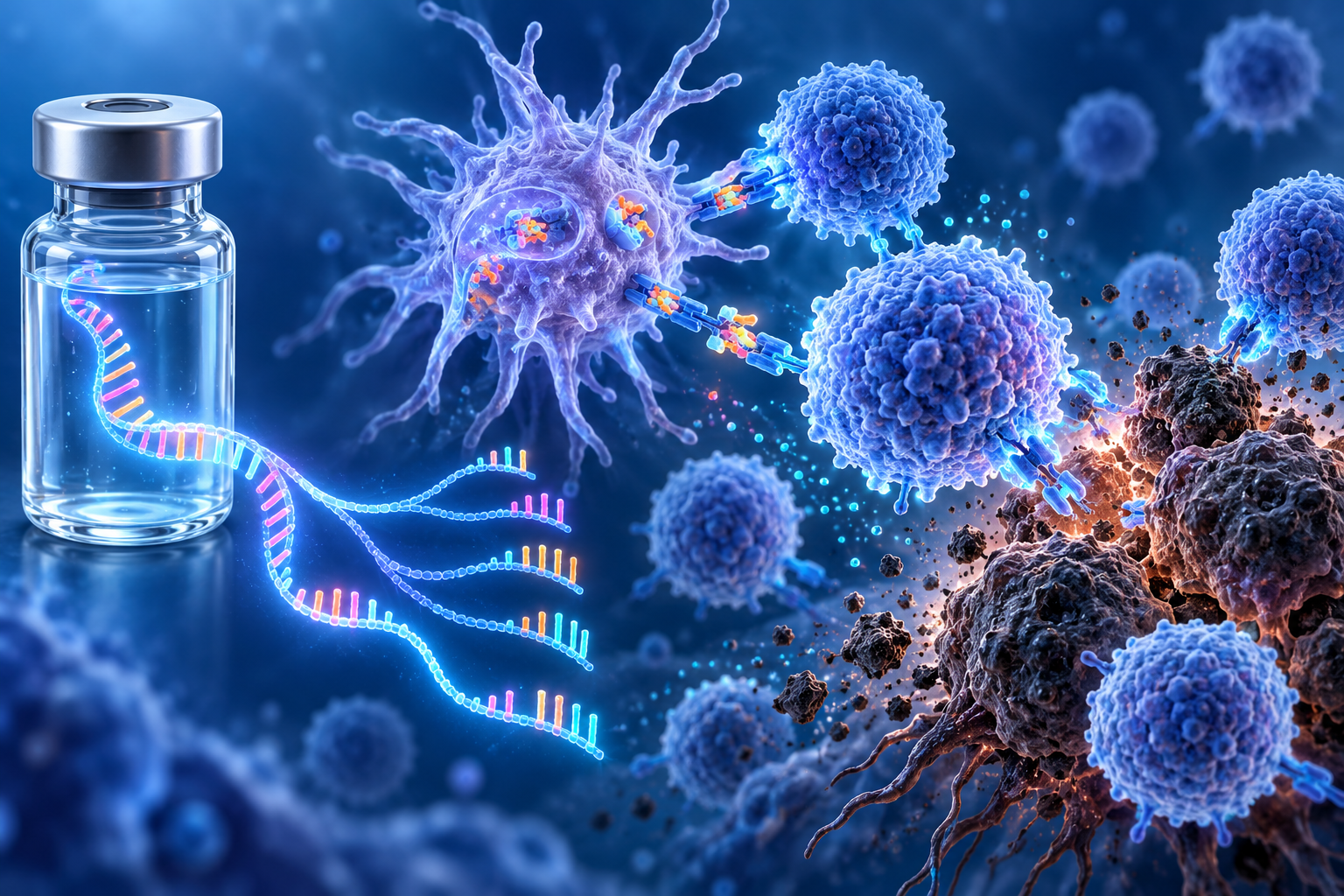
Intismeran is not an off-the-shelf preventive vaccine. Researchers sequence a sample of each patient's tumor, identify mutations that produce distinctive proteins called neoantigens and design an mRNA recipe intended to train that person's immune system to recognize them. The treatment is given in nine doses spaced three weeks apart while the patient also receives pembrolizumab, which helps immune cells remain active against cancer.
The entire process from tumor analysis to a finished individualized dose can take roughly six weeks. That manufacturing challenge is central to both the promise and the uncertainty: every patient's medicine is different, so the system must deliver thousands of accurate, time-sensitive products rather than millions of identical vials.
The companies said the safety profile was consistent with earlier studies and no new safety signal emerged. Reported vaccine reactions were mainly symptoms familiar from other mRNA shots, including a sore arm and fatigue. The trial compared the combination against an active standard therapy rather than no treatment.
Experts not involved in the study called the result a major advance for cancer-vaccine research. Cancer Research UK also cautioned that melanoma is unusually responsive to immunotherapy, meaning success here does not guarantee the same result in lung, kidney, pancreatic or other cancers now being studied.
Cost is another unresolved issue. The companies have not disclosed a possible price, and personalized genetic analysis and manufacturing are likely to be expensive. Approval, production capacity, insurance coverage and access will determine whether a scientific breakthrough becomes a broadly available treatment.
The breakthrough is precision, not a miracle
The word vaccine can easily create the wrong impression. Intismeran does not prevent melanoma in healthy people, and the phase-three result does not prove that cancer has been cured. It is an investigational treatment for patients who already had high-risk melanoma removed and were receiving established immunotherapy.
That caution should not obscure what is important. Cancer mutates differently in each patient, helping malignant cells escape generic attacks. A platform that can read an individual tumor, manufacture a tailored set of instructions and produce a measurable benefit in a large randomized trial changes the practical argument around personalized medicine.
American biotechnology helped turn mRNA from a specialized research tool into a manufacturing platform during the COVID-19 pandemic. Applying that capacity to cancer is a reminder of what open scientific competition, private investment, clinical volunteers and rigorous regulatory systems can accomplish together. The advantage is not only inventing a molecule; it is building institutions capable of testing it honestly and producing it reliably.
The next danger is hype outrunning evidence. Drugmakers benefit from excitement, investors react to headlines and desperate patients may hear the word vaccine as a promise. Doctors and regulators must keep the message precise: recurrence-free survival improved, distant spread was reduced, overall survival is still being measured and the treatment remains unavailable outside trials and authorized access.
If longer follow-up confirms the benefit, the hardest debate will shift from whether personalized vaccines work to who can receive them. A therapy that requires sequencing, custom design and rapid manufacturing could widen the gap between wealthy medical systems and everyone else. Innovation without access leaves a victory incomplete.
For now, INTerpath-001 is strong evidence, not a final answer. It gives patients and researchers a credible reason for hope while placing a clear burden on the companies: publish the full data, prove durable survival benefit, disclose risks and make the treatment scalable enough that personalization does not become another name for privilege.
Comments
Loading comments…